Throughout the post-crisis period, collective wisdom among market forecasters has held that interest rates would rise. But low rates have persisted, proving those prognosticators “dead wrong,” in Jeffrey Gundlach’s words. Gundlach, founder and chief investment officer of Los Angeles-based DoubleLine Capital, spoke on a conference call with investors on December 9. A copy of Gundlach’s presentation is available here.
Gundlach, correctly contrarian in his interest-rate predictions, now believes the Fed will raise rates in 2015 but investors should not fear Fed tightening.
“The Fed is going to raise interest rates in 2015,” Gundlach said, “unless the data change.”
The Fed will base its ultimate decision on the health of the economy – and unemployment specifically. Gundlach believes we should expect a rate hike if monthly job creation continues to be at least 200,000.
The effects of a Fed rate hike will surprise many people, Gundlach explained. Long rates have been decreasing as talk of a rate hike has increased, and Gundlach stated that Fed actions could occur against a backdrop of a “massive flattening” of the yield curve.
“If the Fed raises interest rates,” he said, “the flattening trend would just continue.”
Interest rates will be driven by the interplay between market expectations and actual Fed policy. Let’s look at how Gundlach expects those factors to play out.
Looking back at prior tightening cycles
A raise in rates in 2015 will neither follow historical precedent nor occur for the usual reasons, according to Gundlach.
The Fed has typically raised rates shortly after the official end of the recession. But the current recession ended in June 2009, over four and a half years ago.
That could lead to problems, he said. Near-zero interest rates have driven speculative price increases in high-end assets, like Picassos and Ferraris, according to Gundlach, and rate increases could rapidly deflate those bubbles.
Normally the Fed raises rates for “fundamental” reasons when the economy has reached a healthy level. It had previously set targets of sub-6% unemployment and 2%-plus inflation; only the former target has been reached.
Gundlach said that if the Fed raises rates, it will do so for “philosophical” reasons. “They are just nervous about zero-interest-rate policy going on this long,” he said, “and not having tools to fight any future weakness in the economy. The Fed wants get off of zero, so at least they have the ability to ease down the line.”
Gundlach warned against anticipating a gradual rate increase should the Fed tighten. The last five tightening cycles involved 25 basis point increases at every Fed meeting. He believed it was unlikely that rate increases would be spread out over a two- to three-year period, as some people are expecting.
Is the economy ready for higher rates?
Economic weakness could deter the Fed from tightening, Gundlach warned. Historically, the Fed has not tightened when GDP growth was less than 4%; it is now approximately 2.5%.
The Fed’s main concern, Gundlach contended, is to further lower unemployment. Although unemployment is below the Fed’s 6% target (it is now 5.8%), Gundlach cited a number of weaknesses in the labor market.
A high percentage of jobs are now part-time, he noted, and older people are working longer, leaving fewer opportunities for the younger generation now entering the workforce. Much of the recent job growth, particularly in oil-producing states like Texas, has come from fracking. Gundlach said the decline in oil prices may undo that job growth.
Other measures of slack in the economy, including manufacturing-capacity utilization and apartment-vacancy rates, are below the levels when the Fed has typically raised rates.
“The real reason that the Fed is in such a conundrum about raising rates is average-hourly earnings,” he said. Since 2007, according to Gundlach, inflation-adjusted wages have decreased for 70% of Americans by approximately 0.5% per year.
“The problem is that the middle of the economy has been hollowed out,” Gundlach said. Over the past 40 to 50 years, the minimum wage has decreased by approximately 25%.
“No wonder more than 50% of Americans polled say we’re still in a recession,” he said.
Junk-bond yields have been rising since June, which Gundlach sees as an ominous sign for the markets. Widening junk-bond spreads are a signal that “something is not right.”
The effect of oil prices
Although lower oil prices should spur economic growth, Gundlach warned of other repercussions.
The rapidity of the decline in oil prices – approximately 35% in the last three months – could lead to a “deflationary exercise,” Gundlach said.
If the oil price falls to $40 per barrel (it is now approximately $60), Gundlach said the 10-year yield would fall to 1% (it was 2.22% on the day he spoke).
Gundlach said oil prices are in “phase two” of their decline. In phase one, the big oil-exporting countries acted to “starve out their neighbors and others that meant them harm.” Now, he said, exporters are increasing their production because they need more revenue than can be generated at current prices. This, he believes, could result in a “vicious circle” that will end only when exporting supply reaches its maximum.
Gundlach expects the oil price to go lower, but he did not predict where it would bottom
“I hope it doesn’t go to $40,” he said, “because if oil goes to $40 then something is very, very wrong with the world. Not just the economic, but the geopolitical consequences could be – to put it bluntly – terrifying.”
Inflation has been declining, and is now approximately 1.5%, but according to Gundlach, the headline figures do not yet reflect the full price decline in crude oil. He said that on a year-over-year basis, the CPI increases could reach zero if oil prices decline further. Inflation expectations, as measured by the TIPS market and surveys, are “nonexistent,” Gundlach said.
The bond-market forecast
The bond market’s message to the Fed regarding a potential rate hike, according to Gundlach, is discouraging. Long-rates have declined (the yield on the 30-year bond is down approximately 100 basis points this year) and the yield curve has flattened, signaling economic weakness.
“The bond market is saying that even a moderate rise in the Fed Funds rate might be problematic for the economy,” Gundlach said. “The bond market doesn’t believe the Fed. It says that rates are going to go up less than the Fed talks about.”
Historically, Fed rate increases have typically ended when the yield curve flattened or inverted, Gundlach noted. But that condition is occurring now.
Ultimately the Fed will follow the market, Gundlach said, and not adhere to its forecast – and it won’t increase rates beyond what the economy can tolerate. In the near term, Gundlach predicted that long rates will continue to decline.
Global economic weakness will depress interest rates. German sovereign 10-year rates are lower than those in the U.S., and Gundlach believes it is “unthinkable” that an investors would choose German over U.S. bonds. Foreign purchases of Treasury bonds have accelerated, filling in the role the Fed played with its now-terminated quantitative easing (QE) policies.
As long as the German yield remains below 1% – it is now approximately 0.6% – Gundlach said the U.S. 10-year rate won’t increase.
Next year will start out strong for bonds, Gundlach predicts, because of “rebalancing.” Corporate pension plans will be motivated to sell equities and buy bonds to lock in a better funding status. The S&P 500 is up approximately 15% in 2014 – more than corporate bonds – and this creates “further motivation” for rebalancing, he said.
Gundlach had previously declared that the 1.38% yield the 10-year bond reached in July of 2012 would mark the bottom of the market. He said he is now less convinced that is so, because of the potential to import deflation through low oil prices and weak economies abroad.
Despite the increase in junk-bond yields over the last several months, Gundlach advised against owning them when the Fed starts tightening. He said he is still under-weighting them by approximately 50% in his fund, versus his typical allocation.
Lack of liquidity, particularly among longer maturities, may be the best news for bond investors. “The Fed bought all the long bonds,” Gundlach said. “There aren’t any out there. When people need to buy them – if pension plans want to shift – there is not much supply.”
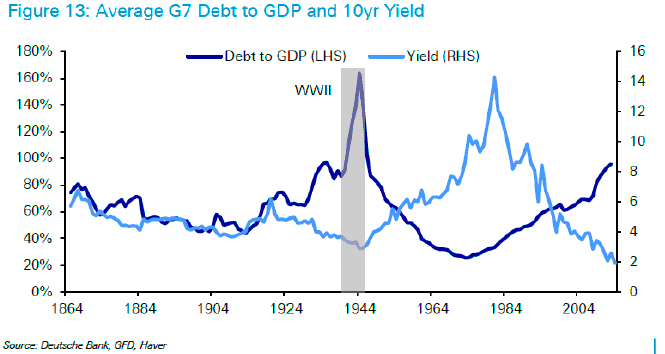
In prior conference calls, Gundlach has warned about the long-term threat posed by budget deficits and entitlement spending. This time, however, he presented the following chart, which offers a counterintuitive message:
This measures the debt-to-GDP ratio and the average yield of sovereign debt across G7 countries. When the debt was the greatest, as it was during World War II, the yield was the lowest. In the 1980s, when yields peaked, debt was low.
Most people would expect the opposite, Gundlach explained; believing when debt is high, interest rates would be too. But he said that the relationship is logical. If interest rates are low, debt is allowed to expand and it “sews the seed for trouble.” The debt then looms as headwind for future growth, according to Gundlach.
“Maybe what people are thinking is exactly wrong,” Gundlach said. “Maybe interest rates will rise when debt starts falling. There is no sign of that yet. In spite of the talk about deleveraging, I don’t see the dark blue line [debt-to-GDP] heading lower.”
Read more articles by Robert Huebscher