Advisor Perspectives welcomes guest contributions. The views presented here do not necessarily represent those of Advisor Perspectives.

The following is excerpted from The Pocket Guide to Sales for Financial Advisors
by Beverly D. Flaxington (ATA Press, 2014), which is available from Amazon via the link above.
What does it mean to have a sales culture in your advisory firm? First of all, it means embracing sales – not looking at the selling process as negative or unsavory. It means talking about new business development, meeting regularly to assess what’s working and celebrating growth wherever possible.
If your advisory firm lacks a sales culture, you must establish one to be successful in ongoing growth. It’s not as easy as saying, “We’ll focus on sales from now on, and everyone needs to be a salesperson!” As a first step, understand that new sales are imperative to the health and longevity of the firm. New sales mean growth. New sales are required if you want to keep the best employees. Great employees leave companies that are not creating growth or opportunities for advancement. Every single employee should be aware that sales equal salaries. They should understand that selling is not just something salespeople do. Every employee must care that the firm survives and thrives and know that they play a critical role in the growth process, whether they are directly facing clients or not. Attitude matters just as much as anything else.
Take the time to actually write down the sales objectives for your firm. This is a critical first step. Most people wrongly assume that just by putting an emphasis on growth and selling, they have created a sales culture; it goes deeper than that. A sales culture has clearly stated objectives, and those objectives are known throughout the firm. They are tracked and measured and communicated.
An effective sales culture means embracing new sales, wanting to grow the business and being willing to put an emphasis on uncovering new assets. A great sales culture is biased toward action. Don’t wait for everything to be perfect before taking action. Create a plan and work with what you have. You can identify 10 “should be” clients; you can find three Centers of Influence to open discussions; you can practice your platform points and telling them more effectively. In a successful sales culture team members are driven to succeed. Simply put, this means embracing hard work, positive thinking and persistence as well as a “no excuses” philosophy.
Characteristics of a great sales culture
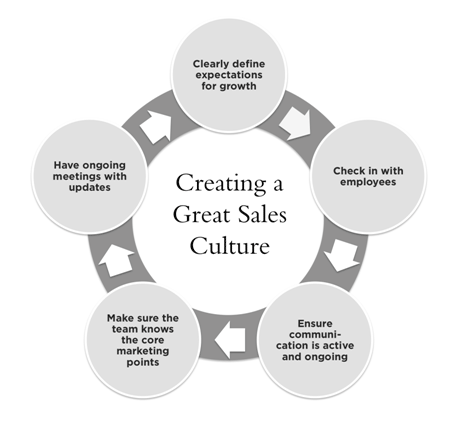
A sales culture often includes enthusiasm and excitement on the part of team members. People are hungry to learn new ideas and to find ways of spreading the great word about what the advisory firm offers. If you don’t think your sales culture is strong enough, here is a guideline for developing a more robust sales culture:
-
Clearly define and set expectations for growth. Write these down, communicate them clearly to everyone in the firm and check that all team members understand what success looks like.
-
Check in with employees to ensure they know how to grow and that they are clear on the objectives. Ask what they need in order to be a part of the growth culture. Do they need coaching, training or sales support? Do they need different and more effective materials? What obstacles to growth do they have, and what can you do to help overcome them?
Ensure communication is active and ongoing. Use the same CRM. Input the necessary information, and make sure everyone on the team is doing so.
Share ideas about what’s working well and what’s not. Brainstorm ways to move prospects through the pipeline and where to close.
Be sure everyone on the team knows the core marketing platform points and how to tell the story. Practice, practice, practice.
-
Have ongoing meetings, updates and conversations about sales. Be clear about what’s expected of each employee and how they contribute. Recognize success publicly, and communicate shortfalls to the employee so they know how to correct.
Creating an effective sales culture can really be described with one word: Consistency. The firm’s goals, values, mission, expectations, language and focus must be aligned and consistent from one employee to the next – whether they are involved in direct sales or not.
Beverly Flaxington co-founded The Collaborative, a consulting firm devoted to business building for the financial services industry in 1995. In 2008, she co-founded Advisors Trusted Advisor to offer dedicated practice management resources to advisors, planners and wealth managers. She is currently an adjunct professor at Suffolk University, teaching undergraduate students Leadership & Social Responsibility. Beverly is a Certified Professional Behavioral Analyst (CPBA) and Certified Professional Values Analyst (CPVA).
She has spent over 25 years in the investment industry and has been featured in Selling Power Magazine and quoted in hundreds of media outlets, including the Wall Street Journal, MSNBC.com, Investment News and Solutions Magazine for the FPA. She speaks frequently at investment industry conferences and is a speaker for the CFA Institute.
Read more articles by Beverly Flaxington