According to Berkshire Hathaway’s Charlie Munger, when it comes to investing, everything important is counterintuitive; everything obvious is wrong. In that spirit, Jim Bianco offered a series of unconventional ideas on the stock market, Fed policy and oil prices.
Bianco is the head of the Chicago-based economic research firm that bears his name. He spoke in San Diego on April 30 at the Strategic Investment Conference, which was sponsored by Altegris and John Mauldin.
The consensus is wrong about corporate earnings and market valuations, according to Bianco, as it is about the direction of Fed policy and oil prices.
I last heard Bianco speak in 2012, when he predicted that Fed policy would be “disastrous” – ultimately leading to inflation – but that equity markets would rally in the short term. That inflation hasn’t materialized, but Bianco was right about stocks.
Let’s look at Bianco’s unconventional ideas.
Corporate earnings, revenues and market valuations
The consensus around corporate earnings and revenues is negative. Bianco said his outlook is “below average,” but perhaps not as bad as many think.
Year-over-year growth in earnings for the first quarter were down 2.9%, but would have been up 5.2% if energy is stripped out, he said. Bianco discussed analyst projections of future earnings, which he described as a “rigged game.” Analysts have been conditioned, he said, to underestimate earnings, so that when corporations report they can claim that they beat those estimates.
Indeed, he said, 72% of corporations had already beaten their Q1 projections. The last time less than half of corporations beat expectations was in 1998.
Analysts are now projecting three consecutive quarters on negative earnings for the first time since the great recession, he said. Historically, analysts overestimate earnings – that is at least until a recession hits. Then, according to Bianco, panic sets in and they cut estimates.
Analysts also predict revenues, which Bianco said are much harder to “game,” because they are not susceptible to financial manipulations. Unlike earnings, analysts tend to over- and under-predict revenues with about equal frequency. Currently, he said, first quarter year-over-year revenues are expected to be down 3.4%, or 2.3% if one takes out energy. Of those companies that have reported first quarter results, Bianco said that only 37% have beaten expectations.
Stepping back, Bianco said, “I don’t see anything that is particularly exciting or particularly compelling in those numbers.” He said that the primary reason for sagging corporate results was the strength of the dollar and, to a lesser degree, low energy prices.
“The outlooks are not as positive from the companies as we have been hoping for,” Bianco said. “They are not disastrous numbers, but it is definitely leaving something to be desired.”
From an investor’s standpoint, Bianco said this news is worrisome because of high equity valuations. The 12-month forward P/E ratio – Wall Street’s “favorite metric,” according to Bianco – is currently 17 and well above its five-year average and at the highest level since early 2000. Buffett’s favorite metric is the market capitalization-to-GDP ratio, which now 137%, according to Bianco. It was only higher at the bubble peak in 2000.
Bianco’s unconventional view is that he’s worried about the stock market. He doesn’t fear a “massive collapse,” but the market is overvalued at a level that he could “tolerate” if corporate performance and outlooks were decent. “But I’m not seeing that,” he said.
“At the end of the year we are going to wind up with a round of zero returns in the stock market,” he predicted.
Fed policy
The Fed has a third mandate, Bianco said, in addition to price stability and full employment. Of late, most observers have contended that its third mandate is to lift the value of risky assets, but in Bianco’s view it is financial stability.
The evidence of that mandate is clear now, according to Bianco, in the Fed’s deliberations over whether to raise interest rates. It does not want a market disruption to follow a rate hike.
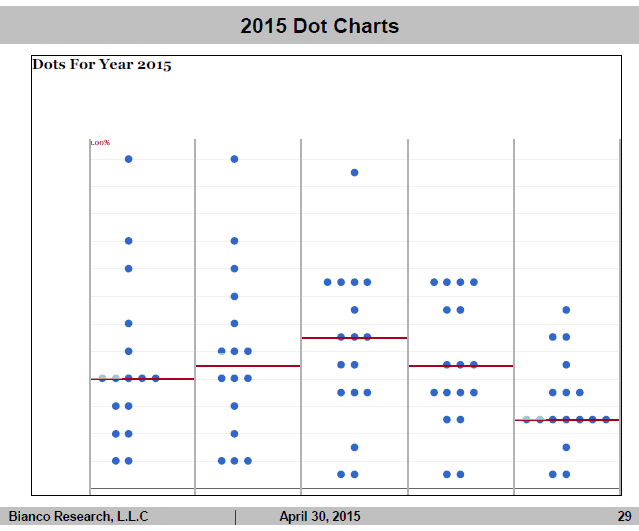
The Fed governor’s attitudes toward interest rates can be seen in its “dot charts,” such as the one below:
Each dot represents the quarterly forecast for the 2015 Fed funds rate of an anonymous Fed governor, starting at the beginning of 2014 and then moving forward in time to the most recent forecast on April 30. The horizontal lines represent the median forecasts. It shows that the median forecast has been coming down.
The futures market gives another forecast of the Fed funds rate. Its forecasts have been coming down as well since the end of last year. But it is well below the forecasts from the Fed governors.
“The market has not priced in a Fed rate hike for this year,” Bianco said. “This is why Yellen is worried. If we raise rates and it is not priced in, we will have a bad reaction.”
Bianco said that the Fed may even be lowering its forecasts in order to bring them more in line with what the market is saying, to minimize the disruption from a rate hike. But, he said, “as long as the Fed fund futures stays below Fed policy, they are going to have a real problem on their hands in terms of trying to raise rates.”
“We won’t get a rate hike this year largely because of that third mandate, financial stability,” he said.
Oil prices
Oil prices, which have been as low at $42/barrel recently, will go below that rate, according to Bianco.
The historical data suggest that oil prices are closely correlated with global GDP growth, Bianco said, which implies that the recent decline can be traced to the slowing of the Chinese economy. Demand was running “way below trend,” he said, but that gap is narrowing.
It’s also a supply problem, Bianco acknowledged, and he showed that crude oil inventories in the U.S. have soared recently.
The consensus, according to Bianco, is that oil prices will go back to $100 as soon as the end of this year, or perhaps by the middle of next year. As evidence, he said, investors are betting heavily through ETFs, such as UFO. “They can’t get into this stuff fast enough,” Bianco said. Assets in crude oil ETFs have swelled as prices have declined, and he said the net long position is now at record high levels.
The main problem with oil, he said, is that “we’ve produced too much relative to demand.” The price was trying to correct for that, according to Bianco, until the speculators poured in and drove prices higher. He said the situation is similar to the housing market in 2006, when prices were rising and speculator rushed in – until there was finally a collapse in 2008.
“Energy is going to have to revisit its lows,” Bianco said.
Read more articles by Robert Huebscher