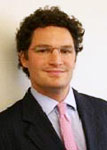
Investors are paid to adapt, not to forecast, according to Louis-Vincent Gave, and three changes are occurring globally that all portfolios must accommodate. One of them is a position that is missing from virtually every investor’s allocation.
Gave is a founding partner and the chief executive officer of Gavekal Dragonomics, a global research and money management firm. He spoke at the Strategic Investment Conference on April 30 in San Diego, an event sponsored by Altegris and John Mauldin.
“The world’s single largest crowded trade, the crowded trade that everyone in this room has bet on and doesn’t even realize you’ve bet on,” he said, “is the absence of China in your portfolios.”
The reason is that China has no allocation in the global bond indices or in the MSCI world stock indices, he said. Even though China’s stock market has doubled in the last year, Gave gave compelling reasons why investors should be bullish on its stocks and bonds.
I last wrote about one of Gave’s talks in 2010, when he predicted that Asian economies would grow faster than the U.S., but its equity markets would underperform the S&P 500. Over the last five years, the MSCI Asia Apex 50 is up 46% in U.S. dollars, versus 86% for the S&P 500.
Let’s look at Gave’s three adaptations investors must make to properly position their portfolios and why he believes China is a compelling opportunity.
The collapse in oil prices
To justify the halving of oil prices in the last six months, Gave said that two things must have occurred: a profound shift in the supply-demand curve and an overhaul in the Chinese political landscape.
The increase in supply – from the American fracking industry – was not a surprise, Gave said. He said the “whole peak-oil thing was hogwash” since new supplies were being uncovered throughout the world. Gave said that oil was one of many commodities that were in a bubble, and the bubble burst because of what happened in China, particularly over the last year.
The arrival of a “new extremely ruthless leader,” Xi Jinping, was the tipping point, according to Gave. Jinping transformed the way China interacts with the commodities markets.
The telling sign was in June of last year, when Jinping struck a deal with Vladimir Putin to purchase Russian natural gas at 40% below-market rates and to pay for it in renminbi.
“China at the end of the day is the marginal purchaser of energy and most commodities in the world,” Gave said. Before Jinping, China was a “price taker” in the market, Gave said, letting trade terms be dictated by its partners. Now, with this deal, it became a price maker.
Similarly, prior to Jinping, China had made a host of commodity deals in places like Angola, Mozambique and Indonesia without particular concern for price. Many of those were fraught with corruption, with Chinese deal-makers taking personal kickbacks, Gave said. Jinping, however, has put 40,000 people in jail, and Gave said that almost a quarter of them were related to commodities dealing.
All of a sudden, according to Gave, China has enforced “real pricing” and deflated the commodities bubble.
Because this commodity bubble was financed by the capital markets through junk bonds and equity issuance – and not by banks – there are no government backstops to allow for a graceful deflation. Losses must be taken swiftly, he said, creating a deflationary shock.
Obvious winners and losers have emerged from the collapse of this bubble. Among the former, most notable are commodity consumers, Gave said, and most of those are in Asia. The need for Asian governments to subsidize commodities has been lifted, he said, leading to a “massive improvement” in fiscal balances. In India, for example, he said that 60% of the money that was to be spent on fuel subsidies will be spent instead on road construction.
That has led to easier monetary policies in Asia, Gave said. Lower interest rates are delivering infrastructure spending, improved productivity, more consumption, better tax receipts and a virtuous cycle.
“In essence, the drop in oil prices for the whole of Asia is an enormous positive exogenous shock,” Gave said.
In the six countries that spend the most on oil as a percent of GDP (Taiwan, Thailand, Korea, India, Turkey and China), inflation has moved from 3.5% to less than 1.5%. Amazingly, according to Gave, bond yields have decreased by only 50 basis points.
Yet the spread between Asian and U.S. bonds is at record highs, Gave said, and that is an opportunity. Spreads should be this high at times of crisis, he said, and today’s levels “make no sense at all.”
“If today you are looking for the place where interest rates can fall 100 basis points, 200 basis points, whether at the short and/or the long end, don’t look at the U.S. obviously,” he said. “Don’t look at Germany, that’s for sure. Look at China. Look at India. Look at Indonesia. Look at the Philippines. If you are looking for yields and potential capital gains in bonds, this is where you will find it.”
The most crowded trade
China is the most important of those countries that has started to cut interest rates, which partly explains the doubling of its equity markets, according to Gave.
But there is a deeper reason for that bull market, he said. “China is in the process of changing its relation with the rest of the world.” For 30 years it lived under Deng Xiaoping, and Gave said China’s mantra was “Don’t make waves abroad. Focus on domestic problems.”
Jinping has changed that stance dramatically, according to Gave. It has sent infantry to the Sudan, frigates to Yemen to evacuate its citizens and foreigners, has launched its own infrastructure bank and created a “silk road” fund to build ports along the Indian Ocean.
But the most important move was to lobby to have the renminbi included in the IMF’s special drawing rights (SDRs), which is a prelude to becoming a reserve currency, according to Gave. That could happen in November, he said, and the renminbi would join the dollar, yen, euro and sterling.
Yields in those reserve currencies are near zero, Gave said, while China’s yields are 3% at the short end and 4.5% at the long end. If that vote goes through, central bankers will be buying renminbi, he said, and central bank holdings could go from 0% to 10%.
That is why the absence of China in most portfolios should be rethought, according to Gave.
“This is the single most important change that is happening today, the change that is going to transform the financial architecture of the post-crisis world,” he said.
China is 14% of global GDP, 22% of global equity volumes and about 14% of global equity market capitalization, Gave said. He said investors should prepare for it to become 10% of global market indices, versus zero today.
“Every Index fund in the world is going to end up having to chase its tail because of the renminbi internationalization,” he said.
The plight of the euro
The change in Europe to which investors must have adapted was the change in policies of the European central bank (ECB), which caused the collapse of the euro, Gave said.
For investors, he said, the key issue was to understand the ECB’s motives behind its quantitative easing (QE). Ostensibly, its QE was an attempt to devalue the euro. But Gave said that it could also be an attempt to do a “stealth recapitalization” of European banks. By allowing banks to buy long-dated bonds at cheap prices, and buying those bonds back from the banks, the ECB has liquefied the commercial banking system.
If the ECB’s motives were purely deflationary, Gave said that is “deeply problematic” for the rest of the world. Europe already runs a current-account surplus of 7% of GDP, and the euro devaluation will increase that and make global trade even more unbalanced.
Gave said he wasn’t sure of the ECB’s motives. He isn’t seeing what he would expect if the banks were successfully reflating: greater lending or improvement in real estate prices, for example. But that could be because “banks there don’t know how to make money anymore,” he said, because the yield curve is too flat.
Gave expressed cautious optimism that the ECB will succeed at reflation. With weak oil, a weak currency and low interest rates, European corporations should be doing well. But earnings, he said, have been weak and haven’t even kept pace with GDP growth.
“If companies can’t make profits with that combination, then they never will,” he said. “You might as well write off Europe.”
Conclusion
The one big underweight for investors, according to Gave, is the U.S.
Although the macro situation in the U.S. is “pretty decent,” he said valuations are too high – in the top 10% of their historical range. To be overweight, he said investors are making one of two bets: P/E ratios will expand, which he said was unlikely because that ratio is now 22, or the Fed will embark on a new plan to inject liquidity into the markets, which he doesn’t expect.
Gave is also worried that a third of U.S. corporate earnings come from abroad. Given the rise of the dollar, those earnings are now “under severe pressure,” he said.
Moreover, Gave said that U.S. has lost much of the competitive advantage that drove the so-called American manufacturing Renaissance. It no longer enjoys a lower cost of energy or a lower cost of capital than its foreign competitors, including those in Asia. Many of those countries had enjoyed an advantage through a lower cost of labor, but Gave said that advantage has eroded because of the increased automation through robots in the manufacturing process. But that is offset by the cost of regulation, which is much higher in the U.S. than abroad.
Forget the traditional delineation between developed and emerging markets, Gave said. “That was a marketing gimmick,” driven by a need to group countries with favorable (emerging) and unfavorable (developed) demographics.
“The reality is that demographics aren’t going to matter that much for the next few years,” he said. “What matters is whether you are a beneficiary or hurt by the strong dollar and weak euro.” Instead, what matters is how countries are affected by the strong dollar, weak euro and weak commodities.
The big beneficiaries of those new trends will be found in Europe and Asia, he said.
Over the next five to ten years, he said most investors will be “forced buyers” of China, as central banks and index funds expand their holdings of Chinese equities and bonds. Even though the Chinese equity market has doubled, Gave said the MSCI Asian index is still 30% below the U.S. since the 2009 market bottom.
There are risks, he said, including geopolitical threats from Russia, a “messy” political situation in Europe and the possibility of disappointing U.S. earnings.
But those risks, he said, are likely to have a smaller impact on China than on the U.S. or Europe.
Read more articles by Robert Huebscher