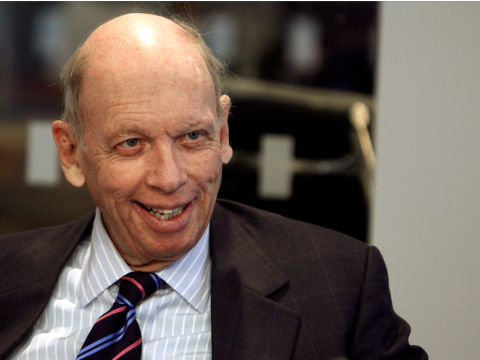
Byron Wien is vice chairman of The Blackstone Group, the largest U.S. alternative investments firm. Wien’s market commentaries over the last several decades have made him one of the most popular living writers on investments, finance and economics. His Ten Surprises, published each year since 1985, are the events he thinks have at least a 50% probability of happening in the next year but that, in the opinion of the average investor, have at most a one in three probability of occurring.
I spoke with Byron on May 24, 2016.
Byron, having read your Ten Surprises for 2016, as well as your more recent market commentaries, I am struck by your uncharacteristically gloomy tone. I think of you as an optimist. What evidence, so far in 2016, do you think points to a negative view being right, and what if anything causes you to possibly change your mind?
When I wrote up my Ten Surprises last December, I was looking at the level of worldwide demand and how many people were tapping into it. I decided there wasn’t enough demand for U.S. companies to increase their “top line” [total sales]. In addition to that, they had very little pricing power. Moreover, productivity was not improving considerably.
I thought there would be very little top line growth. I thought some commodity prices, such as oil, would be rising – not in a material way, but oil wouldn’t stay at $26 barrel. [That was the low that it reached in February 2016.] More importantly, I thought that wages would be going up about 2.5% per year. I thought there would be a margin squeeze, an earnings disappointment. I thought analysts were too high in their earnings estimates, and as a result of that I thought the market would be under pressure. I didn’t think it was egregiously overvalued, but I did think it was vulnerable. And, of course, at the beginning of the year it really looked vulnerable.
What has happened since then?
The economy has picked up. It is hardly a boom, but the fundamentals are a little better. In the U.S., second quarter GDP growth will be 2.5% after 0.5% in the first quarter. [These are annualized quarterly rates of real GDP growth.] Europe is doing better. In China, nobody is worried about a hard landing any more. Japan is actually doing better.
The world is improving and, as a result of that, it looks like the market won’t be as vulnerable as I originally thought. But I am still holding with the view that the market is going to be down for the year.
Turning to politics, it is hard to think of anything other than Donald Trump. Why do you think Trump is so popular?
Let’s talk about both Trump and Bernie Sanders. A big segment of the American people are fed up because so little gets done in Washington. They don’t blame a single party; they blame both parties. They blame the polarization of parties for the inaction.
As I said in a recent Barron’s article, 20% of people in the United States are better off than they were in 2007, but 80% aren’t. It is among those 80% that somebody is standing up and saying, “I’m going to make America great again.” That really resonates, as does somebody saying, “Look, it’s time for socialism because the fat cats and Wall Street have gotten all the gains that we’ve made since the recession ended in June 2009.”
Half of America goes to bed scared every night. If you go to bed scared because you don’t have a job, or you don’t have a job that pays enough to cover the bills, or if you have a good enough job but you are worried that your company isn’t doing well and you might get laid off, then you are nervous. There are a lot of insecure people in this country, and they want a change. Both Sanders and Trump represent a change.
What kind of positive change do voters think that Trump and Sanders can deliver?
Oddly, the specific liabilities of each of those candidates contributed to their success: the fact that Trump took such extreme positions, that he was a blowhard, that he was willing to insult everybody including John McCain, a war hero. And there’s the fact that this is the first time in American history when the oldest candidate in the race, Bernie Sanders, has appealed to the youngest voters. Why? Because he wants to give them what they want: free education. He wants to give them an easier time and a life and they are ready to accept it.
It is the uneasiness of the American population that has been preyed upon by both Sanders and Trump.
People underestimate Trump – he can win. The reason is that his style of debating is very effective against a vulnerable opponent. Hillary Clinton is very vulnerable on her personal e-mails, on her role in Benghazi, on her performance as Secretary of State, on raising money for the Clinton Foundation while she was Secretary of State and on her relationship with her husband.
It would not surprise me to see Trump pull this out and become the next president.
Let’s turn to the global economy. One trend that has permeated the global economy, and about which little has been written, is the oversupply of manufacturing capacity relative to demand. Large-scale advances in manufacturing productivity have driven this oversupply. Do you expect this trend to continue, and if so, will there be a deflationary bias? How strong will it be?
I’ve never bought into the deflationary argument. I’ve studied inflation back to Babylonian times, and I can tell you it is a function of wage rates and housing prices. Wages are going up now. In the 1930s, when deflation really was a problem, they were going down. House prices are going up also, as you saw in the figures that were reported today on new home sales.
We were all worried about deflation earlier this year. I didn’t go into a meeting in January where I didn’t have to talk about deflation. But that was when commodity prices were going down, and now they are going up. In January, everybody thought we were going to have a recession, but I don’t think we’re going to have a recession this year in the United States and maybe not next year. I don’t think we’re going to have a hard landing in China either.
I worry more about inflation then deflation.
Let me ask about slow growth. We are now in one of the longest expansions in history, but it is a very slow expansion. Does it seem unusual to have an expansion this long? If so, is it going to simply continue at these low rates because there is neither a recession nor a proper boom in sight, just more of the same subpar growth, at least in the medium term?
That observation is spot on, and I will give you some reasoning behind it. We can’t afford another recession. The recessions of our lifetimes have occurred because the economy overheated, the Fed raised interest rates, interest rates got to the point where they choked off investment and the economy slowed down and eventually went into recession.
We don’t have an overheating economy this time. We have an economy that is growing, at best, at 2%. Interest rates are already low. If we did for some reason slip into a recession, how would we get out of it? The traditional way of getting out of it is to lower the Federal funds rate and engage in fiscal spending. That is what we did in 2008, and that is what we would propose to do now. But even if interest rates go up once beforehand, they would still only be at 0.5%, so if you lower them back to zero I don’t know how much good that will do.
You have also written that fiscal spending helps get us out of recessions. Isn’t that an option?
There is no appetite in the Republican Congress to spend any money on any government projects – infrastructure, R&D or changing the tax code. You name it, it is going to be very hard to get any fiscal stimulus. Fiscal and monetary policy are the tools to end a recession, and we don’t have those tools in our toolbox. We’d better do everything possible to avoid a recession and that is what we are doing. We are maintaining an accommodative monetary policy.
Everybody points to the fact that the Fed raised rates in December, but at the same time they increased their balance sheet from $1 trillion in 2008 to $4.5 trillion. Those bonds are maturing and they are replacing them. They are showing no signs of letting them run off. The Fed is still accommodative and that is because they do not dare become truly restrictive. If they did and we then had a recession, they don’t have the tools to get us out of it.
Even if fiscal expansion would be more effective than monetary policy at driving economic growth, we already have a lot of debt – enough that, if interest rates went up significantly, the government would be hard pressed to service it. Should deficit and debt reduction be our priority, or should we be willing to accept that the federal government will run a deficit almost all the time?
The Federal debt is $19 trillion now, and we don’t have any trouble funding it because we can fund it at very low interest rates, albeit positive interest rates. In contrast, European and Japanese interest rates are negative. Every central bank around the world has expanded the money supply at a vigorous rate, so there is a tremendous amount of liquidity sloshing around the world looking for a place to park because investors are apprehensive about risk assets.
As long as there is all this money looking for a home, rates are going to stay low. If I were in charge, I would do much more fiscal spending. We’ve lowered the annual deficit from 10% of GDP to 2.8%. I would be perfectly willing to run a deficit of 3.5% instead of 2.8%, spend more money on infrastructure, spend more money on R&D to make us more competitive, spend more money on keeping kids in high school to the point when they can graduate rather than having only three quarters of our kids in public schools graduate and revising the tax code to make it more sensible.
All of those initiatives would increase the size of the deficit, but we should do it.
One topic that hasn’t made it to your list of surprises recently is unfunded pension liabilities, particularly in the public sector. The general consensus is that those liabilities pose a risk to the public that will result in higher taxes, reduced public services or actual defaults on the pensions. What do you think is the biggest risk in pension liabilities if there is one? How would you begin to resolve the problem?
I was born and raised in Chicago, where the pension crisis is at its worst. It’s a real problem and taxes are going to have to be raised. Illinois, New Jersey, California, Puerto Rico -- it’s going to be a problem in more and more states and it’s going to be a problem at the federal level. You can cut the benefits, and I would do some of that, but you’re going to have to raise taxes to fully fund the pension liabilities.
Let’s turn to the markets. You are sticking with your forecast of a down year. But what about over the longer term? You’ve written that equity valuations are a bit frothy. What is your estimate for equity returns over the next decade?
5% to 7%. That is more than twice the 10-year Treasury rate. It’s a lot lower than we’re used to. Real GDP will expand at 2%. There will be 2% inflation. That sums to nominal price appreciation of 4%. You may get another percentage point from productivity. I don’t think there will be any expansion in price/earnings ratios, so 5% should be your target. Unfortunately, pension funds mostly have a target close to 8% and that is too high.
Shouldn’t there be a dividend in that equation?
Yes. You’ll get a 2% dividend on top of the 5% capital gain.
In a reversal of the pattern in recent years, emerging markets are beating both the United States and the non-U.S. developed equity markets. This is your 15th surprise. (In addition to your 10 main surprises, you provided some extras.) This outperformance has taken place despite concerns about a slowdown in China and the impact of low oil prices in Russia and a number of other emerging market countries. Do you think this is a sustainable turnaround in emerging markets or, with just 6% outperformance this year, is it too soon to tell?
It’s premature. I’m not saying the rally is going to lose steam, but commodity prices have to definitively turn, which won’t happen before 2020. The market is a little ahead of itself. That doesn’t necessarily mean it’s going to correct, but my view is that the dollar will be weaker and that will help somewhat. But the real move is two to three years out.
We’ve discussed interest rates to some extent, but I wanted to focus on one of your comments on interest rates in your April 2016 commentary, which was that the negative interest rates that prevail in many European countries – and that could conceivably happen here – will impinge on bank profitability and decrease lending because they cause depositors withdraw money from banks. That is the opposite of what low interest are supposed to do – to stimulate lending.
In an article in Advisor Perspectives a few months ago, Tom Coleman and I argued that low or negative interest rates also deprived the economy of one of its most important sources of demand, which is interest income earned by savers. This last item will become more important as baby boomers retire and live on interest income rather than labor income. What do we have to do to get out of this trap?
We have to increase growth. If we increase growth, we’ll increase capital investment. That will increase inflation and interest rates will go up. If we can’t increase growth, there will continue to be too much money on the sidelines and interest rates will stay low. We need to grow at 3%. We were growing at 3% until the recession of 2008, and we need to get back there, but there aren’t too many signs of that happening.
That is why interest rates are going to remain close to 2% rather than 3%. Without growth, you are not going to get rising rates because you won’t get enough sufficient demand for capital to use up all the cash that is seeking safe haven in the bond market.
Fair enough. Let me mention housing. In your February 2016 market commentary, you said house prices are strong, and more recent data support that. I’m not all that enamored with high housing prices because they encourage heavy borrowing and are like a tax on working families, just as high oil prices. However, housing starts in this decade have been extremely weak and construction jobs have disappeared. What is your reaction to a strong housing market and what is your reaction to the issue I raised? Are rising housing prices good or bad for the economy and for growth?
Rising housing prices are good. But you live in Wilmette, Illinois, just outside Chicago, so you are not typical. House prices there are going up as they are in New York and San Francisco, and in parts of Boston and Washington. But that is not where real people live. Real people live in Milwaukee, Wichita, Kansas City and Tucson, and house prices are going up very modestly there. In places where people who are involved in the financial service industry live, like Wilmette, they are going up in a more pronounced way. Rising house prices make people who are interested in owning their own home willing to buy.
There are only a few parts of the U.S. economy that are doing well. Housing is one of them. Retail spending is another, notwithstanding Macy’s and Nordstrom.
We should cheer rising housing prices. They are going to continue because people in the 25-34 age group are finding jobs. That is the principal age range for family formation. I view rising house prices as one of the strengths of the economy, and I’m cheering it on.
Does that include places like New York and San Francisco where housing prices are touching 10-times incomes?
Housing prices in New York and San Francisco are outrageous. The average apartment in Manhattan costs more than $1 million – the average apartment. That’s crazy. But people want to live in New York. No young person who buys an apartment in Manhattan buys it on his own. He buys it with parental money. It’s a terrible precedent, but everybody wants to live here because this is the most exciting city in the world. I guess they get their money’s worth.
Fifty years ago, I left Chicago because it was the second city and I wanted to live in the first city. I’ve never looked back, and I guess there are a lot of kids like me.
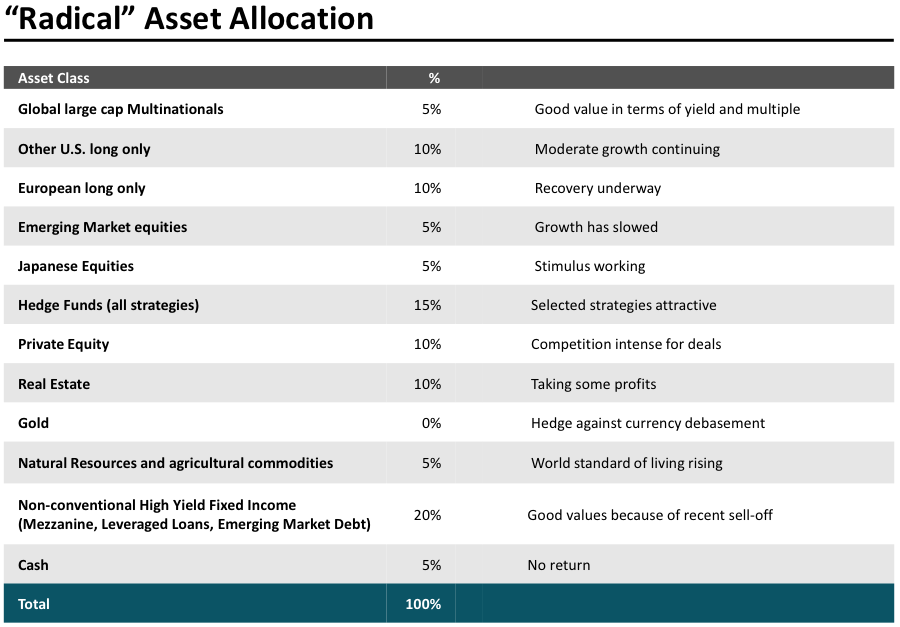
Most analysts have a favorite asset class that they think is underpriced or likely to outperform. I’ve tried to figure out what yours is by reading your commentaries. In December 2015 you wrote, “I am increasing European equities from 5% to 10% in my Radical Asset Allocation portfolio.” This portfolio is shown, as of April 2016, in Exhibit 1. What is a radical asset allocation portfolio? Are European equities still your preferred asset class?
Exhibit 1
Source: Wien, Byron R., “Recovery From a Rough Start – Now What?” Blackstone Group, April 2016.
The asset allocation portfolio in Exhibit 1 is radical because it is a significant departure from the traditional weightings in institutional portfolios, but also because it is basically “all equities.” Even the fixed income component has equity characteristics.
I’m still a believer in innovation and growth. I still like to invest in companies that I believe have open-ended earnings prospects, so I have a substantial part of my personal portfolio in technology and biotechnology. But, even though U.S. equities generally will not do all that well, you can make money in companies that are coming up with dramatic innovations. That is definitely going to happen in biotechnology.
European stocks seem undervalued to me. Europe is growing faster than most people think. There is some opportunity in high-yield bonds that provide funding for the companies that are going to survive. No matter how bad things get, there is always something to do on the long side.
Read more articles by Laurence B. Siegel
 Byron Wien is vice chairman of The Blackstone Group, the largest U.S. alternative investments firm. Wien’s market commentaries over the last several decades have made him one of the most popular living writers on investments, finance and economics. His Ten Surprises, published each year since 1985, are the events he thinks have at least a 50% probability of happening in the next year but that, in the opinion of the average investor, have at most a one in three probability of occurring.