USAA Investments, based in San Antonio, TX, manages over $68 billion in assets. It strives for superior performance over the long-term while adhering to the highest ethical standards. USAA is also widely known for its property and casualty insurance business and for its commitment to serving members of the military and their families.
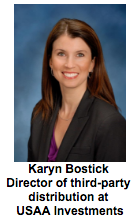
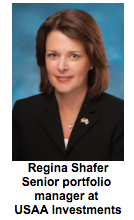
Karyn Bostick, director of strategic relationship management for third-party distribution at USAA, and Regina Shafer, senior portfolio manager of the five-star and bronze-rated USAA Tax-Exempt Intermediate-Term Bond Fund (USATX), were at this year’s Morningstar conference in Chicago.
I spoke to Karyn and Regina on June 14.
USAA has traditionally been known for its focus on those who have served in the military and their families. How has your overall strategic focus been evolving?
Karyn: I think it would be pertinent to give a brief background on USAA because it gets us to where we are today. In 1922, USAA was established by 25 Army officers. Let’s jump ahead to 1970, when we launched our investment company. In 1971 our first mutual fund was launched. That is pertinent because at that time USAA funds became available to the investing public, though they were directly sold through USAA.
Let’s move forward to four years ago, when we started our third-party distribution team to make USAA funds broadly available to the public, advisors and, of course, our members through leading intermediaries. That focus has continued to expand and we are continuing to look at not only broadening our presence on existing platforms – we work with 44 of them – but also building awareness among leading advisors and research analysts. We also recently entered the DCIO space.
To be clear, your funds are available to the general public. There is no requirement that the investor has to be a current or former member of the military.
Karyn: Thank you for clarifying. The funds have been available since 1971, and we have been working diligently to raise awareness around that. Membership in USAA is for the property and casualty side of the business. From an investment perspective, you are absolutely available to work with USAA as a member of the investing public.
Karyn, your personal goal has been to grow USAA’s third-party distribution. How has that been going? What growth have you achieved within the wire-house, broker-dealer and independent channels? What has been your strategy?
Karyn: One of the biggest growth achievement numbers I can give you is that over the 12-month period ending March 31, 2016, our team has increased our assets under management by 20.8% to $4.3 billion. Remember, this is a team that was started four years ago. That growth has been across all three channels: wire-house, broker-dealer and independent.
As far as strategy goes, we are continuing to expand our focus and raise awareness. We do that in multiple ways, from one-on-one touch points to marketing campaigns. We have a website at USAA. It is www.advisor.USAA.com, and that was created two-and-a-half years ago to give advisors a direct focus on our funds and the marketing resources we have available.
We continue to look to work with advisors in support of the military community, which represents over 60 million people across America. They are adopting our investment strategies broadly across industry channels.
Do you also maintain a team of wholesalers?
Karyn: We have a dedicated internal and external team that consists of associates that are based in San Antonio, Tampa, and the Mid-Atlantic, each of who have defined regions. The team focuses more deeply on where we have strong veteran communities, like Texas, California and Florida. While we work broadly across the United States, this tends to be where we see a lot of adoption because it’s where the USAA brand resonates.
As you mentioned, USAA has entered the defined-contribution investment-only (DCIO) space. How do you differentiate USAA’s DCIO’s offerings from others that are in the marketplace?
Karyn: We are new to the DCIO space with our third-party team. That is our new focus. From a DCIO perspective, we have a broad range of taxable, equity and target-date products that are highly rated from third party firms, such as FI360 and Morningstar. That is how we are going to bring to market some competitive products for that space.
From a differentiation perspective, USAA’s mission is to facilitate the financial security for its members and families. In doing that, we feel we are serving the veteran community. There are approximately 2.5 million businesses – about 9% of all businesses – that are majority veteran-owned. Being in this space continues to be a result of our members’ requests to have USAA funds available through leading retirement platforms.
I’d like to ask about your target-date funds, which are part of your DCIO offerings. They have expense ratios between .8 and .9% and they are constructed using other USAA mutual funds. What have advisors found particularly attractive about your target-date offerings?
Karyn: As we continue to speak to advisors in this space, our target-date funds employ a more conservative glide path. We are also hearing that advisors like that they are “to” not “through.” Employing a multi-manager approach that includes sub-advisors provides a high degree of breath versus a single manager solution. We are early to this space, but USAA has over $3.5 Billion in target date assets and overtime and I’m sure we will have a lot more to share with you as we continue to grow.
Another area that has been your focus for third-party distribution is your municipal bond funds. For example, the USAA Tax-Exempt Intermediate-Term Fund (USATX) has a five-star rating from Morningstar, an expense ratio of .54% and has been in the top 8th percentile of its peer group based on its 10-year track record. What has been your key differentiator for your municipal bond funds?
Regina: I manage the USAA tax-exempt bond fund and am here at the conference with Karyn. I would love to answer that question for you. Our overall philosophy for our tax-free bond funds is we have a yield focused, tax-efficient portfolio that we build bond-by-bond through fundamental credit research and bottom-up analysis. That allows us to outperform our peers over the long run.
We don’t try to look like an index. We don’t try to look like our peer group. We really focus on income.
If you look at that 10-year number, at least 97% is pure tax-free income. We don’t buy AMT bonds. We focus on providing a nice level of tax-free income to our shareholders, and we think that is particularly important for the investors in the tax-free bond fund.
One of the issues advisors often face, particularly with respect to municipal bonds, is whether a bond fund is superior to purchasing individual bonds, especially for those clients who are in the de-accumulation phase of retirement and can plan their cash flow needs. How do you respond to advisors when you have been asked about this?
Regina: I can point out some of the more important advantages of a bond fund over an individual portfolio, starting with diversification. You get the portfolio management – professional portfolio management – which includes a team of municipal bond analysts who look at absolutely every single bond that we purchase. That is not always easy for a retail investor or advisor to do and understand.
You get the reinvestment of dividends. An individual investor who has their own portfolio probably doesn’t have the same type of dividend payment that we receive on our $4.5 billion dollar portfolio that we can effectively invest back into the market.
Those are a couple of advantages of a bond fund over individual bonds.
Another issue that we often hear about from advisors related to municipal bonds is the level of unfunded pension liabilities among state and local governments. How has this issue affected your team’s investment strategy?
Regina: It highlights the importance of our process. For our team of municipal bond analysts, part of what they look at are pension liabilities and other liabilities that the municipality may have in order to help us identify the credit strengths and weaknesses of the municipality. That is particularly important as the pension issue is coming to light now. Some municipalities are managing that better than others. But that is something that our analysts take a very close look at and have been for years.
Stepping back, how has USAA been growing its team to support the needs of financial advisors?
Karyn: We are continuing to build our team to meet those growing needs, engaging strategically from the top down as well as from the bottom up. Besides DCIO, which has been a recent focus, our business development group and analyst and wholesaler relations are our focuses. We aim to hire veterans and their spouses. I actually am a military spouse. My husband retired from the Navy recently. That’s part of USAA’s mission and one of the stories we convey to advisors.
From a marketing perspective, continuing to participate in conferences such as Morningstar lets us talk about what we are doing. The availability of our funds is probably the biggest question that we continue to receive. Advisors get to speak to our portfolio managers, like Regina. Financial advisors enjoy that, and we want them to know that we are here and able to serve as needed.
In your conversations with advisors at the Morningstar conference, what other questions have you been hearing?
Karyn: One of the biggest questions I am asked is how we serve the veteran community. USAA’s brand recognition helps to open doors. When our third-party distribution team started in 2012, it was a direct result of our 11 million members asking for our funds to be available through their advisors. When we get the opportunity to talk to advisors about that, we encourage them to ask whether their clients have had or are continuing to serve in the military.
We are getting a lot of questions from advisors about how the DOL fiduciary ruling is going to affect their business. We are still pursuing that response to be able to support them as well as internally to be in compliance by 2017.
In regard to the growth of our intermediary business, we’ve been doing this for four years now. We have had 46 research endorsements – research recommendations that could be placements in model portfolios, acknowledgments of our investment process or placement in a “select list” of mutual funds, if you will. In the last year, our team was able to garner $1 billion in gross sales attributable to those research endorsements. Our relationships across platforms, research analysts and advisors is helping us to continue to grow, and it is something that we are all very, very excited about and look forward to enhancing.
Read more articles by Robert Huebscher