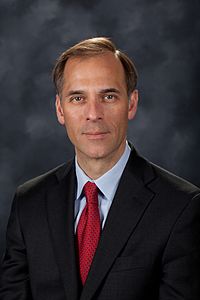
Immigration policy divides Hillary Clinton and Donald Trump. U.S. growth will falter unless the measures proposed by Clinton are adopted to spur increased immigration, according to Mark Zandi. Trump’s policies, Zandi contends, will put the U.S. on a trajectory similar to Japan’s “lost decade.” 
Zandi is chief economist of Moody's Analytics, where he directs economic research. He is co-founder of Economy.com, which was acquired by Moody's Analytics in 2005. Zandi often testifies before Congress on the costs and benefits of proposed policy measures. He has been at the center of a controversy in the current election cycle, with both presidential candidates claiming his analysis supports their views.
He spoke on-the-record at a private event in Boston on October 6.
“No single policy matters more to lift U.S. growth on a sustained basis than immigration reform,” Zandi said. “It is vitally important to our economic future. If we don’t get this right, we won’t get 4% growth; we will get 1%.”
“We will get Japan,” he said.
Zandi also predicted that Clinton will win the presidential election, but he did not endorse either candidate.
I’ll discuss Zandi’s positive outlook for the U.S. economy and the risks it faces and provide some final thoughts on what Zandi said about immigration.
A positive outlook for U.S. growth
“The economic prospects are good for the next two to three years,” Zandi said. There is a high probability the current economic expansion, which is already seven years old, will be the longest on record, according to Zandi. It is now the third longest expansion.
Zandi’s positive outlook is driven largely by the labor market. He said that data for the labor market is more accurate than GDP, which is tough to measure. The data for the labor market is very good, he said, and job growth is double the pace needed to keep up with the growth of population.
“We are months away from full employment,” he said, although that is not true in the energy and trade-sensitive manufacturing sectors.
Indeed, he said, “cheap money has worked.” Zandi said monetary policy is at least partially responsible for the fact that GDP growth excluding government spending has been almost 3% annually for the last seven years. Growth in the government sector has been slower due to fiscal austerity measures, he said.
Zandi said there is no evidence of “secular stagnation.”
Real wage growth should be above 3% given the growth the U.S. has achieved, he said, but it has been between 2% and 3% in last three years. Nonetheless, Zandi is confident that income growth will follow the job growth the U.S. has achieved.
The problem the U.S. will face will be a lack of labor, which underlies the importance Zandi placed on immigration reform.
Stronger wage growth will change people’s perceptions about the economy, he said. People are disappointed now because they look at the economy through wage increases relative to the cost of living, according to Zandi, and that is fueling a lot of the populist political sentiments. Average wage and inflation growth are both approximately 2%.
“No real growth makes people angry,” he said. That may be “okay” for a year or two, but Zandi said it has been a long time, which explains populist perceptions about the economy.
Don’t expect much out of earnings growth or the equity market performance, Zandi said. Higher wage growth will impair profits. Wage growth will be stronger than it was in the last two years because the weakness in energy sector is past its peak.
The housing market is strong, he said. It has been aided by job growth, low interest rates and new types of mortgage lenders, such as community banks, competing to lend money.
Over the next three to five years, Zandi predicted that a surge of Millennials will form households, have children and want to purchase single-family homes. Construction of those homes is “way too low,” he said. It is approximately 750,000 per year, but needs to be 1.2 million to support the demand he anticipates. “We will see a lot more single-family housing construction over next few years.”
Housing price growth and rental growth will be strong, he said, especially relative to returns in the equity and bond. Zandi forecast returns of 5-7% annually from the single-family housing market.
“Housing will add juice to the economy,” said. “It is one more reason why we’re good.”
The risks ahead
Zandi cited several risk that could undermine his sanguine outlook.
His forecast for higher growth implies Fed rate hikes, he said, although he admitted that he has been wrong and expected higher rates sooner. Everything is in place for the Fed to raise rates, he said: the economy is close to full employment, inflation is very close to its target (1.7% versus 2.0% PCE inflation), the equity markets are stable, credit spreads are thin and the global economy is “okay.” He said the Fed is not moving quickly enough.
Long-term rates will rise, but not by nearly as much as short-term rates, he said, because global central banks will continue their programs of aggressive buying of securities. He predicted that the yield curve will flatten in 2017 and could invert in mid-2018; that would imply the next recession will be in 2020.
He forecast a 4% 10-year Treasury rate in the second half of 2018 (it is 1.7% now) and that inflation will go from 2.3% to 3% over that time frame.
Volatility could cause lower stock prices and wider credit spreads, he said, which could dampen growth.
There is a global risk, he said, if developed economic growth slows by a greater rate than the market anticipate. But he said he expects global growth to “hang together” at approximately 3% for the next few years. China, he said, has the tools and resources to do what they need to keep economy on target. China controls its capital account and can prevent money outflows.
Europeans will “keep it together” because they are “all-in” on monetary policy and increasingly willing to use fiscal policy, Zandi said. Europe will succeed because it will marry fiscal and monetary policy to be effective. The European banking problem is a stress point, he said, but he expects that it will not derail his growth forecast
The U.S. election presents a risk if Trump prevails, he said, but he predicted that Clinton will win by 332-206 in the Electoral College. He based that forecast on a model that has accurately predicted elections since 1980. In order for Trump to win, Zandi said, he would need to carry seven states: Florida, North Carolina, New Hampshire, Ohio, Colorado, Nevada and Virginia. Right now, he expects Trump to prevail only in North Carolina.
An implication of his model, he said, is that one county in each of those states is critical; for example, Fairfax will determine the result in Virginia. We elect the most powerful person on the planet based on a very small sample size, according to Zandi.
Why we need immigrants
Zandi said he has evaluated the policies of both candidates at face value, looking only at those that are quantifiable and impact the macro economy. The key difference is clear, he said. Clinton has embraced immigration reform and endorsed the 2015 senate legislation that would legalize citizenship for undocumented aliens. She would double legal immigration, he said, which would lead to a “bigger, more productive economy.”
Trump, he said, wants 11 million people out of the country. That could be done, Zandi said, through a system such as E-Verify that has been implemented in Arizona. Trump wants no change to existing immigration policies, he said. Trump has called for a crackdown on illegal immigrants, but Zandi did not mention that in his talk.
We need skilled workers, Zandi said. “If we don’t allow immigration it will cost Americans jobs.” For example, if a landscaping company loses its illegal immigrant works, it will hurt the whole business. Skilled workers increase productivity, he said, and cited a 2013 Congressional Budget Office study that examined that question.
Immigrants are risk takers and entrepreneurial, he said, and they will spur business activity.
Zandi warned that five years from now the labor force growth will be zero without a change in immigration policy.
“This logic will win the day,” he said. “Businesses will scream because they can’t find workers, and wage growth will follow.”
Read more articles by Robert Huebscher