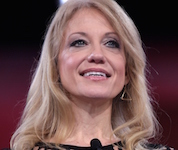
Donald Trump’s electoral win was in part the result of very shrewd analysis and tactics. As his campaign manager, Kellyanne Conway was responsible for Trump’s campaign strategy and its execution. Yesterday, she offered candid insights into the key decisions that led to Trump’s victory.
Conway was named Trump’s campaign manager on August 17, and became the first woman to run a successful presidential campaign. She is also president and CEO of The Polling Company, Inc., a market research company that has served mostly Republican candidates. She spoke at the MarketCounsel Summit in Miami.
“The Democrats presumed who the electorate would be,” Conway said, “rather than letting the electorate tell them.”
Conway said Democrats made a number of faulty assumptions throughout the campaign. They assumed that Hillary Clinton would be able to hold on to the demographic coalition that Barack Obama rode to victory. But it turned out, she said, that millennials and people of color did not turn out and vote for her in the same numbers as Obama.
Tied into that, Democrats assumed that 2016 would look like 2012. But Conway said that her team saw the opportunity for Trump to attract a greater number of self-identified independent voters than in the prior cycle.
In prior elections, Republicans had waited for single people to marry and younger voters to age in order to grow their base, according to Conway. But she saw the chance to attract voters who were unhappy with Obamacare or were fearful of terrorism and their security. She said her team relied on three sets of data to identify potential voters: traditional data, data collected by the Republican National Committee (RNC) and their own propriety analysis that tapped into how voters spent their money and time. She called the latter of those three “situational analysis,” and said it was significantly more important than traditional demographic data.
The effectiveness of Conway’s strategy was apparent in a key statistic. Clinton got only about 55% of female voters, which she said was “astounding,” since it was a mere 1% greater than what Obama received. “Women found that they didn’t share her values and were disconnected,” Conway said.
“Voters had been telling pollsters for decades that they wanted an outsider,” Conway said. “The voters made good on that 30-year self-avowed desire. Clinton didn’t represent change.”
The Democrat who represented change was Bernie Sanders, and Conway faulted Clinton for not treating him and his supporters better. She said that Democrats effectively ignored the fact that he had carried 22 states in the primaries. Nonetheless, Conway said it would have been easier if Sanders had won the nomination and she could have run against the first socialist instead of the first woman candidate.
Overcoming Trump’s weaknesses
On the subject of Trump’s brashness and improprieties, Conway said there is a difference between what offends you and what affects you. “This cycle, people looked at what affects them.”
Conway acknowledged that experience and temperament are important qualifications for a president. “But what some people saw as temperament, others saw as strength and resolve,” she said. “What some saw as experience, others saw as being a D.C. insider.”
Trump’s unfavorable characteristics were “different and more manageable” than Clinton’s, she said. Clinton was viewed by voters as dishonest and untrustworthy, according to Conway, and those beliefs “didn’t budge” over the course of the campaign. Usually female candidates, particularly in down-ballot contests, have three advantages, none of which Clinton possessed. They are perceived as fresh and new, incorruptible (there is no “old girl’s network,” Conway quipped) and as good negotiators and consensus builders.
“Clinton was not viewed as having any of those three characteristics,” Conway said.
Indeed, she said that when you have a lot of money, as did the Clinton campaign, “you trick yourself into believing that everything is okay.”
Conway said it was difficult to articulate Clinton’s core message. “This was a serious point,” she said. “Trump was talking to people and she was talking about Trump.” In the final weeks, Trump had the more aspirational, uplifting message, while Clinton’s campaign was negatively focused on Trump.
Conway called Trump a “transformative messenger.” Before his candidacy, she said the Republican Party represented the elites – the 7% of the population who were job creators – and the 7% who are job seekers. Her insight, she said, was to seek out the other 86% who were job holders who weren’t achieving what they wanted.
This was evident, Conway said, when she attended a county fair in Youngstown, OH, in early September. Approximately 85,000 people turned out in 86-degree weather to hear Trump talk about law enforcement and providing medical care to our veterans.
Democrats underestimated the impact of those rallies, according to Conway. “On good days they were ignored,” she said, “and on bad days they were mostly mocked.” Those rallies translated to an 8%-9% “enthusiasm edge” for Trump, Conway said. It meant that Clinton could not surpass 47% of the votes in states where Obama got over 50% of the vote.
“Undecideds broke for Trump because the one thing they were decided about was that they didn’t want to vote for her,” she said.
The future of the Democratic Party
What happened to the Democratic Party? “It rewarded the leaders who failed them,” Conway said. It gave Nancy Pelosi the House speaker mantle over Tim Ryan who said Democrats weren’t connecting with workers. Ironically, Ryan represented the Youngstown district where the county fair was held.
“Democrats learned nothing from the election,” Conway said. “The Tim Ryans of the world and everyone he represents have been told they don’t matter.” Instead, they elected liberals from New York and California to the congressional leadership positions.
She reminded the audience that in 2018 Democrats will need to defend 25 seats in the Senate, 10 of which will be in states Trump won and seven others in states he closely lost.
Conway said she may stay “outside the White House” to run the 2018 campaign with the goal of getting to 60 Senate seats.
She was asked a few questions about President-elect Trump’s policy agenda. But in response to the question that she has surely been asked most frequently, she said she doesn’t know whether he will be able to maintain his social media presence – including his Twitter account – once he becomes president.
Read more articles by Robert Huebscher
 Donald Trump’s electoral win was in part the result of very shrewd analysis and tactics. As his campaign manager, Kellyanne Conway was responsible for Trump’s campaign strategy and its execution. Yesterday, she offered candid insights into the key decisions that led to Trump’s victory.