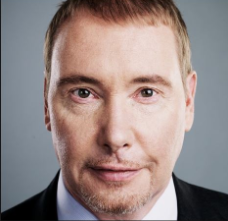
The yield on the 10-year Treasury bond has been tightly coiled in a “zone of death,” Jeffrey Gundlach said. Since the start of the year, it has traded between 2.4% and 2.5%, but it is poised to rally to 2.25% before it retreats to 3.0% by the end of the year, according to Gundlach.
Gundlach is the founder and chief investment officer of Los Angeles-based DoubleLine Capital, a leading provider of fixed-income mutual funds and ETFs. He spoke to investors via a conference call on March 7. Slides from that presentation are available here. This webinar was focused on DoubleLine’s flagship Total Return Bond Fund (DBLTX).
“Sentiment and short positions are set up for a rally,” he said, but the 10-year has “gone sideways, anchored around 2.5%.”
The big change for 2017, he said, has been that the bond market is showing a lot more “respect” for the Fed. Instead of Fed policy being dictated by the direction of the bond market, now the market is moving in response to Fed pronouncements.
That is evident, he said, in the increase in the 10-year breakeven rate (the difference between the yield on a nominal bond and the TIPS rate). It has gone from approximately 1.5% to 2% since the middle of last year, signaling that the market believes the Fed will continue with its rate hikes and inflation will increase.
The other significant development he noted was that the global economy has undergone its most synchronized upturn in the last seven years. Since the middle of last year, the Citibank surprise index, which tracks how economic indicators are doing relative to expectations, has risen steadily for the U.S., the Eurozone, emerging markets, other major economies, Latin America and the Asia/Pacific region.
Let’s look at what else Gundlach had to say about the economy and the capital markets.
Worry about inflation, but not a recession
In his previous webcast, Gundlach said the U.S. usually enters a recession in the first term of a new presidency, although one was not imminent. Now, the chances of a recession are even more distant.
“We don’t see a recession on the horizon,” he said.
Gundlach cited a number of economic indicators that have strengthened over the last couple of months, including small business confidence and manufacturing and service ISMs. The Conference Board leading economic indicators (LEIs) are strong, he said, and economists have not downgraded their estimates of GDP growth, as they have in the post-crisis period.
Nominal GDP growth is now forecasted at 4.7%, which reflects higher inflation expectations. Inflation expectations, he said, could be driven by a fear of tariffs on imports. He noted that cars and car parts are the most widely imported item by the U.S. from the rest of the world. He said a tariff on autos could drive car prices 10% higher.
Indeed, with inflation at or above 2% and unemployment below 5%, the Fed’s targets for raising interest rates have been met. “There are no more excuses not to raise interest rates,” he said.
The bond market predicts a 96% chance of a March rate increase, he said, a 50% chance of a hike in June or July and a 33% chance of another one later in the year. The market is forecasting “two-and-a-half rate hikes this year,” he said.
If inflation and unemployment remain at their current levels, he said the Fed could “go old school” with sequential rate hikes until “something breaks,” which would be a recession following an inverted yield curve. The yield curve has been flattening – about 20 basis points this year. But Gundlach does not expect it to invert in the near future, although it will continue to flatten if the Fed “goes old school.”
The TIPS market is now forecasting that inflation will be approximately 2% every year for 30 years. “That cannot hold,” Gundlach said. Break even rates will go up above the 2.3% level they reached in 2013-2014. When that happens, he said TIPS will be a good investment choice.
Just recently, he said there have been more mentions of “reflation” than “deflation” on the web. The U.S. headline CPI is over 2%, but the internet-based PriceStats service is showing that inflation is up to 3.6%. The most recent monthly increase in core CPI (now at 2.5%) was 0.3%, which Gundlach said was a post-credit-crisis high. Wage growth was 4% annually until January, and is now at 3.5%, which he said is “way over” the Fed’s 2% target. Hourly earnings show the same pattern as wage growth.
Should you invest in Europe, Japan, emerging markets or U.S. equities?
Gundlach opined on the investment opportunities in a number of regions and asset classes.
German real yields are deeply negative due to quantitative easing (QE) by the European central bank (ECB). Nominal rates are 32 basis points and the CPI is 2.2%.
His concerns about Europe were not limited to Germany or to its bond market.
Inflation in Europe has surged to the upside, he said, and that has been a surprise to the markets. Inflation is back, Gundlach said, and German bond yields should rise in sympathy.
Tensions in Europe are high and are being driven by higher unemployment rates in France (9.97%) relative to Germany (6%).
There is too much geopolitical risk in Europe to recommend its equities, according to Gundlach.
“There is a ton of downside on European bonds,” he said. “I recommend investors own none of them.”
Turning to the U.S. equity market, he said that the S&P had been rising in step with the Fed’s balance sheet. That changed late last year; since then the Fed’s balance sheet has been flat but the S&P is rising. Gundlach offered an explanation for why U.S. equities have risen: The Fed has stopped its QE, but other central banks have not. That is influencing U.S. markets, which are in sync with global balances sheets.
But, he said, strong equity prices are also tied to investors’ hopes for better earnings from GDP growth and tax cuts.
Gundlach said that S&P earnings estimates have not been downgraded as much as in past years, and are forecasted to increase approximately 12%.
“Stocks will grind higher until we get to the next up move in the 10-year,” he said, “when it pushes from 2.5% to 3%.” Equities are not cheap at all, he said, and are “in 1929 land.”
Emerging market and European CAPE ratios are a lot lower than in the U.S., he said. He prefers emerging markets to Europe due to their lower geopolitical risk. He recommended both emerging market and Japanese stocks over those in the U.S., he said. Japan is the “best reflation trade,” since it benefits the most because of its debt burden. “But don’t touch Japanese bonds,” he said.
A positive sign for U.S. equities is that margin debt is not “rolling over,” Gundlach said. When that happens, “it will take the S&P with it.”
Ultimately, Gundlach said the S&P will succumb to higher Treasury yields.
But rates are rising and have been rising over the last several years. LIBOR has risen from 50 to 180 basis points since 2015, he said. The only reason rates are not rising faster, despite the Fed’s rhetoric, is because short positions in the bond market are very large, according to Gundlach.
Gundlach has said that the 10-year yield could go to 6% in three years.
How could that happen?
The high debt burden in the U.S. will be the trigger, Gundlach said. Inflation will increase as will nominal GDP growth because there is a “massive supply” of bonds coming to the market in a few years. That will be a result of bonds issued during QE1, QE2 and QE3 rolling over, along with a need to refinance maturing corporate and junk bonds. That comes at the same time a spike in entitlement spending is forecast.
“It would not be that bad for bond portfolios,” Gundlach said, “depending on how those funds are managed.”
Read more articles by Robert Huebscher
 The yield on the 10-year Treasury bond has been tightly coiled in a “zone of death,” Jeffrey Gundlach said. Since the start of the year, it has traded between 2.4% and 2.5%, but it is poised to rally to 2.25% before it retreats to 3.0% by the end of the year, according to Gundlach.