Advisor Perspectives welcomes guest contributions. The views presented here do not necessarily represent those of Advisor Perspectives
This article describes three major methods of investing in international equity markets. They include bottom-up stock picking, “hybrid” stock picking and investing in funds or ETFs that closely follow broad-based international indices. The article also describes the fourth, alternative, method of international equity investing: construction of portfolios from single-country equity ETFs.
The article compares selection of different ships for fishing with investment portfolios built using the four methods above. It describes groups of countries for which each investment method is more appropriate. Finally, the article talks about competitive advantages of building portfolios from single-country ETFs versus the other methods in such areas as potential reduction of risk of capital loss, flexibility of investment selection, speed of entering and exiting investment positions, and investment management fees. The full version of this article can be found here.
International equity investment methods
Just like fishermen who want to catch big fish, investors seek investments that bring them attractive returns. A fisherman’s choice of ships is important in determining whether and where he will be successful in catching fish; similarly, an investor’s choice of building blocks for her portfolios and methods used to develop these portfolios in large part determines whether and where the investor will be successful in generating attractive returns.
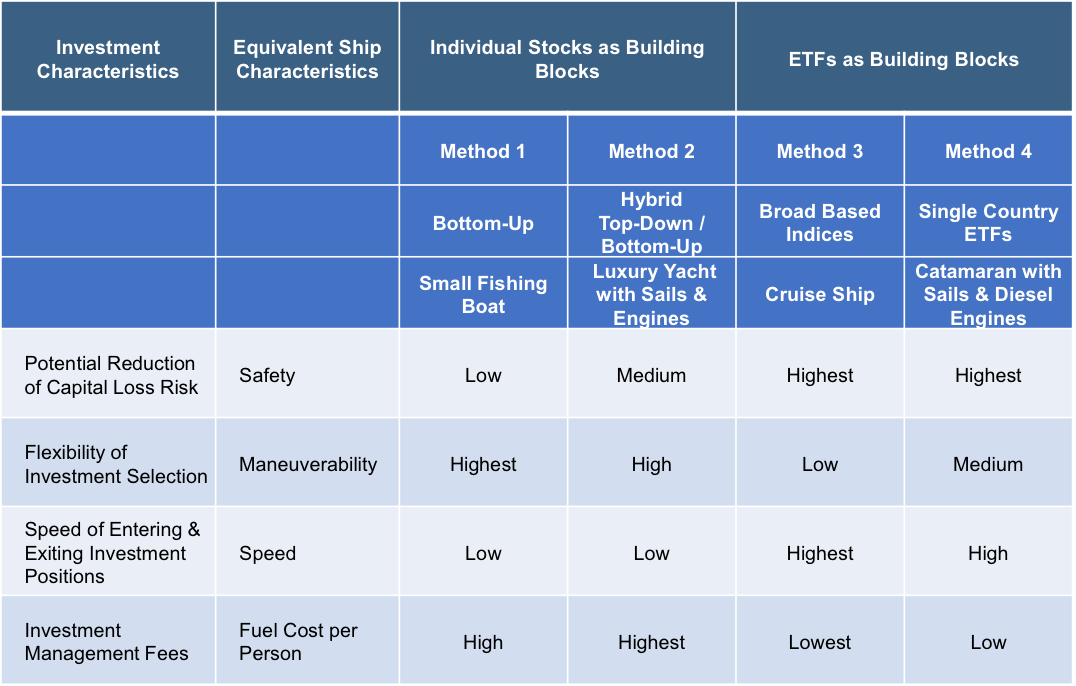
Most choose to invest in international (developed, emerging and frontier market) equities using one of three dominant methods to create portfolios from two major building blocks: individual stocks or ETFs. Investors who invest in individual stocks usually use one of the two methods: bottom-up individual stock picking (see Method 1 in Table 1) or hybrid individual stock picking (see Method 2 in Table 1). Investors also invest in international equities using broad-based indices (see Method 3 in Table 1).
My firm developed a new method of investing in international equities using single-country ETFs (see Method 4 in Table 1). Table 1 demonstrates how the investment strategies are characterized by four major factors: potential reduction of capital loss risk, flexibility of investment selection, speed of entering and exiting investment positions, and investment management fees. Table 1 also provides comparisons of each investment method with characteristics of a fishing ship.
Table 1. Comparison of characteristics of equity investment strategies and ships for fishing
 Source: Beyond Borders Investment Strategies.
Method 1: Bottom-up stock picking: Success in “core” developed markets
In bottom-up investing, investors focus on specific companies rather than on industries or country economies in which these companies operate. This approach assumes that individual companies can do well even in industries or countries that are not performing well. The bottom-up stock picking style of investing is similar to using small and maneuverable fishing boats (see Method 1 in Table 1).
I was fortunate to work with some of the successful bottom-up stock pickers and read ideas shared by other successful investors. Just as many fishermen are excellent in catching certain types of fish in certain lakes, many successful portfolio managers have excelled when investing in certain types of companies within certain industries. For example, some were superb in investing in small-cap stocks, while others in energy or technology stocks.
These successful stock pickers focused on investing in the “core” developed stock markets where the rule of law has been strong and financial disclosure standards have been high (e.g. U.S., Canada and Germany). All of these managers realized that their strengths were in the fundamental analysis of companies and not in the macro analysis of country environments and risks. As a result, none of them tried to make major investments in riskier countries outside of the “core” developed ones.
These managers realized that focusing just on stock fundamentals without paying attention to macro factors (e.g. economic growth, inflation) and political risks in the less transparent and more volatile stock markets of riskier developed countries, emerging and frontier markets most often did not work. Investing in these riskier markets, especially around political or economic crises, is more akin to fishing in oceans where storms, or country and regional crises, could be much stronger than in lakes or rivers of the “core” developed markets.
Method 1: Bottom-up stock picking: Problems in riskier markets
Unfortunately, the bottom-up approach does not work well in international and emerging markets as most active managers underperform their benchmarks.
According to the 2016 SPIVA U.S. Scorecard report published by S&P Dow Jones Indices, 67% and 84% of international developed equity investment managers underperformed their benchmarks over five-year and 10-year periods respectively as of the end of 2016.1 Even more emerging market equity managers, 75% and 86%, respectively, underperformed their benchmarks over these periods. Most U.S. managers working in international and emerging market equity investing are bottom-up stock pickers.
There are four major reasons for the bottom-up stock pickers’ underperformance:
- Macro factors often overwhelm company fundamentals
- Lack of transparency in companies’ financial disclosures leads to higher bankruptcy risk
- Inadequate corporate governance does not protect investors
- Elevated political risk at macro and micro levels
Method 2: “Hybrid” investors in individual stocks: Investment process complexity
There are some managers who use “hybrid” approaches that combine both bottom-up and top-down processes (see Method 2 in Table 1). Top-down investors in individual stocks analyze countries, sectors and stocks in that order. After selecting countries and sectors in the global markets, these investors try to find the best companies there by using bottom-up techniques. If investors are good at both bottom-up and top-down analyses, this approach works.
However, by definition it is a much more complex process: Investors need to be good at both bottom-up and top-down analyses, which is not easy as companies’ research efforts are often dominated by one of the analysis styles. But even though the statistics for the 2016 SPIVA U.S. Scorecard are not provided to this level of detail, a sizable percent of managers who outperformed the index over the five- and 10-year periods in international and emerging markets are these “hybrid” investors.
The complexity of the “hybrid” method lies in its implementation. It is simple to describe this process but not easy to implement it successfully. The most common complexity of the “hybrid” approach is when the bottom-up and top-down analyses point in different directions.
Also, the “hybrid” investment process does not alleviate any company-specific risks, since investors invest in stocks of individual companies. These investors remind me of luxury sophisticated yachts with sails and diesel engines. While they are appropriate for traveling in the ocean and seas, they are difficult to operate and not as sturdy as, say, catamarans. In order to succeed, these “hybrid” teams require very well-trained personnel who have also had years of experience working together.
Method 3: Broad-based international indices: Sturdy but inflexible investments
Another common way that people invest in international stock markets is with ETFs, or funds that closely follow broad-based international indices. It is a safer way to invest in risky markets worldwide versus the bottom-up stock picking. I compare it to fishing from large ocean-faring cruise ships (see Method 3 in Table 1). These cruise ships are very steady and designed to survive storms.
The major problem with fishing from the cruise ships is that they are moving on a schedule and do not have flexibility to stop and allow fishermen to fish where the fish are. If there are a lot of fish in Aruba, but the cruise ship is scheduled to depart for Curacao, it will do this to stay on schedule. And if there are no fish in Curacao, it is the fishermen’s problems. Furthermore, if there are a lot of fish near Barbados, but the island is not on the pre-set route, the cruise ship will not go there.
The broad-based indices have high weights in several of the countries with the highest market capitalization. For example, the weight of the four largest countries in the MSCI All Country World (ACWI) ex U.S. Value Weighted Index was 45.9% as of the end of June 2017.2 If stock markets in these four countries are trading at low valuations and have high expected returns, it is great for the investors. If, however, markets in one or several of these largest countries have high valuations and low expected returns (similar to a “no fish” situation), investors cannot do much, apart from selling the whole fund.
Method 4: Single-country ETF investing: Alternative to existing investment approaches
Investing using single-country ETFs represents an alternative to the three dominant approaches to international investing. It is less risky than bottom-up stock picking and more flexible than investing using funds or ETFs that closely follow the broad-based international indices. This approach is akin to fishing from a large sea-faring catamaran (see Method 4 in Table 1).
Investing using single-country ETFs features four major advantages, three versus individual stock picking and one versus broad-based international indices:
- Potential reduction of risk of capital loss
- Speed of entry and exit from investment positions
- Ability to implement this strategy at low cost
- Flexibility of having exposure only to countries with high expected returns
Potential reduction of risk of capital loss: By investing in country-wide funds rather than individual securities in each country, one can survive strong investment storms. If in a portfolio built from 20 ETFs, the price of one stock out of one hundred in a single ETF drops to zero, the portfolio will survive the loss without much impact. However, if the same happens in a 20-individual stock portfolio, the loss would be much more painful. And if the prices of five stocks go to zero in the 20-ETF portfolio, the impact may still range from negligible to slightly painful. However, if prices of five stocks in the 20-stock portfolio go down to zero, the loss could be extremely painful or even lethal for the portfolio.
Also, management of portfolios that consist of single-country ETFs is easier than that of “hybrid” yachts as the investment manager only uses the top-down approach to selecting countries and does not spend most of its time on selecting individual securities. This makes the investment process less expensive and less prone to human mistakes.
Speed of entering and exiting investment positions: ETFs are traded in the U.S. equity market, the most liquid market in the world. To buy an ETF, or more importantly, get out of an ETF if new negative developments are likely, one can sell positions very quickly. It could be much more difficult to quickly get out of a position if an individual stock is trading on a less liquid and less efficient stock exchange.
Low investment management fees: It is more expensive to build a similar size portfolio out of individual stocks compared to single-country ETFs as it requires more people, research, technology, and other resources.
Flexibility of investment selection: In the broad-based international indices, country weights are pre-set and weights of only a few large countries dominate the performance of the indices. But much higher weights (up to 10% of our portfolio) can be allocated to any country ETF depending on factors such as the country markets’ expected returns, investment valuations, catalysts to the country crisis alleviation, risks to these catalysts, stock momentum, earnings growth, and the ETF’s liquidity. Country selection can be flexible and one can shift investments from countries with lower expected returns to the ones that offer higher expected returns.
Vitaly Veksler is the founder of Beyond Borders Investment Strategies, LLC, where he serves as the CEO and portfolio manager.
1 Aye Soe and Ryan Poirier, S&P Dow Jones Indices, SPIVA U.S. Scorecard, Year-End 2016.
2 MSCI ACWI Value Weighted Index Fact Sheet, June 30, 2017. These four countries with the largest weights included: Japan (20.6% of the total index’s weight), UK (11.4%), France (7.1%), and China (6.8%).
Read more articles by Vitaly Veksler
 Source: Beyond Borders Investment Strategies.