The rise of populism has been fueled by rhetoric bemoaning the downward plight of the middle class, and that chorus has been joined by many from the left. But are we really worse off than we were a generation or a century ago? Not according to Steven Pinker, whose new book documents the dramatic improvement in lives across the globe.
Pinker, a psychologist and linguist and the author of The Better Angels of Our Nature, has written an entertaining and challenging follow-up book: Enlightenment Now: The Case for Reason, Science, Humanism, and Progress. In his latest volume, Pinker makes the case that, in Barack Obama’s words, “if you had to choose any time in the course of human history to be alive, you’d choose this one. Right here...right now." Bill Gates calls Enlightenment Now his “new favorite book of all time.”
Enlightenment Now (he should have worked harder on the title) is so well known and widely discussed by now that I don’t have to describe it here in more than summary form. If you’ve read the works of Matt Ridley, Johan Norberg, Deirdre McCloskey, and Angus Deaton, heard Hans Rosling’s spirited TED talks, or for that matter read Pinker’s last book, you already know the basics: health, wealth, longevity, nutrition, literacy, peace, freedom, and just about all other indicators of human well-being have been dramatically improving over the last 250 years.
Deaton dates the beginning of this “great escape” from near-universal poverty to a time that most economists associate with the first Industrial Revolution. However, Pinker identifies that era as the Enlightenment, the sharp turn toward reason and science – and away from faith and tradition – that captured the Western world in the eighteenth century.
Hello from Hell
I don’t usually read, much less comment on, other reviewers. But the New York Times review of Enlightenment Now is so telling in its two-faced appraisal of the book that I can’t stop myself.
Sarah Bakewell’s review is quite positive. But the illustration intended to draw the reader’s attention to the review is an updated version of one of Hieronymus Bosch’s paintings of Hell, complete with skull, rat, cockroach, vulture, strangulating bird, and, yes, hell fires. Across the panorama stretches a huge, grotesque smile, as if the Times wanted to warn its readers, “Don’t believe anything in this review – or in Pinker’s book. Life sucks.” Apparently, that is what the pooh-bahs who run the Times believe.
The psychological roots of progressophobia
Why is it so hard to believe one of the most obvious facts of our existence – that it’s pretty good? And that it’s dramatically better than the solitary, poor, nasty, brutish, and short lives of those who went before us? Don’t we know that a relatively poor American can do many things that Catherine de’ Medici couldn’t – flush the toilet, take an antibiotic pill, or make a phone call?
Pinker says the reason is as follows:
The psychological roots of progressophobia run [deep]…How much better can you imagine yourself feeling then you are feeling right now? How much worse can you imagine yourself feeling? … [T]he answer to the second one is: it’s bottomless... People dread losses more than they look forward to gains, [and] dwell on setbacks more than they savor good fortune.
Then why are the good old days so often perceived as better than the present, even if they’re not?
One exception to the Negativity bias is found in autobiographical memory… [T]he negative coloring of the misfortunes fades over time. As the columnist Franklin P. Adams pointed out, “Nothing is more responsible for the good old days than a bad memory.”
We also confuse our own situation with that of the commons. Beyond a certain age, life becomes a race against diminishing capability. As Pinker says, “we mistake a decline in our faculties for a decline in the times.” Each of us is getting closer to death each year. But society isn’t getting closer; because of increasing longevity, it is actually getting farther away from death.
The newspaper is a downer: If it bleeds, it leads
Another reason that we perceive life as getting worse is that the news is strongly biased to the negative, which is what sells: if it bleeds, it leads. Pinker writes that if newspapers were published every 50 years instead of every day, the lead story would be the large increase in life expectancy since the last issue of the newspaper. But, from day to day, life expectancy does not change much, while people do get in car crashes, gun fights, and wars. Maybe that is why the Times’ hellish illustration was selected.
Finally, Pinker notes, “the financial writer Morgan Housel has observed that ‘pessimists sound like they’re trying to help you, while optimists sound like they’re trying to sell you something.’” Hmmm.
Building on Pinker’s past work
Enlightenment Now is an expansion and completion of Pinker’s previous book, The Better Angels of Our Nature (that time, he did work harder on the title). Angels focused on violence, an area where Pinker found little-appreciated evidence of improvement. While his argument in that book is sound – human history is the story of almost continuous war – it is possible to push back at his statistical technique of dividing the death toll by the population to arrive at a per capita rate; by that criterion, the bloody twentieth century was the least warlike in history. But that adjustment has the effect of not treating everyone equally: a World War II veteran’s life becomes less important than that of a Spartan warrior.
By broadening the examination to areas other than violence, however – which is what Pinker does in the current volume – the argument for dramatic human improvement becomes clearer and less easily challenged. The world has become so much healthier and wealthier, along with huge increases in quality-of-life measures, that you’d have to be a real misanthrope to concentrate on the downside. This is not to deny that there are extreme tails around the average with real and imagined unfairness, but overall everyone is healthier and wealthier.
Of course, misanthropes exist and are much more numerous than you’d guess. “Steven Pinker wants you to know humanity is doing fine. Just don’t ask about individual humans,” kvetches Jennifer Szalai in the Times (in the headline of a different review than Bakewell’s). She is incensed, for example, by the fact that, while the incomes of a billion Chinese have been multiplied a hundredfold (in nominal yuan terms) in the last two generations, that was achieved at the cost of a perceived flatline in the paychecks of tens of millions of working-class Americans.
Whether that’s true or not, and it might be, many people reject the utilitarian calculus that finds such an outcome acceptable. I do not, and I wonder at the mentality that says a Chinese life is less important than an American one. Perhaps Szalai thinks progress is made only when everyone’s life improves by the exact same amount, but that’s not the way the world works, and when she was recently promoted to nonfiction critic of the Times, someone else wasn’t. Perhaps she should share her good fortune with all the other qualified candidates.
The many dimensions of improvement
In crafting Enlightenment Now, Pinker followed the outline that has been used repeatedly by various authors to enumerate the many dimensions in which human life has improved. The book therefore bears some resemblance to Matt Ridley’s Rational Optimist and Johan Norberg’s Progress, and to my forthcoming book on the same topic, tentatively called Fewer, Richer, Greener; it hard to see how else such a book could possibly be organized. The outline, one chapter per dimension, predictably includes health, wealth, life span, food, happiness, literacy, liberty, the environment, and various aspects of peace and safety, the topic with which Pinker seems most vitally concerned.
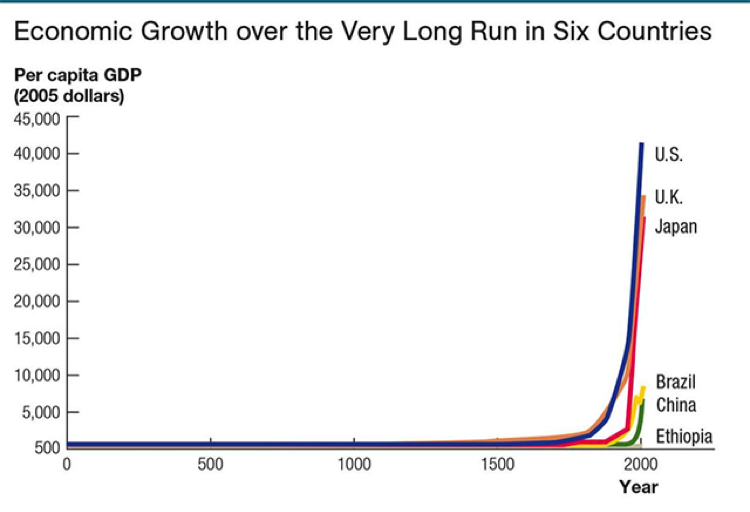
The book is distinguished by its repeated use of time-series graphs, each showing something about the increase in the quantity of a metric (population and life span) and, more to the point, the improvement in quality of life over time. Here’s a generic example:
Exhibit 1
Example of hockey stick graph

Source: Charles I. Jones. 2014. Macroeconomics, Third Edition. New York: W.W. Norton & Sons.
Pinker’s book differs from the others in its length and detail, his ability to digress usefully into related topics and then return to the main stem, and – most notably – his identification of the eighteenth-century Enlightenment of Hume, Locke, Jefferson, and their peers as the source of today’s good times. The last section of Pinker’s book is an intensive examination of Enlightenment philosophy and its connection to persistent human development in the subsequent centuries. Let’s examine that connection more closely.
The Enlightenment and the “great fact”
Exhibit 1 and all its variants (Pinker presents 70 of them) convey what the great economist and historian Deirdre McCloskey called the “great fact”: the roughly 100-to-1 enrichment of those on the “betterment frontier,” the First World, over the last 250 years.[1] Many of those off the frontier have not done much worse: middle-income countries such as China, Brazil, Mexico, and Turkey provide a level of living comparable to that of the U.S. somewhere between 100 and 60 years ago, when the U.S. was inarguably already a First World country.
It is this betterment, not the fact that poverty still exists, that needs explaining. Poverty is the natural state of mankind and of other animals; for most of human existence, you’re poor if you don’t know where your next day’s meals are coming from, and you’re not poor if you do. Approximately 90% of all of the people who have ever lived suffered from what we would call today extreme poverty.[2]
Pinker’s explanation is, of course, the philosophical movement called the Enlightenment that spread through Europe and America like a virus between about 1700 and the early 1800s. Americans are most familiar with the political Enlightenment, the emphasis on the primacy and dignity of the individual that emerged from leaders such as Thomas Jefferson.
But the Enlightenment was much more than a celebration of individual political rights. It was a victory of science over superstition, continuing the powerful trend that had been established during the Age of Reason in the 1600s. It was a time when, at least for many, religion became a private rather than a public matter. It was a literary and artistic movement, embracing figures as varied as Jonathan Swift, Immanuel Kant, and Ludwig van Beethoven.
It was the birth of modern times.
How the Enlightenment made the economy grow
But how did the Enlightenment spawn economic development on a scale of 100-to-1 over the next quarter of a millennium? And why is Pinker’s explanation better than those of economists who traced the great fact to changes in technology, literacy and education, availability of financial capital, democracy and the rule of law, or, in McCloskey’s telling, the newfound respectability of the bourgeoisie and of business careers?
Mostly, it turns out, the Enlightenment helped us by removing barriers that we, ourselves, had put in our path. (Bragging about clearing this path, Pinker jokes, is a little like bragging about having kicked a heroin addiction – maybe you shouldn’t have become an addict in the first place.) Foremost among the obstacles was the medieval view that God, a perfect being, created the world for us in as perfect a condition as possible, so attempts at improvement were unseemly or bound to be fruitless. Accepting the received wisdom of clerics, who claimed to have a monopoly on knowledge, was another obstacle. A third was the lack of markets, where innovators could receive a reward for new products, processes, and ideas.
Forward thinkers, such as Desiderius Erasmus, had chipped away at these barriers centuries earlier. The Age of Reason, from Galileo to Newton, set the stage for the Enlightenment by overthrowing the authority of the church and commanding new respect for science and other forms of empiricism. But it was during the later Enlightenment that these modern ideas achieved critical mass and created an intellectual landscape wherein the Industrial Revolution and a business culture could thrive.
And that, argues Pinker, is the connection between the revolution in the world of ideas between, say, 1700 and 1820 and the revolution in standards of living from 1820 to today and beyond.
Back to philosophy class
The concluding chapter of Enlightenment Now, entitled Humanism and covering not just the Enlightenment but its sequelae in more modern times, revisits the senior seminar in philosophy and the history of thought that so many of us loved in college. It’s pretty heady stuff, packed with lists of “good guys”:
Impartiality underlies many attempts to construct morality on rational grounds: Spinoza’s viewpoint of eternity, Hobbes’ social contract, Kant’s categorical imperative, Rawls’s veil of ignorance, Nagel’s view from nowhere, Locke and Jefferson’s self-evident truth that all people are created equal…
and “bad guys”:
Some tyrannophiles were Marxists…but many were Nietzscheian. The most notorious were Martin Heidegger and…Carl Schmitt, who were gung-ho Nazis… Indeed no autocrat of the 20th century lacked champions among the clerisy, including Mussolini (Ezra Pound, Shaw, Yeats, Lewis[3]), Lenin (Shaw, H. G. Wells), Stalin (Shaw, Sartre, Brecht, Picasso)… At various times Western intellectuals have also sung the praises of Ho Chi Minh, Muammar Gaddafi, Saddam Hussein, Kim Il-sung, Pol Pot, Julius Nyerere…Slobodan Milošević, and Hugo Chavez.
and on and on and on. Clearly the fight for rationality and humanism is not over. In fact, Pinker goes into a bit of detail on the counter-enlightenment, the movement inspired by Johann Herder’s cri de coeur, “I am not here to think, but to be, feel, live!” – a sentiment that would have fit perfectly in any one of the revolutions of 1968.[4] The counter-enlightenment lives on, Pinker argues, in the anti-science sentiments found on both the left and right today.
But first – a word about the universe:
We know that our species is a tiny twig of a tree…that embraces all living things and that emerged from prebiotic chemicals almost four billion years ago. We know that we live on a planet that revolves around one of a hundred billion starts in our galaxy, which is one of a hundred billion galaxies in a 13.8-billion-year-old universe, possibly one of a vast number of universes… [We know that] [t]here is no such thing as fate, providence, karma, spells, curses, augury, divine retribution, or answered prayers…
In other words, we believe in science. We form our views about our surroundings based on theory, experimentation, and evidence, not superstition, fantasy, and tradition. That, Pinker implies, is the missing link between the Enlightenment and the great fact. Now that we’ve discovered the truth about the way the world functions, we can build machines that work; we can grow more than enough food for everyone; we can discover new medicines; we can make sustained material progress.
A conservative liberal: Pinker and the politics of optimism
Is Pinker a liberal or a conservative? He says he’s a liberal. Yet Pinker’s 2002 book, The Blank Slate, irritated many liberals by championing evolutionary psychology and lampooning the view that the human mind is a blank slate which, if you program it correctly, can take on whatever characteristics you want. And, as a self-described “watchdog” who is wary of political correctness and free-speech restrictions in universities, Pinker has become a hero to many centrists, traditionalists, and conservatives.
He’s still at it:
An example [of anti-science] is this scholarly contribution to the world’s most pressing challenge: “Merging feminist postcolonial science studies and feminist political ecology, the feminist glaciology framework generates robust analysis of gender, power, and epistemologies in dynamic social-ecological systems, thereby leading to more just and equitable…human-ice interactions.”[5]
(This is not satire from The Onion.) But, in Enlightenment Now, Pinker corrects the impression of himself as a conservative warrior:
The facts of human progress strike me as having been as unkind to right-wing libertarianism as to right-wing conservatism and left-wing Marxism… [C]ountries that combine free markets with more taxation, social spending, and regulation than the United States (such as Canada, New Zealand, and Western Europe) turn out to be not grim dystopias but rather pleasant places to live, and they trounce the United States in every measure of human flourishing…
…except, I might object, the desire to stay put. Just about every young, ambitious, educated European I talk to wants to move to the United States (or the U.K.), not because of its level of human development, but because that’s where they think they can get a job.
So I’d classify Pinker as a liberal, but a conservative one.
By the way, I find it deeply ironic – and wrong – that belief in the possibility of progress has acquired a conservative cast. It was the liberal Whigs, not the hidebound Tories, who wrote Whiggish history, the storyline that sees history as a progression from benighted to enlightened (Enlightenment?) conditions. It is also disappointing that so many of today’s so-called liberals express illiberal thoughts, such as the desire to restrict speech. Pinker is on the side of the angels on this question.
Progress, but at what cost?
All this improvement – it’s exhausting just thinking about how many indicators of well-being are on the increase – must have a downside. To Pinker’s credit, he does not overlook variables that have gotten worse, including inequality and climate stability.
But, in a compelling review of Enlightenment Now in The Atlantic, the psychologist Alison Gopnik noted, accurately, the most important aspect of life that has been damaged by Enlightenment and globalist values: the local connection. This includes friend-to-friend as well as husband-wife, parent-child, and extended family bonds – and, very importantly, the large number of people whom you know only a little, but whose combined influence on one’s life and on one’s children’s lives can be profound. E-mail, Facebook, and video conferencing just don’t equate to running into the same people day after day, getting to know some of them well and many of them superficially, and having a lot of people come to your funeral (which, as Yogi Berra is supposed to have said, they will do so that you come to theirs).
Children now grow up expecting to live on the opposite side of the country (or in a different country) from their parents and siblings, and in many cases they do. They form their own tribes, but the new tribal arrangements can break up as quickly as they were formed, leaving only an electronic trail. It’s a productive and exciting way to live, but people who are less than fully satisfied by it at an emotional and spiritual level cannot be blamed for their disappointment.
That said, Pinker cautions us:
[S]ingle and working mothers today spend more time with their children than stay-at-home married mothers did in 1965… But time-use studies are no match for Norman Rockwell and Leave It to Beaver, and many people misremember the mid-20th century as a golden age of family togetherness.
Conclusion
Unlike Bill Gates, I don’t have a favorite book of all time (except for Winnie-the-Pooh) and never will. However, Enlightenment Now says much of what I’ve been trying to say in my own articles and forthcoming book. Pinker says it with erudition, style, and humor, and with a much deeper base of knowledge than I have. Spend some time with it, even if, at 453 pages, it’s more time than you might like. The future will be better than the past.
Laurence B. Siegel is the Gary P. Brinson Director of Research at the CFA Institute Research Foundation and an independent consultant. He may be reached at [email protected]. His web site is http://www.larrysiegel.org.
[1] The increase is about 30-to-1 in money income, adjusted for inflation, but what you can buy with the money has improved radically, thus the 100-to-1 estimate of the increase in well-being.
[2] Or something close to it. The U.N. defines extreme poverty as an income of less than $1.90 a day in today’s money; the late Angus Maddison, the most authoritative student of historical incomes, calculates the typical income through human history (from the year 1 A.D. through 1820) at $3 to $4 (or, to be precise, just under $2 in 1990 dollars) a day.
[3] Sinclair Lewis? Wyndham Lewis? C. S. Lewis?
[4] Despite wishing not to think, Herder was, like many romantics, a good guy in most other ways.
[5] Pinker, Enlightenment Now, p. 396, quoting Carey, Mark, Marguerite Thurston-Jackson, Alessandro Antonello, and Jaclyn Rushing, 2016, “Glaciers, gender, and science: A feminist glaciology framework for global environmental change research.” Progress in Human Geography, Volume 40, issue 6, pp. 770-793.
Read more articles by Laurence B. Siegel