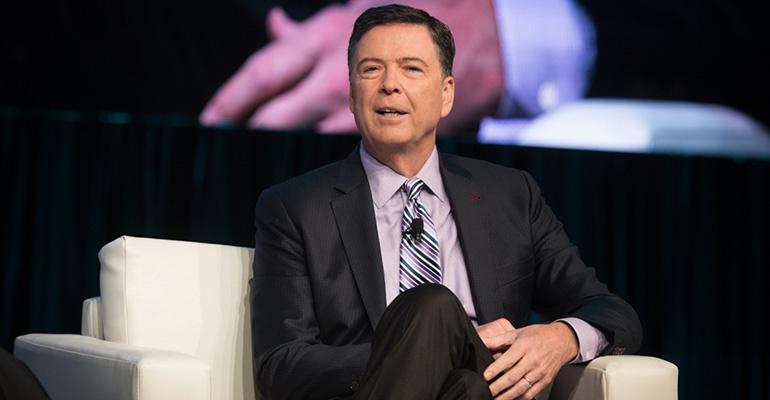
Donald Trump’s attacks on the truth and the rule of law will damage the norms upon which our country was founded, according to James Comey, the former FBI director.

Comey was a keynote speaker on June 6 at the annual Pershing INSITE advisor conference in Orlando, FL.
Comey recounted a terrifying childhood incident that led him to his career in law enforcement. He opined on the Mueller investigation, Hillary Clinton’s emails, prosecuting the Mafia and Martha Stewart, and more broadly, on the traits of effective leadership.
But his sharpest comments were directed to the current administration.
Comey said he doesn’t care about Trump’s views on policies, but about “what’s above that”: American values.
“Donald Trump threatens truth and the rule of law,” he said. “His approach to the job is going to do damage to our norms.”
He recalled that George W. Bush spent much of his presidency defending his claim that Iraq had weapons of mass destruction, and Barack Obama was held accountable for saying that “if you like your doctor, you can keep your doctor.” He is afraid that Trump’s falsehoods are so numerous that Americans will not bother to try to hold future presidents accountable.
“The president lies so much this touchstone melts away,” Comey said.
On a somewhat positive note, Comey likened the Trump era to a forest fire, which does damage but spurs new growth. For example, he said, the importance of civics courses is coming back. “I feel good about that,” Comey said.
A life lesson as a teenager
Comey grew up in New Jersey. As a senior in high school, while at home one night with his younger brother, a serial rapist-robber kicked in the door. He was planning to attack his sister, who wasn’t home at the time. Comey initially ignored the noise, but the robber pointed a gun at his brother and forced him to go upstairs. Comey heard the noise from his parents’ room, opened the door and saw his brother lying face down on the bed.
He confronted the robber, who then threatened to kill his brother.
Comey spoke with the robber and eventually established a level of trust. The robber eventually locked the two of them in the bathroom. They quickly escaped, but were caught again. Comey reflected that he had broken the trust he had worked to create, and was sure he and his brother would be killed.
Eventually, the police arrived and they were rescued. Comey did not say whether the robber was ever caught.
That episode, Comey said, gave him a perspective on life. “When you see the end so close and so young, you realize that a lot of things that seemed important really weren’t.”
He said that it gave him empathy for victims, because he wasn’t hurt. “I realized how much life changes for a woman who is sexually assaulted.”
“I saw the path and that led me to the work that I do,” Comey said.
Supermarket leadership lessons
While a youth, Comey worked at the now-defunct Grand Union supermarket, stocking shelves in the paper aisle. He said he was “totally into making the paper aisle look great.”
He had a great manager, Harry Howell, who was “tough and kind” – leadership traits Comey has learned to emulate during his career. Comey knew Howell loved him and his coworkers, but also had high standards.
One day, Comey was stamping prices on merchandise with what was then a new, high-tech label gun. A coworker played a joke and asked Comey to toss the labeler to him, knowing that Howell was about to step in the path. The labeler broke it Howell’s feet.
Howell said, “Clean it up.”
Comey said that simple comment, which was accompanied by a trusting look in his eye, displayed confidence and a joy in the people who worked for him – but was sufficiently tough to express the need for excellence in the work to be done.
Flattening the hill
Comey is the author of the recently published book, A Higher Loyalty: Truth, Lies, and Leadership, which Michael Edesess reviewed here.
He said the message he hoped to convey through that book was that truth, integrity and ethics matter, above all, for personal success.
Comey said he tried to write a book that was story-driven and taught leadership “without being boring.” Indeed, many of stories he told during his talk also appear in the book. “My vision of what good leaders should look like is Harry Howell,” he said.
Truth is the central value in any successful country or company, according to Comey. Leaders can make better decisions only if they hear the truth. “Human beings are afraid,” he said, especially when speaking ”up the hill” – to one’s superiors.
Comey realized speaking up was hard in the FBI, and that he needed to create a comfort level where everyone could provide feedback, particularly to him about himself.
The “imposter complex” must be overcome, he said – the fear that someone would be exposed by speaking up. “You can’t get the truth without ‘flattening the hill,’” he said.
He offered two words of advice to flatten the hill. Leaders need to model an openness, humility and candor about the ways in which they are flawed. “Embrace the kind of conduct you want to see,” Comey said. For example, he told a story when he met with an executive at the FBI who had presented a recommendation to him. Before listening to the executive’s presentation, Comey read it and said he agreed. That executive pushed back, saying there was more to consider before making a decision.
Comey retold this story throughout the organization, to illustrate the need for critical thinking at all levels of the FBI.
He said he even changed the dress code from “funeral-like attire” to a more casual style to promote listening.
Prosecuting the Mafia and Martha Stewart
Earlier in his career, Comey handled high-profile cases while working as a prosecutor in New York. Understanding syndicated crime networks taught him how not to lead.
Sammy “the bull” Gravano was crime-boss John Gotti’s number-two assistant. Comey worked with him when he “flipped” and decided to testify against Gotti and his network. Comey said he learned that everything about organized crime is based on lying.
The lying begins with the induction or “making” of a member, who meets with the boss, underboss and a consigliere of a crime family. They ask, “Do you know why you are here?” The correct answer, he said, is to be a member of the family. But one is required to lie and say they don’t know why they are there.
Comey said that the U.S. Mafia has two rules: No killing police officers, and no using explosives. The reason, he said, is that our government is too powerful and would crush the organization if either happened. But those two acts are not prohibited in Italy, because its government is weaker. There are other rules, like no sleeping with other member’s wives and no dealing drugs, but those are enforced, he said, “like rules against fighting in hockey.”
“The entire enterprise is filled with falsehoods,” Comey said.
A member cannot lie to another member unless it is to lure him to his death. Comey once asked a member about this rule. His response was that it “makes you realize you can only lie about the most important things,” which, of course, was itself a lie.
“Lying is nonstop and the boss is the absolute center of the organization,” Comey said. He has seen similar behavior in private enterprise where the boss “sits at the top of an incredibly high hill.”
Comey was also responsible for prosecuting Martha Stewart for lying to investigators about selling approximately $50,000 in stock as a result of insider information. He was part of a team that uncovered her lies. This happened at the same time as high-profile failures were unfolding – WorldCom, Adelphia and Enron.
Comey said he became ashamed of himself for initially hesitating about pursuing her case because Stewart was rich and famous. But he realized that hundreds of people are prosecuted every year for knowingly and intentionally lying about material matters. “We must vindicate that value,” he said.
This was his first real experience with a lot of public criticism and hate. But he said he was very glad he brought the case, because it sent the message that “you better tell the truth if the government interviews you, or you will be locked up.”
Feedback and leadership
Comey reflected on the broader traits that make a great leader.
“You have to have enough confidence to be humble and to know that you are good but not good enough,” Comey said.
You need to be able to let others shine, he said. At the FBI, he never decided who should brief him on a topic. But he watched carefully to see who was chosen to speak to him. Good leaders didn’t do this themselves; they brought their best experts. Comey would watch the leaders’ faces to make sure they were “shining” when their appointed person was doing a good job. He wanted to be sure those leaders were instilling confidence in their subordinates.
“My life has been about putting guardrails around myself,” he said. He looks for friends who will tell him when he has “screwed up.”
“There is a seduction of certainty,” he said, “emotionally and chemically.” Your brain produces chemicals that stimulate a pleasurable feeling when you are certain about something, he said.
“You need to have the wisdom to crave feedback and criticism,” Comey said.
The Clinton emails
Comey had a critical role in the 2016 presidential election when, in late October, he re-opened his investigation of Hillary Clinton’s emails after discovering a new trove on Anthony Weiner’s personal computer. Some have claimed that this decision cost Clinton the election.
He defended that decision, which he said was the hardest he has ever had to make. He admitted he is not certain if he made the right choice.
During the summer of 2016 he thought he was done and “there was no conceivable, prosecutable case,” he said.
But on October 27, he met with his team, who had discovered hundreds of thousands of Clinton’s emails on Weiner’s computer. Initially, he thought he found the missing emails from first three months of Clinton’s term as Secretary of State, when she was using an unsecure Blackberry. “If there was a problem,” he said, “it was likely to be in those first three months.”
The Obama Justice Department decided to get those emails, he said, thinking it could be the “mother lode” that could change the result of his investigation.
Comey was told that he could not use commercially available software to “de-duplicate” the emails because they were on a classified server. Without de-duplicating the data he thought he could not complete his investigation before the election.
He had to decide whether to take action in the run-up to an election that could affect its outcome.
He could tell Congress that what he said previously – that there was no evidence against Clinton – was untrue.
Alternatively, he could stay quiet. “To my mind,” he said, “that would perpetrate a lie. Concealing would be catastrophic. It could have destroyed the FBI and Justice Department for the rest of my life.”
Comey had to choose the “bad” option over the “catastrophic” one.
“I am proud of the way the decision was made,” he said. “I think I made the right decision.”
“You’ve got to do the thing that is least bad for the institution you are responsible for,” Comey said.
The Mueller investigation
Comey recalled his involvement in Russian interference with the 2016 election.
He said Vladimir Putin personally directed that attack with three goals: to undermine the U.S. regardless of who was elected, in order to show how corrupt the U.S. is; to hurt Hillary Clinton, who Putin hated for fomenting demonstrations in 2001; and to elect Donald Trump because of his respect for business people.
In the summer of 2016 Comey saw this interference was starting.
“I don’t know if it made a difference in the result of the election,” he said.
The most important thing, he said, is that Russia succeeded beyond its wildest dreams by “dirtying up America.”
It will be back this fall and especially in 2020, Comey predicted.
Whether any Americans conspired or assisted Russia is the important legal question, according to Comey. “I don’t care what the truth is as long as it is found,” he said. “If Robert Mueller is allowed to do his job, he will find out the truth.”
Russian interference and the Trump presidency should be viewed in the proper context, according to Comey.
America has made continual progress but with periods of retrenchment. We forget, Comey said, that for example, in the 1920s the Ku Klux Klan had a resurgence as a result of immigration. One-third of Congress were members, he said, but that eventually “self-corrected.”
“America is great because it is founded on a set of values that we embrace,” Comey said. “As long as we focus on that we will be fine in the long run, despite the pain in the short run.”
Read more articles by Robert Huebscher