Northern Trust: The Six Themes that Will Drive Markets
Membership required
Membership is now required to use this feature. To learn more:
View Membership BenefitsBob Browne is an executive vice president and chief investment officer for Northern Trust, which had $1.1 trillion in assets under management as of September 30, 2018. He is a member of Northern Trust's Operating Group and Management Group. He is also co-portfolio manager of the Northern Global Tactical Asset Allocation Fund.
Bob chairs the firm’s Investment Policy Committee, which sets investment policy for all Northern Trust groups in all asset classes. He is responsible for the investment group which manages multiple investment strategies including fixed income, active equity and passive investments. Bob joined Northern Trust in January 2009 and has more than 25 years of investment experience.
He holds a B.A. with a major in economics from the College of the Holy Cross. He also has a Masters in international business studies from the University of South Carolina. Bob is a holder of the right to use the Chartered Financial Analyst® designation.
I spoke with Bob last week.
Please tell me about the background behind your five-year forecast. Who is part of the team that develops it and how is it used within your asset management business? Beyond calling it a 5-year forecast, how would you succinctly describe the Capital Market Assumptions (CMA) report?
The Northern Trust CMA team, which is composed of senior investment professionals, gathers annually to develop long-term financial market forecasts. This global team of top-down investment strategists, bottom-up research analysts and client-facing professionals, adheres to a “forward looking, historically aware” approach. This involves understanding historical relationships between asset classes and the drivers of those asset class returns.
Part of the process is a rigorous discussion on how these relationships will evolve in the future. Our forward-looking views are encapsulated in our annual list of CMA themes, which – combined with our quantitative analysis – guides our expectations for five-year asset class returns.
The CMA return forecasts are combined with other portfolio construction tools, such as standard deviation and correlation to annually review and/or update the recommended strategic asset allocations for all Northern Trust multi-asset class strategies or products that we manage. All of them are rooted in our investment philosophy that says all investors should be compensated for the risks they take — in all market environments and any investment strategy.
The report identifies six key themes that you expect to drive the direction of markets around the world. Starting with Mild Growth Myopia, please explain what you mean by this.
One of the 6 themes we identified this year is Mild Growth Myopia. In short, we believe subdued economic cycles and stronger financial systems will push out the next recession and limit its severity.
To further elaborate, many investors lament that the global economy seems stuck on a slow growth trajectory. But we believe those investors are short-sighted. The same forces keeping a lid on growth have also buffered downturns and extended the cycle itself. The service economy’s steady expansion has smoothed out cycle peaks and valleys. Meanwhile, the very gradual removal of monetary stimulus through the slow trajectory toward monetary policy “normalization” has lessened concerns over fiscal policy limitations. Think of it as a lack of fiscal “gun powder” to stimulate the economy in the event of falling demand.
We are nearly 10 years into the U.S. expansion, and the cycle has matured and recession odds have risen – but the onset of a slowdown will be later and less threatening than suggested by the standard playbook because of the moderating forces I just described.
A second theme is Stuckflation, a repeat from last year. What does it mean and why the repeat?
Most major central banks have fallen well short of their 2% annual targets over the past decade – and many of the supply-side forces behind the shortfall are only gaining traction. This is reflected in low interest rates and flattening yield curves. Technological innovations combined with vast troves of data are enhancing price discovery and optimization techniques globally. While we believe that monetary policy adjustments and trade frictions will produce uncertainties and pockets of inflation, we also believe that companies and consumers will continue to find ways to alleviate such pricing pressures. In sum, the ability for supply to meet demand will keep inflation “stuck.”
This is actually the third year for the Stuckflation theme – and we think it rings as true as ever. Just recently we have seen inflation start to roll over yet again after briefly touching the 2% mark. Central banks have taken notice. We focus so much on this theme because it is so integral to our economic outlook. Without inflation, the Fed and other central banks can be more cautious on raising rates, especially given the “right-sized” financial regulatory environment. And with more caution surrounding monetary policy tightening, it is hard to see a recession over the five-year horizon.
You address central banks in your theme of Pass/Fail Monetarism. How will such stark outcomes influence policy decisions?
Stuckflation and a boisterous political backdrop argue for under-the-radar monetary policymaking, but operating with large financial market footprints makes this challenging. This is new territory, where only two grades exist: Pass or Fail. Monetary experts know recent business cycles ended because of financial instability – not high inflation. With stricter regulations this time around, a more cautious monetary path may be taken. Here is the key point: Building “dry powder” too fast only to increase the odds that its use will become necessary is self-defeating. We believe central bankers will understand this.
One of themes, Technology Slowzone, sounds contradictory given the pace of technology. Please explain.
After being allowed to flourish without governmental interference in its business models and data collection endeavors, technology now finds itself in the political cross-hairs. Social media data mining for political purposes has sparked deep angst over the integrity of democratic elections just as it is being increasingly leveraged by politicians on a global level. A period of political maneuvering is now underway. However, technology’s benefits are too great to be throttled for long. Tech should regain its swagger by adhering to revamped rules of the road. Per the theme, this is a “slowzone,” not an outright stop – and certainly not a change in direction.
You talk about the impact of globalization in Global (Re) Positioning System. Do you see that as a long-lasting trend?
Yes, it has been 70 years since the post-WWII multi-lateral system was put in place; it will take many years for it to adjust to the new digital and highly integrated world we live in. This includes organizations such as the World Trade Organization, the United Nations, the IMF, NATO, OPEC – you name it. All are being heavily scrutinized.
The catalyst for this theme is also what drove the populist movement. Those left behind by globalism and information technology have questioned whether western-style democracy can right the ship; they also have weak attachment to the just-mentioned post-WWII institutional frameworks built by the U.S. Global engagement will continue, but based on frameworks that are transactions-oriented, rather than driven by ideology. Investors appreciate that these new approaches will favor tech savvy and globally integrated corporate structures. Over time, the tug-of-war between free markets and managed capitalism will be resolved somewhere in the middle.
In Executive Power Drive, you talk about populism having an impact on political leaders. What’s the connection to markets?
We think investors are accepting leaders who challenge political norms in order to favorably tilt the economic landscape. Mainstream, rules-compliant politicians are in retreat everywhere as tech-enabled populists push strong leaders and new agendas onto the political stage. One truism embraced by all sides is that control of executive political power and technology are the most important levers for shaping the future economic landscape. Populism has often been described as a road to economic dysfunction. But, for now, asset owners have bought into the movement and been rewarded with strong returns. Investors will likely stay supportive until populism runs its course.
The CMA includes an outlook for growth, inflation, and the likelihood of recession. Please begin with your expectation for growth.
Without taking into account inflationary effects, we expect the global economy to experience annualized real growth of 2.5% over the next five years, a slight increase from last year’s five-year forecast of 2.4%. The two largest economies in the world – the U.S. at 25% of global GDP and China at16%, when measured in U.S. dollar terms, are expected to grow at an annual pace of 1.9% and 3.5% respectively. Recent U.S. fiscal stimulus in the form of tax decreases will serve to elongate the current economic expansion but will not meaningfully alter the structural growth channel to which the U.S. has largely been confined.
China’s “official” growth numbers are likely overstated – but so is the risk of a debt-driven hard landing, given the benefits of a command-control economy in dealing with such issues. The “imminent” China hard landing has been flagged for some time – just as the “day of reckoning” for developed market debt levels has been flagged for decades. Outside of trade war proliferation, we expect the slow moderation in Chinese growth to continue. Meanwhile, the European Union, which represents 19% of the global economy, is expected to grow at a 1.6% annualized pace, reflecting a continued monetary union, but slow progress on unions of other sorts, including fiscal, political, and banking.
For many years Northern Trust has said that inflation would remain subdued. This year’s forecast is no exception. Why?
The structural forces that have kept inflation low over the past decade, including demographically-hobbled demand and technology-enabled supply, are not going away. Specifically with respect to supply, the impacts of technology can be felt in three general categories: 1) automation; 2) price discovery; and 3) price optimization.
Automation has been with us for years going back to the industrial revolution, but its benefits continue. As technology continues to advance, automation, which was once mostly confined to the factory floor, is seeping into retail, as order/checkout kiosks are in early stages of deployment. Automation is also impacting office jobs, where data reconciliation will slowly be displaced by new technologies such as blockchain. Meanwhile, the internet has vastly increased price discovery, which has made raising prices difficult, since consumers can quickly and effortlessly move to the lowest-cost provider.
While these first two areas are well understood by most, it is this third area – price optimization – that is underappreciated. Big data will allow price discrimination in an increasing number of industries, meaning the same good can be priced according to the consumer’s demand curve. Think airline seats today. Ultimately, this allows more efficient pricing, resulting in falling average costs. Economists would call this removing dead weight loss. The overarching theme here is that substitution – whether it is substitution of input costs, goods or prices – promotes flexible markets and dampens inflationary pressures.
We expect inflation to remain tame around the world with five-year annualized inflation expectations ranging from 0.8% in Japan, which is (generally structurally low), to 2.2% and 2.1% respectively in the UK and Australia, (which is generally structurally high). Rounding out the large developed economies, we expect inflation of 1.9% in the U.S., 1.7% in Canada and 1.2% in Europe.
The report is very bold in stating that a recession will not occur within the next five years. You’ve said a recession in the next five years is unlikely, although the odds one may occur have increased. What is the basis for this prediction?
Those in the “recession is coming” camp point out that the length of this expansion means we are due. For instance, the current U.S. economic expansion just turned nine years old – one year shy of the longest expansion in post-WWII history, which took place in the 90s. However, when measured by cumulative growth, we still have a ways to go. The 40% of nominal growth in this expansion represents just half of the cumulative output experienced during the Reagan and Clinton administrations. Even if we grow for another five years at our expected nominal growth rate, we will still be just shy of the cumulative growth in those earlier expansions. This is not to say that the odds of recession have not increased. They have. But, even if we do have a recession, the severity is likely to be less than many expect. True, there is less fiscal and monetary ammunition to deploy in the next downturn, but central bankers know this and will tread lightly, as we note in our Pass/Fail Monetarism theme, which is enabled by our Stuckflation theme. Also, a stronger financial system lowers systemic risks while the continued shift to a service economy smooths out the “boom-bust” of yesteryear given less cyclicality in service industries.
Taking into account your analysis of growth, inflation and a potential recession, what risk cases would change your views? Specifically, what are the key risks that would trigger a recession sooner than in five years?
We have two key risk case scenarios at present:
Central Bank Tunnel Vision: In its effort to continue to raise rates amid recent domestic economic strength, the Fed fails to acknowledge the extent to which its policy tightening and rhetoric is pressuring financial markets.
China Troubles: The U.S.-China rift introduces major disruptions to global economic functioning and exacerbates the slowdown in Chinese demand, materially impairing global growth.
Both of these have been somewhat alleviated recently with Fed Chair Powell’s recent dovishness and the restart of discussions between the U.S. and China on trade/overall relations.
Like most investors, advisors are interested in understanding what you think will affect global investment returns – and how this translates to your asset class forecasts. What’s your view on global equities?
We use a building-block approach, involving four primary forecasts:
- Revenue growth: Expected revenue growth for each equity index is based on our nominal economic growth forecasts multiplied by the index’s geographic composition.
- Profit translation: Companies’ ability to turn revenue into per-share earnings. This includes changes in profit margins and both share repurchases and issuance.
- Valuations: Price paid for profits.
- Dividend yield: Current yield generated at the index level.
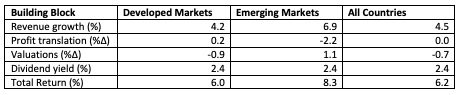
- The table below outlines Northern Trust’s building block expectations for developed markets, emerging markets and global equity markets as a whole.
Forward-looking statements and assumptions are Northern Trust’s current estimates or expectations of future events or future results based upon proprietary research and should not be construed as an estimate or promise of results that a portfolio may achieve. Actual results could differ materially from the results indicated by this information. Capital Market Assumption (CMA) model expected returns do not show actual performance and are for illustrative purposes only. They do not reflect actual trading, liquidity constraints, fees, expenses, taxes and other factors that could impact the future returns. Stated return expectations may differ from an investor’s actual result. The assumptions, views, techniques and forecasts noted are subject to change without notice.
Developed market equities = MSCI World; emerging market equities = MSCI EM; all country world equities = MSCI ACWI. Components may not exactly equal total return due to compounding.
The modest growth outlook articulated in our Mild Growth Myopia theme results in mid-to-lower single digit revenue growth across developed markets and high-single digit revenue growth in emerging markets. Meanwhile, our structural expectation for Stuckflation should allow developed market profit margins to remain elevated. When combined with the expectation for continued share repurchases, developed markets should experience positive profit translation. We believe valuations will remain elevated; we have projected only slight valuation contraction in both developed and emerging markets.
With rates rising, what’s your expectation for bonds? Have we finally seen the end of the bond bull market, or will rates eventually revisit their lows of July 2016?
The end of the 30-year-plus bull market does not mean the start of the next bear market. Our Mild Growth Myopia, Stuckflation and Pass/Fail Monetarism themes set the stage for short-term rates to move only modestly higher over our five-year horizon. We expect the U.S. Treasury yield curve to flatten as the Fed slowly increases its policy rate to a new, lower-than-historical neutral level (2.5% upper bound) in the first half of our five-year forecast period and then hold steady for the remainder of the period. This will put downward pressure on 10-year yields for which we forecast a 2.75% level. As such, and answering the question, our base case is for rates to remain relatively range-bound – neither moving materially higher nor retesting the July 2016 lows. Other yield curves globally should experience more of an upward shift, as opposed to a flattening, because of their expected slower path to the achievement of policy rate neutrality. We believe this upward shift in global rates will be generally less than is anticipated by forward market rate markets. Overall, investors should not be concerned about investing in fixed income in this environment.
A third asset class included in the CMA is real assets. How do you see them faring in the next five years?
While natural resources have consistently trailed global equities over the past ten years, we expect that ongoing global economic growth and better calibration between supply and demand should allow for outperformance over the next five years.
We believe global real estate will or should be supported by its exposures to term or interest rate risk, as well as credit risk, both of which we expect to be positive influences on the asset class. But negative investor sentiment remains as the real estate market is forced to respond to the more digitally based economy.
Global listed infrastructure can serve as a lower-risk asset class, but also a slightly lower-return alternative to global real estate for income generation. The public-to-private transfer of infrastructure projects has opened up a new set of opportunities.
And lastly, what’s your outlook for alternatives?
Private equity and hedge funds ave the ability to enhance risk-adjusted portfolio returns through nontraditional means.
Investors have questioned expected private equity return premiums, given higher valuations and increased asset flows to private equity funds. Higher private market valuations over the past few years have been mostly, but not completely, in lockstep with higher public market valuations. Increased asset flows are finding increased opportunities as companies stay private longer.
Hedge funds derive their value from the generation of “alpha,” defined as returns not explained by risk exposures already in the investment portfolio. For the average hedge fund, alpha has been persistently shrinking. Our low single-digit hedge fund return expectation assumes this low average alpha, but we recognize the dispersion across individual strategies. Manager selection is paramount.
Membership required
Membership is now required to use this feature. To learn more:
View Membership BenefitsSponsored Content
Upcoming Virtual Events View All













