Advisor Perspectives welcomes guest contributions. The views presented here do not necessarily represent those of Advisor Perspectives.
In one of the earlier articles in our series, we identified six distinct sources of competitive advantages. Our nine-part analytical series on the analytical framework for evaluation and assessment of economic moats is designed to develop a deeper understanding of different types of competitive advantages and an appropriate analytical framework. This is the sixth article in the series and focuses on switching cost as the source of a sustainable competitive advantage.
Warren Buffett on his acquisition of stake in IBM
Explaining his rationale for acquiring shares of IBM, Warren Buffett compared IBM to the auditors and law firms of a big company. The common thread among the three was the difficulty that the client faces in switching from one service provider to another. He said, "The IT departments… they very much get working hand in glove with suppliers. And that doesn't mean things won't change but it does mean that there is a lot of continuity to it. And then we went around to all of our companies to see how their IT departments functioned and why they made the decisions they made. And I just came away with a different view of the position that IBM holds within IT departments and why they hold it and the stickiness and a whole bunch of things”.
Defining switching-cost moats
Switching-cost moats, as the name suggests, exist when the customer faces significant costs in the process of switching from one service provider to another. The switching cost may emanate because the customer needs to incur these costs to ensure a smooth transition or could be driven by economic implications related to potential loss of business or inconvenience to the customer’s clients.
Switching cost-based moats fall squarely in the category of competitive advantages that arise from customer captivity. There are two primary forms of such captivity. The first one is a result of customer’s choices while the second one is a matter of barriers that the customer faces in leaving the ecosystem of the current supplier. In one, the customer chooses to be captive and in the other, it is externally imposed.
We classify customer’s choice-based captivity moats as consumer-preference moats; a moat type that was a subject of one of our previous articles. This article discusses moats where customer’s captivity is driven by barriers that the customer faces when switching from existing supplier to another one. Such moats are commonly known as switching-cost moats.
Analytical framework: Switching costs and sustainable competitive advantages
For switching costs to lead to sustainable competitive advantages, two critical elements need to be present: customer captivity and pricing power. These are the same factors that act as critical elements for consumer-preference moats. As discussed, switching cost-based moats fall in the category of moats that arise from customer captivity, i.e., the same category in which consumer-preference moats belong. The commonality of category drives the commonality of critical elements for the analytical framework.
This in turn raises an important question. Why have a distinct classification for these moats if the analytical framework shares the same driving elements? We offer two reasons. While the driving elements are the same, there are differences in ancillary factors that have a significant bearing on the application of the analytical framework. And two, there are important differences between the two type of businesses driven by differences in customer’s behavior towards these two class of businesses as in one case the customer chooses to continue using the same product while in the other one, her ability to switch is materially reduced.
The switching costs that give rise to truly dominant moats are not one-time costs. Instead, the customer continues to incur additional cost or suffers inconveniences over an extended period of time when switching from its existing supplier.
1. Customer captivity
The driving factor giving rise to switching cost-driven moats is customer captivity. Presence of switching costs reduces the customer’s willingness to switch its service provider leading to customer captivity. Such captivity may emanate from a multitude of factors including negative impact on the ability to service one’s customers, higher learning costs required to understand the new product, risk of business disruption during transition, or significant inconvenience caused to the customer’s clients.
As Buffett’s comments highlighted, such businesses are characterized by continuity and stickiness. Indeed, it is the existence of significant barriers to switching that have the result of eliminating viable alternatives that is the basis of such a moat.
Consider the case of Dassault Systemes. Dassault is a leader in the product life cycle management (PLM) software business with a 30% market share. As a provider of PLM solutions, Dassault helps its customers integrate data, processes, business systems and, people across the customer’s business. Dassault’s products allow its customer in managing this information throughout the lifecycle, from ideation, design and manufacture, through service and disposal.
Once implemented, these solutions become embedded in the customer’s product development and lifecycle management processes. The mainstream PLM industry is associated with extremely onerous switching costs, as employees need to be retrained, business processes need to be redesigned and migrated, and business disruptions have to be suffered. The extreme nature of switching costs associated with Dassault’s products came to fore when Daimler made a decision to switch its CAD system. In late 2010, Daimler announced that it will replace Dassault’s CATIA with Siemens PLM’s NX. The decision to switch resulted in a migration process lasted for nearly five years, resulted in large training costs as nearly 6,000 employees had to be trained, and caused significant disruption to Daimler’s supply chain.
Three years later, Dr. Siegmar Haasis, Daimler’s CIO of R&D compared the decision to an ill-advised walk he took with his children through the Grand Canyon. Haasis explained that the decision to switch its CAD system was made as the company faced a decision of having to choose between changing their PLM system and the CAD systems. In the end, Daimler decided that it would rather change its CAD systems than change its PLM systems.
2. Pricing power
The other important element for the existence of switching cost-based competitive advantages is pricing power. If the presence of switching cost does not provide the business with pricing power, the competitive advantage of the business will be minor to non-existent.
Presence of pricing power is important for two reasons. The ability of the business to charge a higher price provides the business with the ability to generate supernormal returns on capital. Two, existence of pricing power allows the business to pass on any cost inflation to its customers through price increase, letting the business maintain that supernormal profitability through business cycles.
So, what do we mean by pricing power? As we discussed in our article on consumer preference-driven competitive advantages, pricing power does not refer to an unlimited or unchecked ability of the business to raise prices at any rate that it desires. Indeed, the pricing power of a switching cost moat is limited by the extent of costs that the customer will need to incur to switch minus benefits derived from switching.
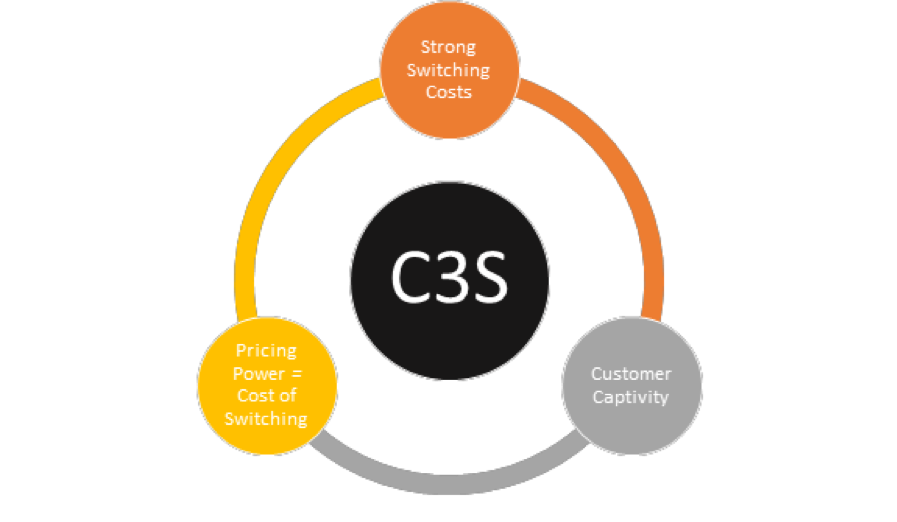
Figure 1 summarizes the key elements of our analytical framework concerning switching cost moats. C3S (Customer Captivity driven by Cost of Switching) refers to the internal ranking term used at MAEG to define switching-cost businesses.
Figure 1: MAEG’s analytical framework for switching cost moats

Analytical framework: Ancillary elements
In addition to the primary components of the analytical framework discussed above, the analyst, in her efforts to develop a fuller understanding of the business model of the company, should pay heed to additional factors as discussed below. What follows is not an exhaustive list of ancillary factors.
1. Retention rate
As discussed, the most important element of such moats is the customer captivity. Accordingly, the analyst should pay special attention to the retention rate of such businesses. If a business’s retention rate is 90%, it doesn’t mean that 10% of their customers switched to competing products/services. Some of those customers that did not continue with the company may have closed shop and thus did not need the product/service any more. The analyst should differentiate between attrition caused by customers going out of business vs. customers switching to competing products.
Customer attrition driven by the customer switching to a competitor needs to be critically assessed as it could serve as the first warning sign of reduction in switching costs faced by the customer as well as the availability of a viable alternative. If true, the extent as well as the durability of the moat of the business is at risk of disintegrating.
2. Market share of incremental business
An important element to be considered here is the business’s market share within the industry’s incremental volume. Once a business has built a moat, it cannot afford to rest on its laurels. To ensure that the competitive advantage that is currently enjoyed by the business will sustain in the future, the business needs to continuously innovate and ensure that it stays ahead of its competition.
A true moat doesn’t just retain and maintain its existing customer base, it successfully attracts additional customers/users. A business that is experiencing declining share of the industry’s incremental volume is a sign the business is failing to attract new customers. Over time, such a business will lose its competitive advantage as its existing customers will either end up switching or are driven out of business with the passage of time. Keeping track of the company’s incremental market share is extremely important with declining market shares serving as first warning shots of the possibility that the business’s moat is under threat.
Consider the case of Windows as an operating system. If we consider smart phones and tablets as part of the overall computing devices market, Windows’ market share of the incremental volumes declined significantly as smart phones and tablets increasingly accounted for a larger part of the overall computing devices market. As a result, even though the retention rate of Windows has stayed high, its competitive advantage narrowed.
3. Reduction in barriers to switching
The analyst should pay close attention to technological advances that promise to reduce the barriers associated with switching to alternative products. Consider the case of tax-preparation services. Before Intuit arrived on the scene, H&R Block’s tax-preparation services were associated with strong competitive advantages. As Intuit, over the years, managed to minimize the barriers associated with switching from a tax accountant to its DIY product for a meaningful proportion of U.S. taxpayers, H&R Block’s competitive advantage was meaningfully dented.
4. Long product lifecycles and exit barriers
Sometimes, the competitive advantage of a business is a result of very long product lifecycles associated with inability to exit from the initial investment leading to relatively insurmountable switching costs. In such cases, if the supplier is able to generate substantial aftermarket revenues, it will have endowed itself with a substantial competitive advantage.
Consider the case of MTU Aero Engines, an aircraft engine manufacturer. Aircraft engines have a very long life and are the most crucial part of an aircraft. Once an aircraft program is associated with a certain engine, buyers of the aircraft will be using the engine for the life of the aircraft. As the engines age, they require maintenance and create the need for spare parts. This in turn gives rise to a lucrative maintenance, repair and overhaul (MRO) business which MRU as the developer of the engine is able to capitalize on. Indeed, MTU frequently loses money on its initial engine sales as these sales create an extended period of profitable future business.
Application of the framework: Ansys, Inc.
Ansys is a developer of engineering simulation software for design analysis and optimization. The company was founded in 1970. The simulation software enables users to test products and predict how products will behave and how manufacturing processes will operate in real world environments. The software allows engineers to simulate multiple concepts before the manufacturing or design process is complete.
Ansys serves over 45,000 customers, and its software can be found in industries such as aerospace and defense, automotive, energy, healthcare, electronics, consumer goods etc. Nearly 600,000 licenses of Ansys’s software are employed by about 2,400 academic institutions spanning over more than 79 countries. This in turn supplies a steady stream of engineers that are trained in Ansys’s software.
Consider how an engineer designs a new product. She might begin by developing a physical prototype but the engineer might require to make changes after testing the prototype and it might result in several iterations before the final prototype is conceptualized. However, this adds cost and time to the product design and development process. The engineer can, instead of building prototypes, rely on the simulation software. The simulation software will allow her to create the product in virtual form on a computer. More importantly, the software allows her to test the product by simulating how it will actually work in the real world. These simulations can help engineers understand how failure could occur and how to correct the design to prevent it.
High costs to switching
Much as in the case of Dassault above, Ansys’s business is associated with switching costs which are similar in nature as that of Dassault. There are significant costs associated with training engineers in alternate software. It takes time for engineers to master new simulation tools. As discussed, Ansys’s simulation tools are used at the level of academic institutions such that they train engineers to use specific simulation tools. In addition, customers often have established complex workflows based on Ansys’s products with the company’s solutions being embedded in customer’s product development processes. Thus, switching from Ansys to a competitor’s product will likely result in disruption to customer’s business processes as they will need to be redesigned and migrated.
Significant benefits from using Ansys’s products
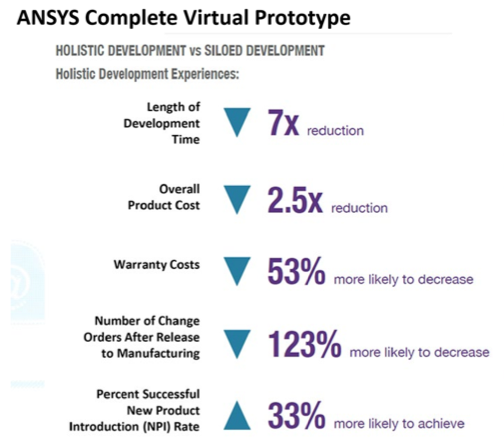
Ansys’s customers derive significant benefits. Simulation helps avoid product failures and do so earlier in the development process. This helps save significant costs to the customers as it is easier and less expensive to make changes early on in the development phase. Figure 2 shows that Ansys’s customers derive significant benefits by using its software.
Figure 2. Quantifiable benefits
Source: Ansys Investor Day 2016 Executive Summary Presentation
The benefit to the customer from deploying simulation software is not only in assisting the customer design and test its product but also in selling the product to its end customer as was illustrated in Pratt & Whitney’s case. Pratt & Whitney was able to leverage simulation to prove the performance of its key Geared Turbofan (GTF) engine to its customer and successfully showcased that the GTF engine can deliver over 15% improvement in fuel burn while reducing its noise footprint and carbon emissions.
Pricing power
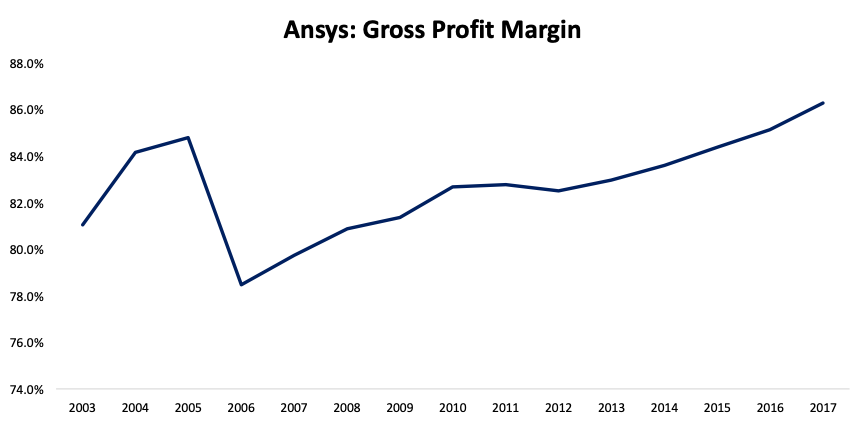
The high switching cost barriers that its customers face when combined with significant benefits they realize, endow Ansys with strong pricing power. The pricing power enjoyed by the company is evidenced in the persistently high levels of gross profitability of the company as is seen in figure 3.
Figure 3: Ansys’s Gross Profit Margin Trend
Source: Company data and MAEG
Market share of incremental business
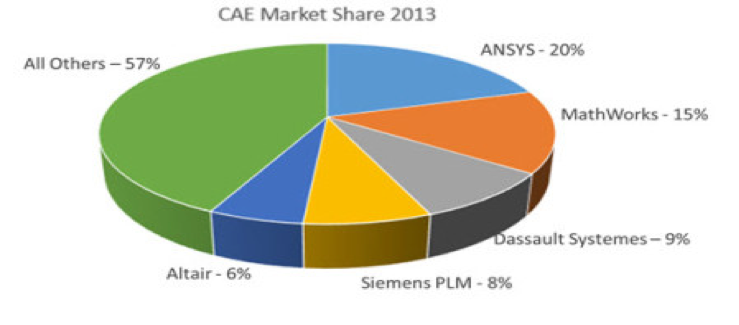
The company has a dominant 20% market share in the simulation and analysis software sub-segment within the overall PLM Industry. Figure 4 shows market shares of various players within the industry. As is seen, Ansys is the most dominant player followed by MathWorks and Dassault.
Figure 4: Simulation and analysis market share (2015)
Source: Henry Fund Research Report on CAE Software
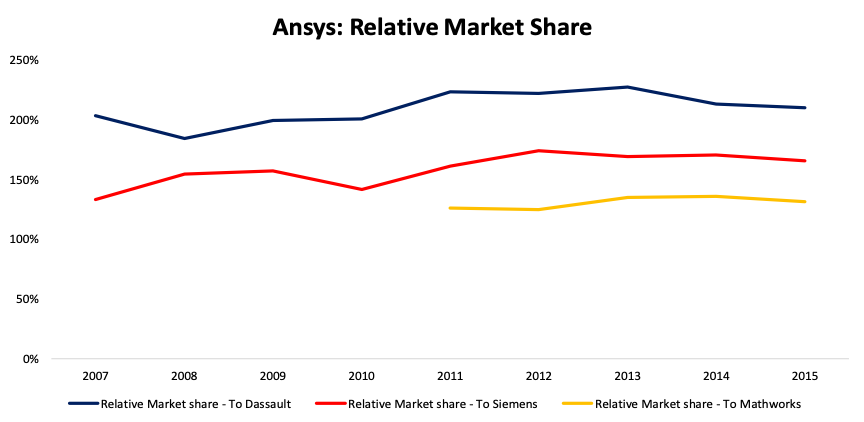
Figure 5 below shows relative market share for Ansys as compared to Mathworks, Dassault, and Siemens PLM between 2007 and 2015. As is seen, the relative market share of Ansys has stayed stable against all three companies suggesting that then company has continued to maintain its share of the incremental business.
Figure 5: Ansys’s relative market share
Retention rate
Ansys has very high retention rates with license renewal rates that exceed 95%.
Our analytical framework when applied to Ansys points towards a strong customer captivity driven by switching costs. Additionally, no deterioration in incremental share of the business as well as persistently high retention rates reiterate the strength of the company’s moat. Accordingly, we classify Ansys as switching cost-based moat.
Summary
While switching-cost moats share important attributes with consumer-preference moats, there are important differences that warrant a separate classification. When a business is able to embed itself in the customer’s business processes in a way that it becomes prohibitive for the customer to switch and the business is continually able to enhance the value realized by its customer, it ends up building significant competitive advantages. However, it is the presence of those ancillary factors that enhance the value proposition of the business and help it become a true moat; one that serves to protect and build value for its stakeholders.
Baijnath Ramraika, CFA, is a cofounder and the CEO & CIO of Multi-Act Equiglobe (MAEG) Limited and is the Executive Director at Sapphire Capital. As a portfolio manager, he manages the Global Moats Fund and the India Moats Fund. Contact him at [email protected]. Baijnath’s thoughts and ideas can be read at his blog at www.symantaka.com
Prashant K. Trivedi, CFA, is a cofounder of MAEG and the founder and chairman of Multi-Act Trade and Investments Pvt. Ltd.
MAEG is an investment manager and manages the Global Moats Fund, an investment fund that invests in a global portfolio of high-quality businesses with sustainable competitive advantages. Sapphire manages the India Moats Fund, an investment fund that invests in a portfolio of high-quality Indian businesses with sustainable competitive advantages.
Multi-Act is a financial services provider operating an investment advisory business and an independent equity research services business based in Mumbai, India.
More Alternative Investments Topics >