 We need to fight the virus before we open the economy, according to Larry Summers.
Summers is a professor at Harvard’s Kennedy School of Government. He is a former president of Harvard, and was Secretary of the Treasury under the Clinton administration. He is also an economic advisor to the Biden campaign. He spoke via a webinar to Harvard Business School alumni on April 20.
The pandemic was not a great surprise, he said. He believes that this will be the century of global health, like the previous century was one of advancements in physics. He was asked if our response to the virus is running the risk of creating unnecessary economic hardship. But, he said, those who frame the question that way miss two fundamental issues. It is not our policy that ruins our economy; it is the disease itself. “When we are hiring trucks to move bodies to the morgue,” he said, “not many people are going to go outside.”
We can’t blame the economic contraction on the policies, according to Summers.
Second, he said, we can create a near-term bit of growth by relaxing our protocols. But if that unleashes a second wave of cases, we will lose in the long term. There will come a point when it is right to open the economy, he said, but no reasonable person thinks it is this week or next week.
If we were better at lockdown, we would be able to move out of it faster. But, many in the country are fighting for liquor stores and nail salons to be classified as essential businesses, undermining that goal.
If we had a more competent federal government, Summers said, we would rely on it more, especially on issues like sourcing ventilators and masks. But the more there are regional differences, the more it makes sense to have localized policies. However, federal oversight would be more effective.
Summers doesn’t think we will exit lockdown safely. It won’t be a steady march from “darkness into light,” he said. There will be a series of movements and missteps. If there are no protests, it will mean we probably aren’t moving fast enough.
“It will be a quite a while before we see a large number of people in a small place,” he said. “That won’t happen in 2020.”
A collapse of the global system
He is worried about the collapse of the global system, particularly the U.S.-China relationship devolving into a new Cold War. The virus should have pushed the U.S. and China closer, but the opposite is happening.
On a second level, he is worried that the U.S., which he said can do “extraordinary things,” will suffer economically and from a loss of life because it cannot produce and provide for basic medical needs, like swabs and testing kits. He is worried that there will not be clear enough thinking and adequate systems to provide funding for those who need it.
Summers was critical of some of the aspects of the payroll protection program (PPP). Hedge funds should not be eligible for the PPP, he said, nor should HBS professors who run small consulting practices. He also objected to Boeing getting money that isn’t at the expense of shareholders.
But a small pizza business should get the money to support its employees, he said. For the smallest business, the government should be willing to lose money.
There has been an “excessive view” that we should save every business and every job, Summers said. In a typical year, a third of the jobs in the U.S. are vacated. In the best of times, we don’t provide for continuous employment. We need to put a lot of money toward stimulating purchasing power and supporting working income, he said, supporting state and local governments to support the needy.
But we don’t need to put grant money toward large numbers of companies on a large scale, according to Summers. The government should be a “preferred creditor” where possible, even taking equity stakes. The government made money on the TARP program during the financial crisis, and it should do so here where appropriate.
“Capitalism should be allowed to serve its primary function,” he said. “We should not abandon market principles.”
Summers made a historical analogy to the Fed’s response to the crisis. What we did this year was like climbing the Himalayas, he said; 2008 was like ascending the Rockies, and everything else was like the foothills of Vermont. He would have done things very much like the Fed did. But when we are in “whatever it takes” mode once a decade, he said, there needs to be a lot of soul searching and thinking about how the financial system is functioning. He wonders about a world where the Fed is buying high-yield ETFs.
There was a heated argument about the decision whether the Fed should or could have bailed out Lehman. We are far, far beyond that, he said, in terms of the Fed’s intervention in the economy.
In terms of fiscal support, we are closer to the post-Pearl Harbor period than to the financial crisis.
“When you are scared for your life to go shopping,” he said, “it’s nearly impossible to get the economy going.”
When we get the health issues under control, the economy will recover faster than people think.
If we put the health problems credibly behind us, then we will be able to engage in the planning necessary for recovery. But he isn’t sure that will happen, because he is not confident the requisite planning is being done.
Are we sowing the seeds of inflation?
He thought in 2009 and 2010 that those who were worried about inflation had not done a good job in their economic studies. They should have understood that when money pays interest there isn’t the same need to disgorge it quickly. Also, the Fed had tools to manage interest rates to contain incipient inflation, he said. Those who were warning of inflation then were “basically foolish,” he said, and history has proved that view correct.
This time is more complex because there is a supply shock. The production of the economy is much lower. But we are doing a great deal to boost demand. “I would guess that we are heading into a continued disinflationary period across the world,” he said. This crisis has done more to reinforce his view of global deflation.
But the risks of inflation are higher than they were three months ago, he said.
There will be more uncertainty and it will increase savings and reduce investment, according to Summers. Those factors will reinforce the “secular stagnation” arguments he has been making for a couple of years. That will mean more “bubble risks,” he said, like those related to debt-financed share repurchases by corporations.
The crisis will reinforce the “demassification” of the economy, Summers said. More virtual conferences, more e-commerce, a reduced need for office space, and more home offices will develop and that will reduce the neutral real interest rate, which will become negative. “It will be harder for central banks to create inflation,” he said.
Most of the policy action will be in things that blur fiscal and monetary policy – like the Fed buying junk bonds. “We will live in a world of more hybrid policies,” he said.
State and local governments should be supported by the federal government, through grants or Medicaid support or by relaxing the balanced-budget requirements. During a downturn, it may be a good idea to invest in infrastructure. But it is not a time to stop investing or for local hospitals to tighten their budgets. This would also be a good time for the federal government, since it is providing money, to improve policies in those areas.
“Don’t stop funding when revenues are their least and needs are the greatest,” Summers said.
He was asked whether the U.S. stock market had accurately reflected the economic consequences of the virus. The general experience is that serious recessions come with serious market downturns, he said, and, “15% we are experiencing now is not serious.” There will be many false dawns, as there were during the Great Depression and during the financial crisis. For reasons that economists can debate, the evidence is pretty strong that recessions don’t allow you to get back to the previous GDP growth trend line. That was true following the financial crisis and following other recessions.
“We will have a substantial, modestly sustained market decline,” he said. He was surprised by the bounce from the market bottom that occurred starting March 23. The Fed can matter for a while, he said, but it can’t matter forever.
Given those circumstances, he is skeptical that the worst is past and all is well, or that an omniscient market is justifying economic optimism.
A worst-case scenario
He was asked what the worst case scenario, at the 95th percentile of the left end of a probability distribution, might look like.
It is some combination of a bad outcome on the health side (no vaccine and no post-infection immunity) and that there is continuing morbidity, he said. Whatever the policy is, he said, nobody wants to socialize. Second, there is cascading financial failure, because, for example, no major retailer is paying rent, nor are some major Wall Street firms. People won’t pay mortgages, credit cards or car loans. Substantial non-payment problems could lead to substantial distress.
Moreover, there could be “vast potential trouble” in the non-China emerging markets, which have had a timid response compared to developed markets to the virus. Lack of health care, inadequate institutions and no export markets will cause emerging markets to suffer “brutally,” he said. He said he was wrong to some degree in his prior views about globalization, and that self-sufficiency will resurge. Davos, a gathering of thousands of the world’s elite in a congested place, “may be doomed.”
Third, there could be uncertain and highly toxic politics that cause Americans to lose confidence in traditional institutions.
Those three worries together, he said, could manufacture a “really dark perspective.” But that is not his best guess as to what will happen. “Our history is that we can overcome those obstacles,” he said. “But it’s much easier to lay out a disastrous scenario now than in December 2008.”
If Trump wins, there is no guarantee that we will maintain our liberal democracy, according to Summers. Any thoughtful study of history leaves the lesson to never say “never.” When he was an economics student in the 1970s, he studied liquidity traps as a purely hypothetical exercise. Now, that is a real issue, but students regard double-digit inflation as similarly hypothetical. The capacity for self-denying prophecy gives him the confidence to believe our democracy will survive.
The survival of the EU or the euro is less likely than before the crisis. The degree of heterogeneity among countries has gone up, he said, as has support for radical policies. Support for free movement has gone down. But that doesn’t mean the risks of a breakup are high enough to be likely, he said.
How businesses respond to crises
He was asked how businesses, including Harvard, should respond to this crisis.
The question is whether universities will respond in the ways good or bad businesses respond to tough times, he said. Bad business cut costs across the board and cut the visible discretionary spending, which he called, “a strategic removal of the butter from every piece of bread.”
Good businesses do some of that, he said, but then they do three other things. They think about things that were right to do before the crisis, but they didn’t have the courage to do and use the excuse of the crisis to take action. Second, if you are a leader, you recognize your strength is stronger in a crisis. So you acquire people, entities or markets and see it as a strategic opportunity. Third, you identify some aspect of the situation that enables you to play “offense instead of defense.” Harvard has an exceptional brand and needs to take advantage of on-line learning to a much greater degree than it did before, he said.
Good leaders are never satisfied, and never miss an opportunity to contribute or mentor someone else, he said. They are loyal to the people who are loyal to them, even when it is not easy, and want to grow and learn.
Summers concluded with a number of positive outcomes from the crisis.
He hopes we will live with less frenetic travel and with more of the personal interaction we are having now, with more family time and a bit more of an appreciation for our common humanity across the country and across different parts of the world.
He said that there was a complete failure of the institutions that allowed the crisis to escalate, and that a market-based theory is insufficient. A market-based economy requires strong public sectors, which is a death knell to libertarians and the Reagan-Thatcher ideology. He hopes there is a wake-up call to recognize that politics can’t be merely “an articulation of feelings.” This crisis should lead to a broader appreciation for calm, rational competence, he said.
More ETF Topics >
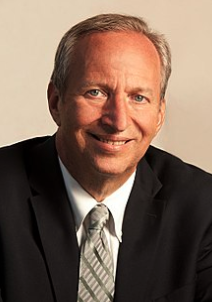 We need to fight the virus before we open the economy, according to Larry Summers.