Looking to Evolve Your Business? Avoid This Common Mistake
Membership required
Membership is now required to use this feature. To learn more:
View Membership Benefits Advisor Perspectives welcomes guest contributions. The views presented here do not necessarily represent those of Advisor Perspectives.
When failure isn’t an option, neither is progress.
We need to progress to grow, because what got you here won’t get you to your desired future state.
Growth is cyclical – try, learn and progress. In an ideal state the process is – try and progress – you get it right the first time and never have to iterate. But the ideal state is unfortunately not realistic.
The cycle of growth
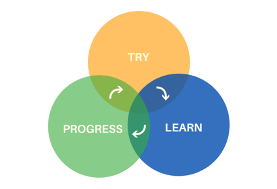
To try is to initiate change or progress towards a goal.
To learn is to be open to feedback, to use quantitative and qualitative data to iterate and inform future attempts. To learn is to not just be open to failure, but to seek failure as essential information.
To progress is to advance or improve in a way that positively impacts your outcomes.
The hardest part of the growth cycle is the anticipated and actual learning
If we look to an example, it’s clear how this cycle works and how we can easily get in the way.
I was running a sales strategy team and was tasked with reaching a small subset of financial advisors who were affiliated with a specific firm. We didn’t have all of the data we normally would use to target, and our ability to use email was limited due to their firewall.
The marketing team I was working with suggested using advertising to reach these advisors.
The firm was not fond of advertising as a marketing strategy. Previously, they had spent a lot of time and money on advertising to little success. We knew it’d be an uphill battle to get consent, but we also saw the opportunity to be very targeted, to reach the right advisors by partnering with a digital marketing expert and by using retargeting tactics. Due to limitations (limited email capacity), we needed to try a new approach.
In order to get permission to try we had to be mindful of existing prejudices and frame realistic expectations.
We ended up framing the digital advertising tactic as a short-term and low-risk experiment. We were clear it may not work, but it was worth the risk and resources. We educated the team on why it strategically made sense, how we were going to tactically execute and committed to share our learnings (good and bad) weekly.
It worked – we could try! With the expectation that this was a short-term experiment, we tried, learned, iterated and progressed (and in this case succeeded in reaching the right advisors and “warming the door” to sales calls). This experiment changed the firm’s perspective and use of advertising in support of growth. Through this effort, we progressed as a marketing and sales team, and as a firm.
If we had never been able to try a new tactic, the firm would likely be using the same tactics with limited success. If we had not set the expectation that there may be failure, and that that was okay (because we were going to quickly learn and evolve), we would have played it safe and downplayed the learning. Instead, we amplified the learning. Learning became expected and welcome versus disappointing.
Three symptoms of a fear of learning (a.k.a. failure)
In my experience working at an RIA, asset manager and now as a business consultant, I see too often three negative outcomes from an unhealthy relationship with the learning stage of a growth cycle.
If a business or individual doesn’t value or has an aversion to learning from failure or sub-optimal results, they will often:
- Avoid failure by not trying;
- Half-heartly engage to minimize perceived failure or loses; and
- Overextend the efforts due to sunk-cost bias.
The learn phase is supposed to inform, ideally early and often. Failure provides great information. Anytime you’re doing something new, you naturally want to minimize failure. But to progress you need to make sure to make some room for it.
As you look to the future and see an evolved version of yourself or your business, be aware that you will need to learn (and fail) to get there. There are no guarantees or easy buttons in life or business.
If someone promises you guarantees success, run the other direction.
If you are comfortable cutting your losses or taking the safe road, that’s fine as long as you’re also okay with safe and slow progress. To make a quantum leap in your life or business, here are five steps to help reframe how to take action towards progress.
Five steps to create space to innovate
- Get crystal clear on the ideal outcome(s).
- Seek outside perspectives and expertise.
- Set realistic expectations with yourself and your team – we expect some failure, that’s okay as long as we learn from it.
- Use low-cost and low-risk experiments to try new tactics to align well with your goals.
- Have a framework to measure effectiveness, learn and iterate as needed.
Big risks can deliver big rewards. However, there are ways to take risks in relatively safe or controlled ways.
Next time you think about your future firm and how you’re going to be serving larger clients or delivering a digital experience, don’t stop at the dream. Move towards your dream with intention using those five steps to innovate.
As long as you keep trying and learning, you will progress toward your goals.
I partner with RIAs and financial professionals looking to unlock their potential. Outsourced CMO, sales and marketing strategist, accountability partner, change maker – those are some of the names I’ve been called over the past 15 years. If you are looking to take your business to the next level, I’d love to help. Learn more resources at www.shaunamace.com or contact me at [email protected].
Membership required
Membership is now required to use this feature. To learn more:
View Membership BenefitsSponsored Content
Upcoming Virtual Events View All