Gundlach – We Will See 9% Inflation in 2022
Membership required
Membership is now required to use this feature. To learn more:
View Membership Benefits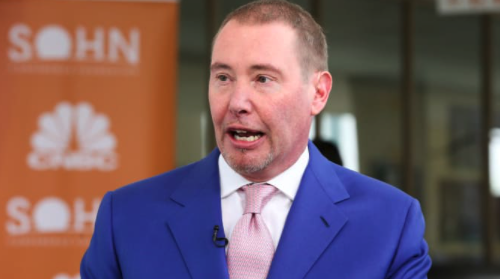 Headline inflation will breach 9% this year, according to Jeffrey Gundlach. That will force the Fed to aggressively raise the Fed funds rate.
With the nominal Fed funds rate near zero and inflation at 7.5%, the real Fed funds rate is -7.4%. It hasn’t been that low since the 1970s. With commodities up significantly, he said, “the inflation rate will not peak at 7.5% and could certainly be 9% and maybe 10%.”
“If we get 9% CPI,” Gundlach said, “I can’t possibly see how the Fed will pull back on fighting inflation.”
Gundlach spoke to investors via a webcast, which he titled “Convoy,” and the focus was on his flagship total-return fund (DBLTX). Slides from that webcast are available here. Gundlach is the founder and chairman of Los Angeles-based DoubleLine Capital.
The title of his talk was originally meant to relate to the convoy of Canadian truckers protesting COVID restrictions. Gundlach was struck that the normally “gentle” Canadians would protest in that manner. More recently, he said it related to the runaway rise in commodities prices.
But it now signifies the darker image of the 40-mile Russian military convoy stalled outside Kyiv.
Inflation woes
The Fed has been ineffective at fighting inflation he said. As a result, bonds are “incredibly” overvalued with nominal rates at 1.85% and inflation at 7.5%.
Everyone expects the Fed to be deeply committed to being “on the job” to stop inflation, he said, and the Fed is hearing that message.
The headline CPI of 7.5% will be where we end the year, he said, making it two years in a row with high inflation. “It will make the Fed’s 2% target look laughable.”
Ports remain congested on both the east and west coasts, he said, which is another reason not to expect a rapid relaxation of inflation. It will also be hard to recruit truck drivers, Gundlach said, which is partially due to the trends toward robotization and driverless vehicles. Nobody wants to train to be a truck driver if their job will be obsolete in a decade.
Inflation is a global phenomenon and for foreigners, it is more problematic, as their currencies are depreciating relative to the dollar. The DXY (“Dixie”) trade-weighted index of the dollar has risen by several percent since the start of 2022.
Home prices remain strong, he said, with about 20% annual growth based on the Case Shiller index. But the CPI shelter index is up only 4.2%. Apartment rates are up 10% annually. Housing inflation will “start bleeding into inflation,” he said, “and offset improvements in the supply-chain disruption.” (For an alternative take on this issue, go here.)
Wage inflation is on the rise, he said, and the evidence is “everywhere.” Gundlach said that Taco Bell is hiring cashiers at $21/hour. Wages are now rising for all age cohorts, which was not happening six months ago.
Wage growth has been greater than mortgage rates, which has kept home prices affordable and helped the housing market. There is now only 1.6 months of home supply on the market, the lowest level since 2000.
The Fed funds rate has been very highly correlated to wage growth, usually moving before it. But not this time; wage growth is 4.5% and the Fed has been slow to respond, Gundlach said.
The markets react
Gundlach referred to the “bloodless verdict of the market,” which he said has been “horrific,” driven by oil at $120/barrel. Virtually all asset classes, except real assets, have suffered losses in 2022.
All corporate bonds have suffered losses, and it has been even worse for emerging market debt, which includes Russian bonds. Stocks are down about 13% (the Nasdaq is down 18%), but emerging market equities have done better, down “only” 12%. The world equity index is -13% year-to-date, and “there is nowhere to hide,” he said.
The big signal from the bond market is that the two-year yield is up more than 80 basis points since the start of the year which Gundlach said implies six rate hikes over the next couple of years.
Japan and Germany now have positive 10-year yields for the first time in several years, he said.
The economy is “really screwed up,” Gundlach said. The PCE data for consumption of services and durable and non-durable goods were all close one another until the pandemic. But since the pandemic durable consumption has risen, implying that consumer purchases were pulled forward. With commodity price increases, there will be demand destruction, he said. “Money will go to food and energy.”
“There has to be a payback for this,” Gundlach said, implying that durable goods consumption will slow dramatically.
The yield curve has flattened, he said, and that “somewhat corroborates a recession.” That view is backed up by weakening consumer sentiment, he added.
The trade deficit was stable for eight years until the pandemic but has nearly doubled since then.
There is a big fiscal drag, he said. Since the pandemic-stimulus programs wound down, the fiscal policy contribution to GDP has been negative.
Employment has not made it back to its pre-pandemic job level; no net new jobs has been created since the start of the pandemic. But jobs are plentiful, and unemployment is low, at 3.8%. That gives the Fed more leeway to raise rates. The labor force participation rates are still about 1% below pre-pandemic rates, which Gundlach attributed to people still living off stimulus payments.
Crime is rising, he said, in part because of lax policing policies. He said that in Los Angeles new mandates state that thefts of less than a certain amount will not be prosecuted.
He commented on the Ukrainian situation and criticized the U.S. for not providing enough weapons and support prior to the invasion, and for holding out the promise of NATO inclusion.
Asset class valuations
Gundlach commented on valuations for several asset classes.
The dollar is highly correlated to the slope of the yield curve in the short term, he said. As the yield curve has flattened, the dollar has strengthened. In the long term, though, it is correlated to the twin deficits, which forebodes a weakening dollar.
Emerging market equities are very cheap, valued at less than half of U.S. markets, he said.
European equity markets have been challenged over the last several weeks, allowing the U.S. to outperform.
When the dollar finally “buckles under the weight of the twin deficits,” he said, which could be triggered by the next recession, it will signal U.S. underperformance relative to emerging and European markets.
Another trend that is reversing is the Nasdaq outperformance relative to the S&P 500.
From 1994 through 2011, the performance of the Bloomberg commodity index, the Barclay Lehman “AGG” and the S&P 500 were roughly the same. But since 2011, commodities struggled and the S&P 500 has been up 400%, It was because of zero interest rates, he said, which helped equities and “risk assets.” “When the government gets involved in markets, it creates asset price inflation.”
Commodities have been “absolutely on fire,” Gundlach said, especially since early 2022. But, he said, a big up move in commodities, especially in energy, is typically a catalyst and a cause of a recession. “This is not bullish for consumers,” Gundlach said.
We are getting more concerned about the potential for recession,” he said.
The 2-10-year yield curve spread has gone from 150 basis points to almost zero over the last few months. If it goes to zero, he said the chance of recession in the following months goes up to a “very high percentage.”
This year, corporate spreads are widening, while Treasury yields have risen. Credit conditions are wreaking. But default rates are non-existent, thanks to stimulus policies and refinancing. But Gundlach did not say corporate bonds were cheap enough to recommend buying them.
Gold has started to “shine,” he said, which is impressive given the strength of the dollar. But he said he “doesn’t think it is a buy.” Commodities are a better investment and inflation hedge. Over the long term, he is bullish on gold, consistent with his long-term bearish view on the dollar.
Beyond the next recession
Gundlach concluded his talk with an ominous prediction for the U.S. following its next recession.
With the next recession, he said, we will not be able to go back to “1995 economics.” That was the last time the Fed used conventional policies to stimulate the control of the economy. Now it relies heavily on tools like quantitative easing, asset purchases and zero interest rates.
We will need a new “basic economic system,” he said, with a “reset.” That will include a change in economic policy, tax structure, controls on financial institutions, prevention of identity theft, and political institutions that are more responsive to citizens.
The next recession will “lay all of that bare,” he said. “We will fight the next recession with the same tools,” he said, but that will usher in a time when those policies will be abandoned.
Robert Huebscher is the founder and CEO of Advisor Perspectives.
Membership required
Membership is now required to use this feature. To learn more:
View Membership BenefitsSponsored Content
Upcoming Virtual Events View All













