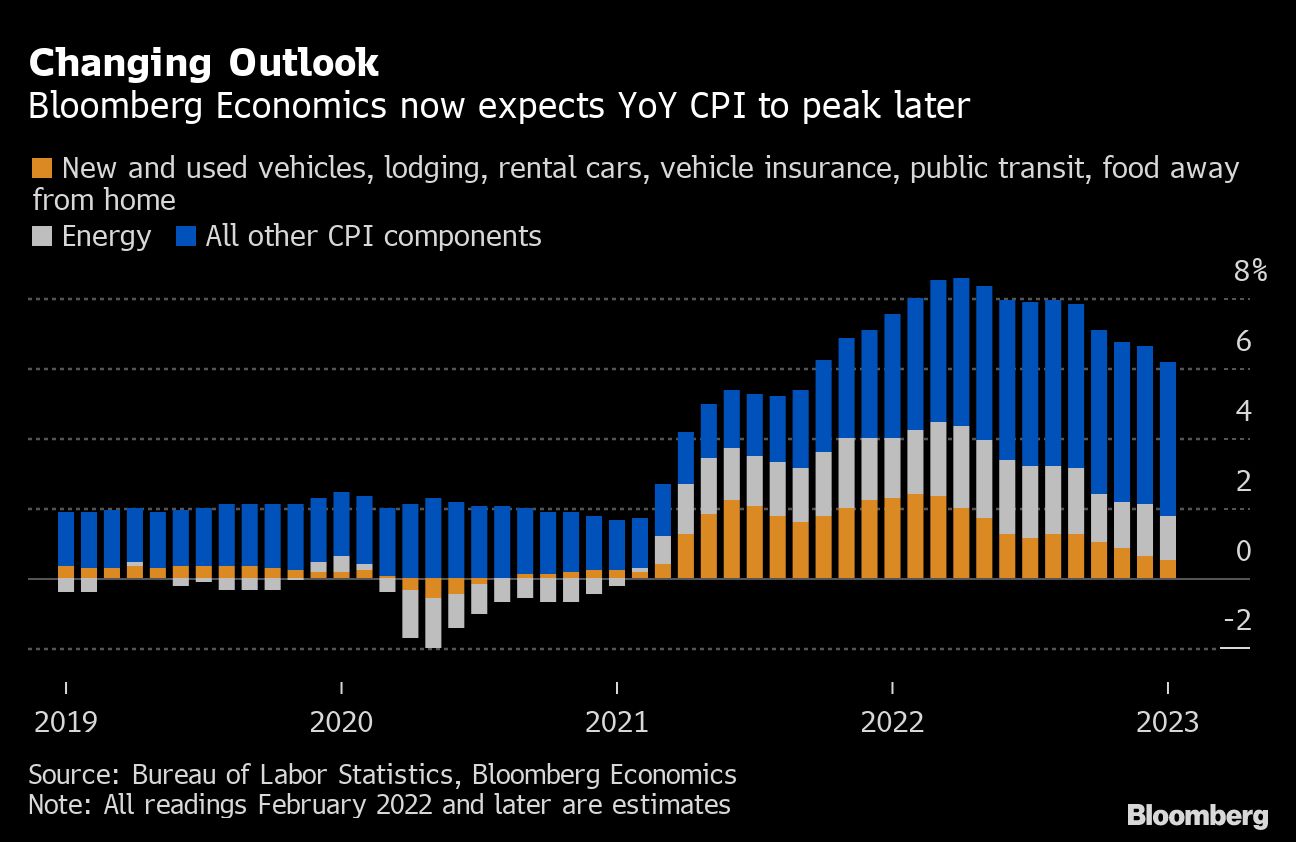
A few weeks ago, many economists were eyeing February as the peak in U.S. consumer inflation. Now it’s looking more like a fresh baseline.
The consumer price index, due Thursday, is forecast to accelerate to a 7.8% increase in February from a year ago, which would be the most since 1982. But economists are now saying it could peak somewhere in the 8%-9% range this month or next, as the invasion of Ukraine and severe restrictions on the Russian economy send the prices of staples like oil and food soaring.
“There’s going to be a lot of noise in the next six months that’s going to be extremely difficult to disentangle,” said Omair Sharif, founder of research firm Inflation Insights LLC. “If you thought it was difficult to figure out what used car prices were doing and whether that was transitory, multiply that by a thousand.”

Americans are already grappling with decades-high inflation that’s outpacing wages and only going to get more painful. The war has sent already rising food prices to a record and the average price of gasoline to an unprecedented $4.25 a gallon. Fuel costs are poised to continue climbing after the U.S. said it will ban imports of Russian oil.
While some economists concede the oil shock will dent U.S. growth, it’s likely not enough to completely derail the recovery, which is still supported by a strong job market and easing Covid restrictions. Though the Federal Reserve is set to raise interest rates next week for the first time since 2018, soaring energy prices add uncertainty to the central bank’s rate hiking cycle over the coming year.
Thursday’s CPI report will catch some of the recent surge in oil prices, but most of that impact will be registered over the coming months. It’ll also give a good indication of the direction of prices for things like cars, home furnishings and housing that had been contributing to higher inflation before the war. Shelter costs, including rent, have been rising steadily and the trend is expected to continue for the foreseeable future.
Bloomberg’s monthly survey of economists conducted March 1-7 showed respondents now expect year-over-year CPI gains to average 7.7% in the current quarter -- up from 7% in the February survey. They expect the CPI to be up 4.5% in the final three months of the year, more than a percentage point higher than last month’s forecast.
In the last week, the cost of regular-grade gasoline has jumped a record 60 cents a gallon. Food prices are also surging, as the war disrupts exports out of the Black Sea region that’s known as the world’s breadbasket.
“While higher food-related commodities on their own would not have as big of an effect on overall inflation as a similar rise oil prices, they come at a time when consumers are already facing steep price increases,” Wells Fargo & Co. economists including Sarah House said in a note. “Food is a purchase that cannot be put off.”
Together, food and gasoline make up nearly a fifth of the average consumer basket, a share that rises for lower-income households. On top of greater costs for food and gas, Americans are also simultaneously dealing with higher rent and utility bills.
When families have to spend more money on necessities, they have less to spend on discretionary items and services. Economists at Barclays Plc expect the spike in energy prices to subtract an annualized 0.3 percentage point from consumption growth on average per quarter through the end of 2023.
Consumers tend to be particularly aware of changes in gas and grocery prices, the war and a sharp increase in fuel prices will take a toll on confidence. U.S. consumer sentiment -- as measured by the University of Michigan -- is expected to fall to a fresh decade-low in early March when that data are released Friday.
“That said, the U.S. economy has become much more resilient to changes in oil prices versus decades past,” the Barclays economists wrote in a March 3 note. And “fortunately, the shock to energy prices is hitting when the U.S. economic recovery is on relatively solid footing.”
What Bloomberg Economics Says...
“Before the war, Bloomberg Economics had expected year-on-year CPI inflation (due Thursday) to peak in February... The current surge in energy prices, and emerging signs that supply-chain bottlenecks are intensifying again, led us to revise our forecast for the year. We now expect inflation to touch 8% in February, and -- depending on geopolitical developments in Europe -- it could peak at 9% in coming months.”
-- Anna Wong, Yelena Shulyatyeva, Andrew Husby and Eliza Winger, economists
The U.S. added 678,000 jobs last month, and the unemployment rate is nearing its pre-pandemic level. Covid-19 infections have fallen sharply from the omicron surge in January, and local governments across the country are easing pandemic restrictions.
And while pandemic aid programs have wound down, consumers are still sitting on a sizable pile of excess savings in the aggregate. The downside is that wages aren’t keeping up with inflation and may decline further.
“The hit to consumers’ wallets from the run-up in gasoline prices so far will be noticeable but not likely to come close to killing the expansion,” said Stephen Stanley, chief economist at Amherst Pierpont Securities. “Meanwhile, the inflation impact will be substantial, adding to the acceleration of prices that was already in place.”
Bloomberg News provided this article. For more articles like this please visit
bloomberg.com.
Read more articles by Reade Pickert, Olivia Rockeman