The Belkin BR2 Report is designed for the Registered Investment Advisor community. It is a weekly report hosted on the www.hyperpyron.com website. The work is posted weekly and emailed to subscribers. Direct Link here: BR2 Report
The annual cost of the report is $2500.00 per annum. We have a limited time offer for Advisor Perspectives readers and Listeners. Please enter the code”PERSPECTIVES” (Case Sensitive NO QUOTES) where it asks for a coupon under the one year subscription and the annual cost will be reduced to $2200.00 USD.
This is a shortened version of the Weekly Belkin Report. If you have any questions please feel free to contact Marc Mishkin at +01 646 435 4440 or email: [email protected]
Press Clips: Fed Incompetence, Record Outflows, Big Money Dumps Stocks To Retail, Gold & Commodities Zoom
Yahoo Finance Mar 3 - Fed Chairman Powell: 'We Should Have Moved Earlier'
“We should have moved earlier,” Powell said Thursday. When inflation began popping in early 2021, the Fed brushed the figures off as "transitory" and hoped that supply chains would alleviate and slow further price increases.
Bloomberg Mar 4 - Europe Stocks See Biggest Ever Weekly Outflow as War Intensifies
European equities had their largest outflows on record at $6.7 billion in the week to March 2, the strategists wrote, citing EPFR Global data. The redemptions from the region caused the first outflow in 10 weeks for global stocks to the tune of $5bn
Bloomberg Mar 7 - Morgan Stanley and Citi Strategists See Equities Storm Forming
Citi strategists led by Jamie Fahy said a global gauge tracking analyst estimates on corporate profits has turned negative for the first time since September 2020. This is a potential “game-changer,” eroding their conviction on the prospects of risk assets, they wrote. Earnings delivery is “paramount” at a time when liquidity is being sucked out by central banks across the world, the Citi strategists said. “Removing this support could leave some indices floating on air.”
Bloomberg Mar 4 - Big Money Unloads Stocks as Retail Traders Buy in Spiraling Market
Evidence comes in a report by Goldman Sachs Group Inc.’s prime brokerage, which found that over three days, hedge-fund clients unwound risk at the fastest rate in three months in cumulative dollar terms. At the same time, flows tracked by JPMorgan Chase & Co. showed retail traders bought $4.1 billion in the week through Tuesday, with money sent to S&P 500-linked ETFs more than 2 standard deviations above the 12-month average.
UK Telegraph Mar 6 - One-In-10 Chance Of Nuclear Apocalypse ‘But Keep Buying Shares’, Says Investment Firm
A financial research company has raised eyebrows by saying there is a 10pc chance of civilisation being destroyed in a nuclear apocalypse – while urging clients to keep buying shares regardless. BCA Research, a Canadian business, told clients to “stay bullish” on stocks and “largely ignore existential risk” as their investments will become “irrelevant” if the Ukraine crisis leads to nuclear armageddon. Peter Berezin, chief global strategist at BCA, wrote: “Despite the risk of nuclear war, it makes sense to stay constructive on stocks over the next 12 months. You should ignore existential risk.”
Bloomberg Mar 7 - Tiger Global’s Loss This Year Widens to 23% After February Swoon
Chase Coleman’s Tiger Global Management posted a 10% decline for its flagship hedge fund last month, a significantly steeper drop than the broader market, according to people familiar with the matter. That follows a 14.8% swoon in January, extending its loss for the year to 23%. The smaller Tiger Global Long Opportunities Fund, which primarily makes bullish wagers on equities, declined 11% in February, the people said. A spokeswoman for the New York-based firm declined to comment. Together, the funds manage about $35 billion. Their biggest U.S. holdings at year-end were JD.com Inc. and Microsoft Corp., which both dropped about 4% last month.
Bloomberg Mar 4 - Stock Market’s ‘Denial Trade’ on Russian Invasion Is Buckling
Equity markets have come round to the idea that Russia’s invasion of Ukraine could have long-term consequences for the global economy. “It is interesting that the market did not believe that the war would start a month ago, then we did not believe that it would escalate past Donetsk and Luhansk, so, it is a bit of a denial trade,” says Marija Veitmane, State Street Global.
Bloomberg Mar 4 - Gold Set for Biggest Weekly Gain Since 2020 as War Boosts Havens
Gold headed for its biggest weekly gain since July 2020 as the war in Ukraine fueled demand for haven assets. Investors have sought out bullion amid the uncertainty, with holdings in exchange-traded funds backed by the metal climbing to the highest since March.
Bloomberg Mar 4 - Commodities Post Record Weekly Gain of 13% on Ukraine War
The Bloomberg Commodity Spot Index, which tracks 23 futures contracts, climbed 13% in the week ended Friday. That’s the most in data going back to 1960.
Business Insider Mar 2 - Bets Against Energy Stocks Are At The Highest In More Than A Year
Short interest in energy stocks is the highest since December 2020, S&P Global Market Intelligence said Wednesday.
Bloomberg Mar 2 - Oil Shock May Push More Foreign Funds Out of India, S. Korea
With Brent crude crossing $110 a barrel, that clouds the outlook for two of Asia’s larger oil importers -- which are also home to the region’s worst-performing currencies this year. While stocks in Mumbai and Seoul have already taken hits from concerns over Federal Reserve interest-rate hikes and a related technology selloff, analysts see both as more susceptible to risk-off sentiment.
How Far Could Stock Indexes Fall?
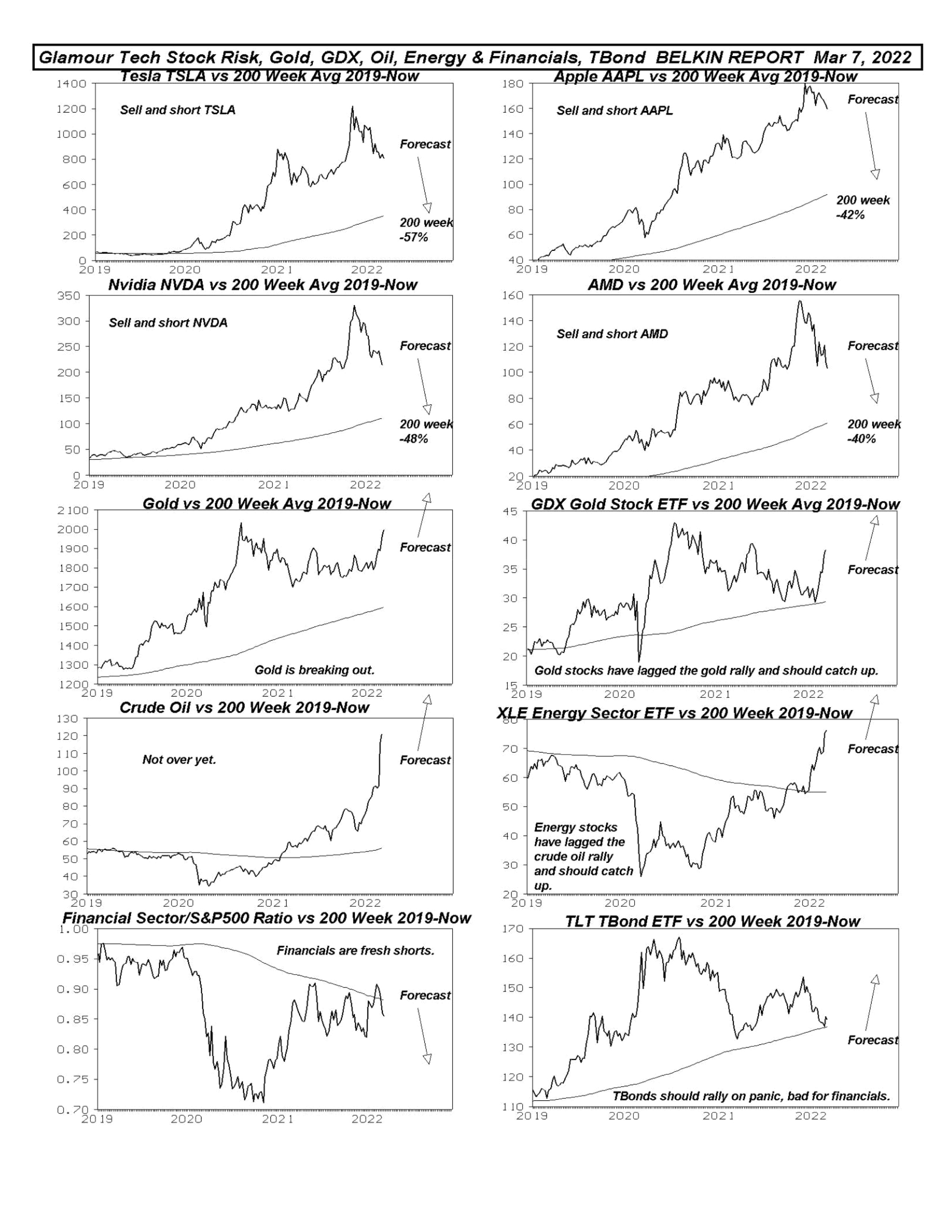
 The buy-the-dip mentality created by central bank monetary policy largesse hasn’t really fractured yet in the US. Punters are still trying to catch the falling knife. This is evident in sentiment indicators like still -positive equity ETF fund flows and the Fidelity Top Orders By Retail Investors site. FIDO buy orders way outnumber sells even on a day like today with the Nasdaq down -4%: (TSLA -4%, buy 7690/sell 5173, TQQQ 3X leveraged Nasdaq 100 ETF -11%, buy 6983/sell 3287, NVDA -6%, buy 6091/sell 2525, AMD -5%, buy 5318/sell 3164, SPY -3%, buy 5807/sell 2109).
Retail investors are programmed to buy the dip. But in a bear market that is the road to the poorhouse. Other measures confirm the complacency that still exists even though the Nasdaq is now down -20% from its Nov 19, 2021 peak (four months ago). TRIN measures advance/decline issues vs. volume. A low TRIN level is complacent, a high TRIN level is panic. Nasdaq TRIN is still ridiculously low (.85 for the 3 day and 10 day averages). At the bottom of major declines TRIN averages can reach 1.3 or higher. High TRIN levels indicate panic selling when investors get margin calls and dump everything, no questions asked. Markets are nowhere near that scenario yet. The model forecast points down for stock indexes and retail investor sentiment should get way more terrified before a tradable stock market bottom arrives.
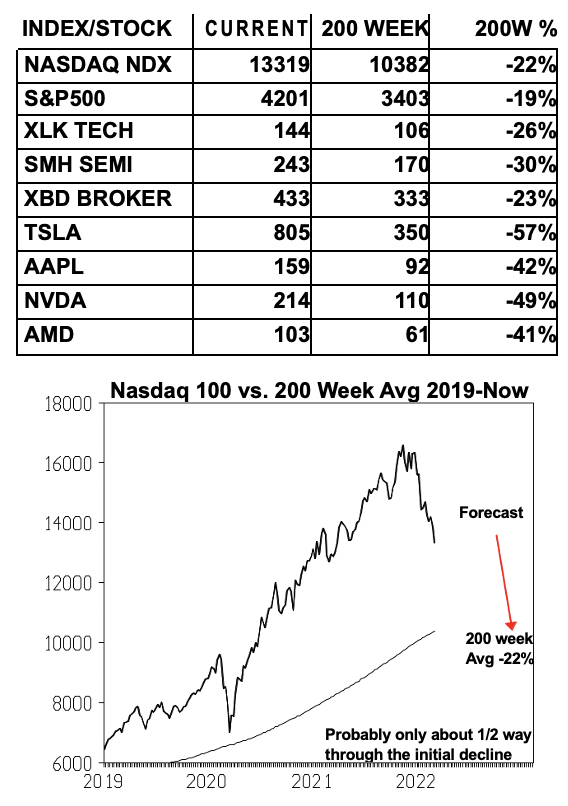
So how far could US stock indexes fall? Our tried- and- true trend analysis target is the 200 week average zone (indexes broke their 200 day averages in January and the Nasdaq hit a new 2022 low today) . 200 week averages typically provide some support in market sell-offs. That level is -20% to -30% lower for key US indexes (Nasdaq -22%, SMH semi ETF -30%) see table. The indexes that are still up the most probably have the most downside risk; like semiconductors, glamour tech stocks and brokers.
Thankfully there is huge dispersion in sector and group performance. Today with the Nasdaq down -4%, the energy sector (XLE) was up +2%, gold stocks (GDX) were up +3% and utilities (XLU) were up +1%. That’s huge positive relative performance, and even decent absolute performance, particularly in a bear market. Our model continues to like energy, gold stocks and defensive sectors for long positions.
Judging by performance figures leaking out (Tiger Global -23% ytd), most hedge funds seem to be on the wrong side of markets, clinging to tech and even short energy stocks (see press clip Bets Against Energy Stocks Are At The Highest In More Than A Year). The mentality of a market bottom is capitulation after big losses. We’re not there yet.
Even in Europe where stock indexes slumped sharply in the past week there is no panic yet. European equity outflows have started though. Keep in mind Europe was the top global long recommendation of brokerage houses before the Russia/Ukraine invasion hit. And Eastern European EM and FM markets were jacked up to the sky in demented anticipation of war. They were down -10% to -30% last week in belated recognition and the model forecast remains down.
Bottom Line: US indexes could easily fall another 20% -30% in the current decline. Sell and short into brief snapback rallies. Shift out of tech, consumer discretionary and financials into energy, gold miners and defensive sectors. As discussed in our major change last week, government bonds could rally on panic stock market selling. Don’t go down with the tech ship, dispersion offers anti-consensus long opportunities even in the midst of this bear market.