Get out of stocks, according to Gary Shilling, who has gone to 30% cash in the portfolios he manages. The economy will be in recession by the end of the year, and stocks will fall in response.
Shilling runs the New Jersey-based economic consulting firm that bears his name, A. Gary Shilling & Company, and is the author of The Age of Deleveraging: Investment Strategies for a Decade of Slow Growth and Deflation, published in 2010. He spoke yesterday as part of a webinar sponsored by Wealth Trust asset Management.
The volatility in U.S. equities is typical of a market top and is a warning sign of an imminent decline, according to Shilling. The question is whether to ride it out. His research demonstrates that buy and hold is not a better strategy than trading.
If one excluded the 50 best performing post-war months, the return from equities was no better than from Treasury bills. But avoiding the weak months was more important. It is “grade-school math,” according to Shilling: If you lose 50% of the value of your assets, you must make 100% to get even.
“Take a lot of money off the table,” he said.
Stocks are very expensive. The 10-year CAPE ratio is 37.4 versus its average of 17.1. It would take a 55% decline to get back to the long-term CAPE average and, Shilling warned, markets usually overshoot to the downside.
Stocks are vulnerable because the Fed is “behind the curve,” he said. When the Fed starts hiking rates, a recession follows most of the time.
“A soft landing is very much against the odds,” Shilling said.
The yield curve, based on the two-year to 10-year spread, is close to being inverted, which he said is “a sure signal of a recession.”
The Fed is tightening and dealing with a huge portfolio on its balance sheet of almost $9 trillion. It’s switching from quantitative easing (QE) and buying $140 billion in securities a month to liquidating its balance sheet. It is going from very easy policy to tightening, Shilling said, and that is a “huge change.”
The Fed has been concerned with supply-chain bottlenecks, but it has a difficult problem dealing with that via monetary policy. It can affect demand through credit but cannot affect the supply of goods.
The backlog of ships arriving in California from Asia has decreased from 140 to 78 since the worst of the supply-chain crisis. But Shilling cited a number of statistics indicative of a weakening economy. Among consumers, which account for 70% of U.S. GDP, hourly wages are increasing at a rate of 6.7%, which trails the CPI, which is increasing at a rate of 7.9%; real wages are down 1.2%. Approximately 1.5 million people have chosen early retirement, and that has restricted their spending. Retail sales have been declining in the last year. Inflationary expectations, which lead to accelerated buying, are very low – consumers expect only 6.7% inflation. Surveys show that consumer and business sentiment have declined.
Housing, which is about 6% of GDP, had been growing rapidly during the pandemic, as people moved from cities, mortgage rates were low, and consumers were cash-rich from stimulus checks. Those sources of growth are gone, he said. Mortgage rates are rising, and that is the “death knell” for housing.
“We are looking at a recession,” Shilling said, given the inverted yield curve, Fed policy, consumer behavior, and trends in the housing market. The recession will start later this year, he said, and with that, there will be a “distinct decline” in inflation. The supply of goods and services will catch up with demand. Inflation may drop back to the 2 to 3% range, he said, and the dollar will continue to be strong as a safe haven.
In his business as a money manager, Shilling said he is short stocks. He said that speculation is widespread, especially in crypto assets and SPACs. Money from stimulus programs went to stocks and housing, not into consuming goods and services. FAANG stocks are especially overvalued, he said, and their prices will go down as rates rise (and a higher discount rate is applied to future cash flows).
Bonds have more than discounted what the Fed has done, according to Shilling. When the recession happens, the Fed will ease and may do so early.
“We have lots of cash,” he said, and it is not “trash.” If you want to be in stocks, it should defensive ones, like utilities and consumer durables. He is maintaining a 30% cash position in the four portfolios he runs, which are all managed with the same approach.
Over the long term, Shilling was much more positive.
The economy grows in the long run because of productivity and population growth, he said. Corporate profits in the long run (which he defined as 20 years) grow in step with it. The only variable is P/E ratios, which are cyclical. Most investors make gains by riding stocks up with the economy at times when P/E ratios are not in decline.
We’ve been in a growth economy in the entire post-war period, and that has been the primary driver of long-term healthy equity returns, Shilling said.
Robert Huebscher is the publisher and CEO of Advisor Perspectives.
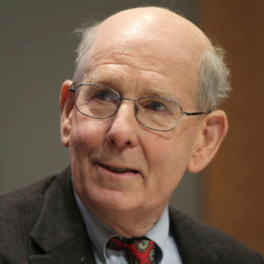 Get out of stocks, according to Gary Shilling, who has gone to 30% cash in the portfolios he manages. The economy will be in recession by the end of the year, and stocks will fall in response.