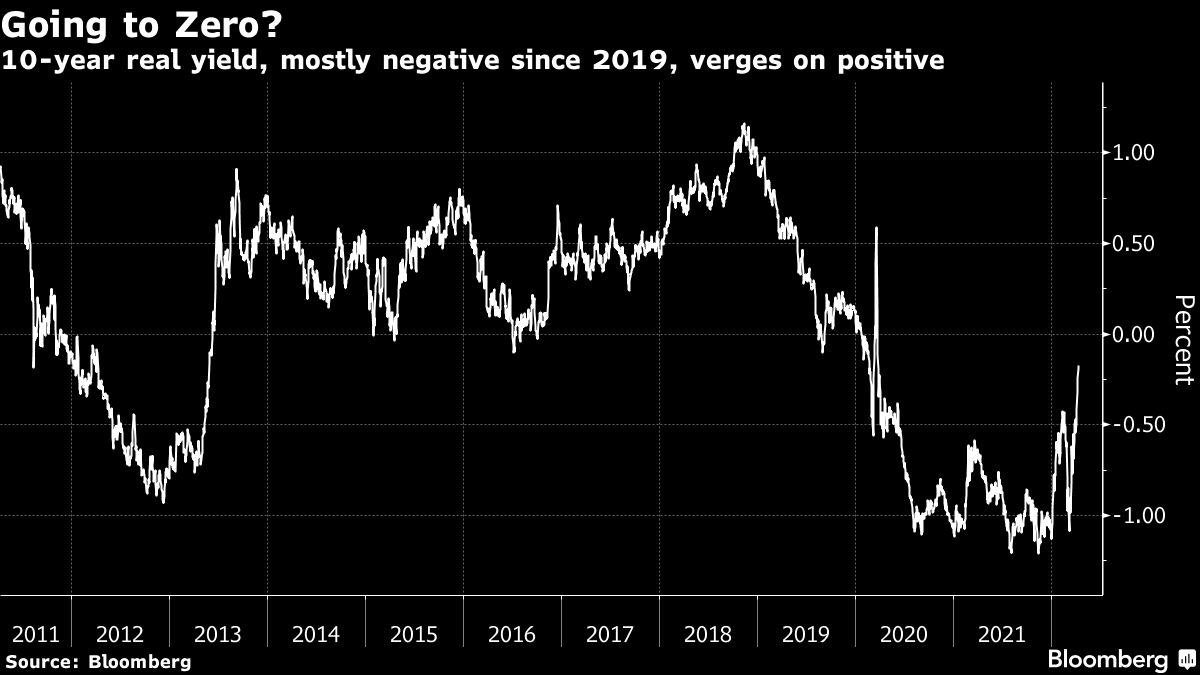
The U.S. bond market is hurtling toward the clearest sign yet that the Federal Reserve’s shift into a hawkish gear is making a difference -- a real 10-year interest rate higher than 0%.
While all Treasury yields have climbed this year as the Fed began what’s expected to be an aggressive series of rate increases aimed throttling high inflation, in the past two weeks the baton has been passed to inflation-protected notes and bonds. Their yields are termed “real” because they represent the rates investors will accept as long as they are paired with extra payments to offset inflation.
For borrowers, whose revenues may rise with inflation, real interest rates represent a sort of true cost of money. For 10-year loans, it’s been negative since early 2019, except for briefly during the market mayhem of March 2020. Ten-year real yields on inflation-protected Treasuries surged to -0.15% from -0.49% in the past week. The trough was -1.26% in November.
“The Fed going to tighter policy should fundamentally argue for higher real yields,” said Michael Cloherty, head of U.S. rates strategy at the securities arm of UBS AG.

The era of negative real yields supported demand for riskier assets -- loosening financial conditions. To get inflation back under control, the Fed needs to tighten them via higher real yields. The pace may be faster this time. In late 2018, the 10-year real yield rose above 1% after exiting negative territory in 2016, as the Fed slowly tightened policy.
Market expectations for how much the central bank will raise its policy rate have exploded higher, with futures tied to Fed meeting dates now priced for it to peak at around 3.15% in mid-2023, up from 0.25%-0.5% currently. Goldman Sachs Group Inc. chief economist Jan Hatzius Friday said it was possible to envision circumstances under which it could exceed 4%.
“A real yield above zero means valuations for equities and all assets require re-assessing,” said David Bianco, chief investment officer, Americas for DWS. Fed officials “sound very convincing about fighting runaway inflation, and they are going to act.”
In the two weeks after Russia invaded Ukraine on Feb. 23, touching off a surge in commodity prices that stoked demand for inflation-protected bonds, real yields briefly dived back toward last year’s lows. The differences in yield between inflation-protected and regular Treasury debt -- representing the amount of inflation needed to equalize their returns -- widened, in some cases to the highest levels on record in the past two decades.
The subsequent rebound in yields to the highest levels since before the pandemic has been led by real yields, however, a sign that investors expect the Fed to succeed in bringing inflation under control.
The U.S. consumer price index for March, to be released Tuesday, is forecast to show a month-on-month increase of 1.2% -- bigger than any since September 2005 -- that lifts the annual rate to 8.4%, last seen in 1982.
Normally, a strengthening economy lifts real yields and inflation expectations simultaneously, but an aggressive Fed sets the stage for those to diverge, creating “extreme volatility in TIPS,” Cloherty said.
A Treasury Inflation-Protected Securities index has lost 3.3% since March 23 for a total return of -4.7% in 2022. While comparable regular Treasuries have fared even worse -- with a year-to-date total return of minus 7.8% -- they’ve outperformed in the recent period, losing only 2.4%.
The underperfomance in TIPS deepened with the disclosures -- first by Fed Governor Lael Brainard on Tuesday, then in the minutes of the March Federal Open Market Committee meeting on Wednesday -- that balance-sheet shrinkage would begin sooner and unfold more quickly than some market participants expected.
The minutes showed that the Fed is set to start shrinking its balance sheet next month by not replacing all of the maturing Treasuries and mortgage-backed securities it holds. The last time the Fed undertook so-called quantitative tightening, from 2017 to 2019, it set monthly limits for how much of its maturing holdings wouldn’t be replaced with new securities.
The minutes suggested the combined runoff cap could reach $95 billion within three months. While the peak cap was in line with bond dealers’ expectations, the pace was quicker than some predicted.
As the Fed expanded its balance sheet from March 2020 to March 2020, TIPS outperformed because central-bank purchases of TIPS accounted for a larger share of the amount outstanding. The $256 billion increase in its TIPS holdings to $388 billion -- more than a fifth of the market -- exceeded the growth in the market over the same period.
“The Fed became a major buyer of TIPS, and now they are not buying,” said George Goncalves, head of macro strategy at MUFG. “On the margin, QT matters more for TIPS than the broader Treasury market.”
Meanwhile, investors, who piled into the iShares TIPS Bond ETF last year, have been net redeemers this year.
Ruffer LLP, an institutional investment manager of about $33 billion, recommends short-dated TIPS for inflation protection, which have less price sensitivity than the broad market to rising yields.
“The Fed and retail are the buyers of TIPS and both are stepping away,” said Alex Lennard, investment director at Ruffer in London.
The recent resilience of U.S. equities has helped bolster confidence that the Fed’s policy rate will reach 3.25%, and the potential implications for the dollar of the geopolitical realignments set in motion by the Ukraine crisis put investors deeper into uncharted territory, said Glen Capelo, managing director at Mischler Financial.
“The Fed hasn’t tightened solely because of inflation since the early 80s,” he said. “It’s the first time they’re truly tightening while unwinding QE at the same time.”
What to Watch
- Economic calendar:
- April 12: CPI, NFIB small business optimism
- April 13: MBA mortgage applications; PPI
- April 14: Jobless claims, business inventories, retail sales, University of Michigan sentiment and inflation expectations
- Fed calendar:
- April 11: Atlanta Fed President Raphael Bostic, Governor Michelle Bowman, Governor Christopher Waller, Chicago Fed President Charles Evans
- April 12: Governor Brainard, Richmond Fed President Thomas Barkin
- April 14: Cleveland Fed President Loretta Mester, Philadelphia Fed President Patrick Harker
- Auction calendar:
- April 11: 13- and 26-week bills, 3-year notes
- April 12: 10-year notes
- April 13: 30-year bonds
- April 14: 4- and 8-week bills
Bloomberg News provided this article. For more articles like this please visit
bloomberg.com.
Read more articles by Michael MacKenzie