The Ukraine invasion and the ensuing energy crunch show clearly how important it is to move off fossil fuels and toward renewables.
Or, on the contrary: The invasion is yet another distraction from climate policy, delaying the transition away from fossil fuels and leading to a rise in emissions.
Welcome to the endless cycle of debate over whether or not Russian President Vladimir Putin’s war of choice will be the much-needed push to jumpstart climate policy around the world. It splits neatly between so-called activists focused on the “should” or “ought” versus the often self-styled realists espousing “careful,” “balanced” views. It also apparently splits sharply between Europe and the United States.
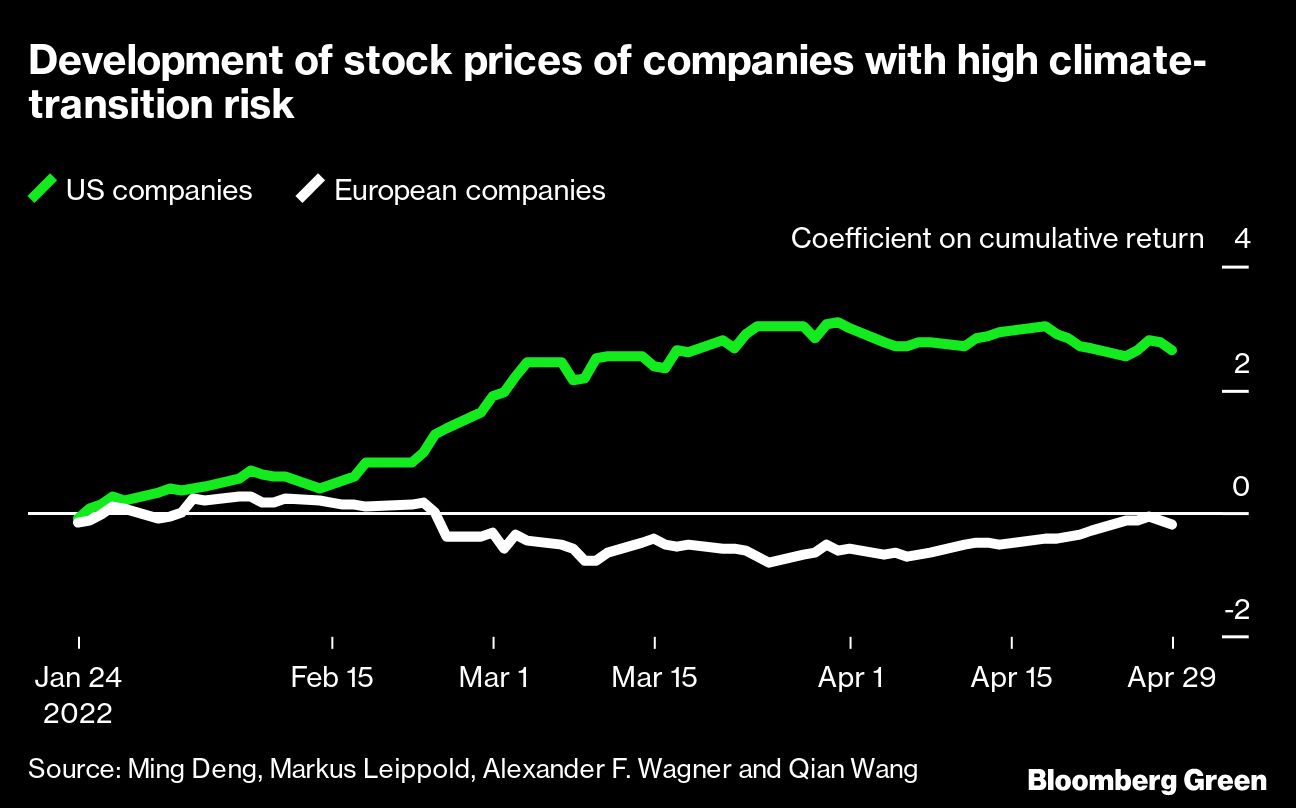
A team of researchers at the University of Zurich and the Swiss Finance Institute tackled the question by looking at companies’ stock prices. The results are striking. Stocks of U.S. companies deemed to be most affected by what the researchers call “climate transition risk” soared after Putin’s invasion, while those of European companies did not — or, if anything, fell slightly.

The only cogent interpretation of these results is that investors expected the Ukraine invasion to have very different effects on climate policy in the two regions. In Europe, it would mean a continuation of the clean energy transition, possibly speeding things up. In the U.S., meanwhile, investors expected the war to slow down the transition even further, bringing a renewed emphasis on domestic oil and gas extraction.
To lend more credence to these results, the researchers looked to companies most exposed to physical climate risk. That underlying risk did not change due to the invasion, so their stock prices should not have either. And indeed, they didn’t.
Companies poised to take advantage of the clean energy transition, meanwhile, at first rose both in Europe and the U.S. Stock prices remained high in Europe, while declining to pre-invasion levels in the U.S. There was lots of initial talk about U.S. policy helping speed the transition away from fossil fuels, such as Bill McKibben prominently calling for “Heat Pumps for Peace and Freedom.” But American clean-energy policy initiatives have largely fizzled, while Europe has indeed doubled down on some transition policies since the invasion, including, for example, promoting heat pumps.
All that paints a rather complex picture about the clean energy transition and about the crucial interplay of corporate and financial interests and policy. Most businesses experience climate risk as reflected in climate policy risk, making policy itself often seem more of a threat than an opportunity. That relationship must change, and fast.
Climate policy itself must not be seen as a threat to existing business models but as an opening for new ones to thrive. It is precisely at the intersection of business and policy leadership where the greatest opportunities lie.
This is also an opportune time for a quick personal announcement: This is my final regular Risky Climate column. I might still write for Bloomberg Green on occasion going forward, but there are a couple of personal changes in store. After visiting Columbia Business School for the past semester on leave from New York University, I’m permanently moving there this fall, precisely to focus on this intersection of business leadership and climate policy in the clean energy transition. I’m also going to write a monthly column for Project Syndicate focused on these questions. It’s been fun being part of the Bloomberg Green family since its inception. Thank you for keeping me honest and on my toes.
Bloomberg News provided this article. For more articles like this please visit
bloomberg.com.
Read more articles by Gernot Wagner