Advisor Perspectives welcomes guest contributions. The views presented here do not necessarily represent those of Advisor Perspectives.
We are all familiar with the Consumer Price Index (CPI) as a measure of inflation and price stability, which the Fed targets at a 2% annual rate.
When this statistic is volatile, the Fed refers to measures of core inflation to mask off the more volatile components from food and energy. This, it claims, is found within the Personal Consumer Expenditure (PCE) figures, with food and energy components removed.
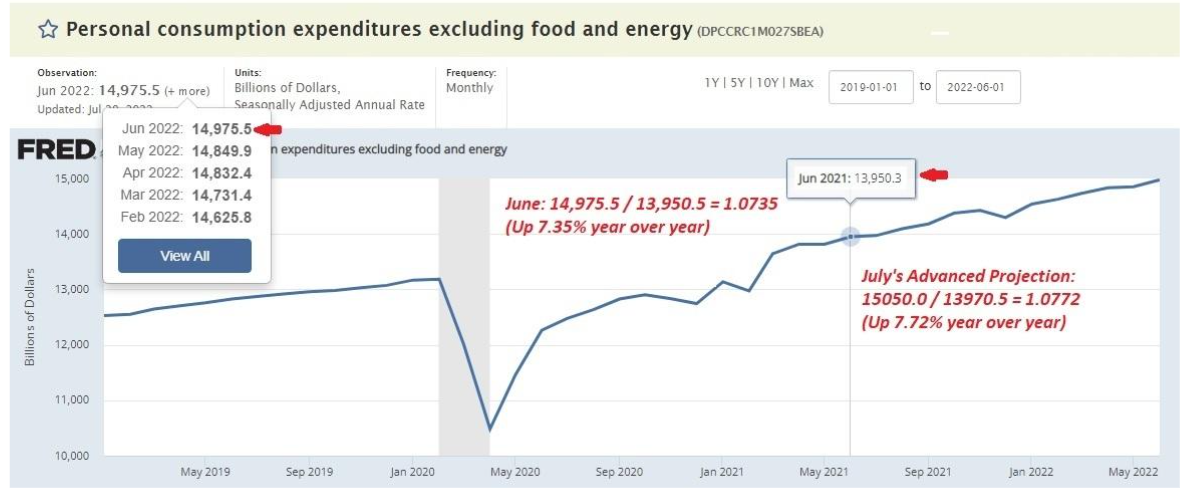
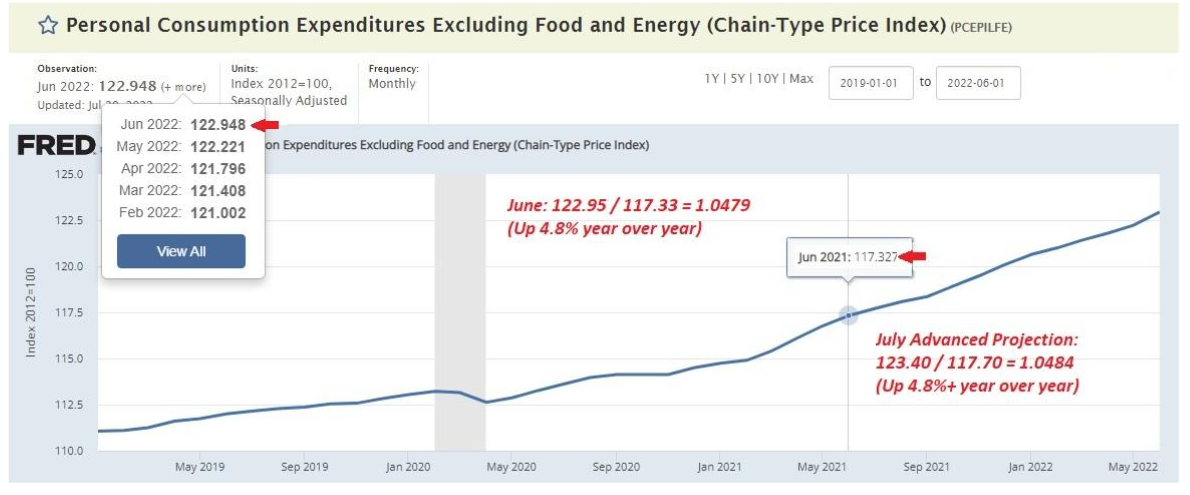
There are two indices that are used to measure inflation. One uses raw data, and generates an absolute total, currently running just under $15 trillion annually for the nation. The other is a “chained” index, which is compared to a base value of 100 established in 2012. This chained index is running above 122.
Here is where the Federal Reserve data can be found:
These two charts are reproduced below, with my notations in red. They show what these Fed favorites are likely to show when the July 2022 data comes out over the next couple of weeks, using nominal projected values for each of these statistics.
Of course, the actual values might differ slightly from the projections, but that is unlikely to be by very much. Notice in the second chart that the upward inflections in the trend since February of 2021 are continuing to swamp out the smaller downward inflections.
The Fed may put these under a finer microscope than using year over year analysis, such as quarter-to- quarter or month-to-month, but it has not stated so in its recent commentaries on the topic. Using a finer graduation also increases the introduction of statistical noise into the process, and reacting to noise in a process is not good practice.
The July CPI “inflation relief move” to 8.5% that everyone seems so happy about is not what the Fed is going to pay attention to. It is much more likely to see these two PCE stats as reasons to continue its hawkish moves, until these curves begin to move back to tracking the long-term trends it wants to see.
Richard Vesel is the founder of AdvancedProjections.com, where you can read more about this topic.
Read more articles by Richard Vesel
 Advisor Perspectives welcomes guest contributions. The views presented here do not necessarily represent those of Advisor Perspectives.