How to Talk to Clients About Thematic ETFs
Membership required
Membership is now required to use this feature. To learn more:
View Membership Benefits Advisor Perspectives welcomes guest contributions. The views presented here do not necessarily represent those of Advisor Perspectives.
There are more than 1,100 thematic ETFs available globally, representing $244 billion in assets. Why the continued flow of investor assets and expanding products in this category? Thematic ETFs are a popular investment vehicle for a growing number of investors, driven by the ongoing trend toward investing in something that sparks passion or reflects one’s belief systems.
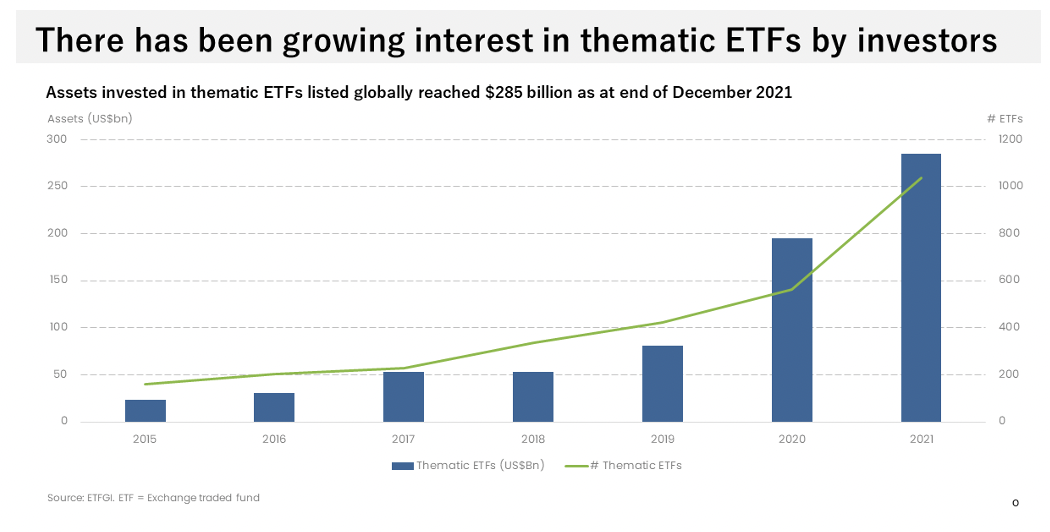
In fact, these types of funds are in such demand among investors that, according to some industry experts, 88% of U.S. professional investors plan to increase their allocations to thematic ETFs over the next 12 months. Another survey, this one by Brown Brothers Harriman (“BBH”), noted that “85% of global ETF investors said they plan on increasing exposure to thematic ETFs and 38% of investors plan to allocate 11-20% of their portfolio to thematics, an increase of 4% from 2021.” These growth projections align with the significant uptick in assets invested in thematic ETFs since 2015, which reached $285 billion as of December 2021.
For advisors, the continued attractiveness of these low-cost, accessible, and diverse funds means that this asset class can no longer be ignored. Additionally, the recent market selloff, inflationary concerns, and rising interest rates are increasing anxiety for a lot of investors, so advisors might see an increase in phone calls from concerned clients in the near future and coming months. Advisors should be prepared to answer questions and talk to clients about these assets. According to one advisor, it would be “a good time to remind clients that these thematic ETFs were built to prosper over the course of a decade, and do not represent a quick trade” because “many of the companies held in these funds are already making tremendous progress.”
Not all thematic ETFs are created equal. These funds typically focus on a specific trend that is garnering investor excitement – like space exploration, robotics, work from home, and even whiskey – which can be fleeting or too specialized for investors to see long-term returns. Therefore, it’s essential that advisors educate clients on which thematic ETFs will have the most staying power based on the fund’s investment thesis and its implementation, as well as when it makes sense to tap into specific themes based on a client’s risk appetite and investment goals. To that end, below are some key points that advisors should keep in mind when dispensing advice and recommendations on thematic ETFs:
- Buyer beware –Be thorough. The name of a fund may not be a clear indication of the exposure being offered. Additionally, the manner in which the exposure is sourced may not be appropriate for all investors. For example, some ETFs, such as in the medicinal psychedelic sector, use swaps or derivative instruments instead of equities, which exposes investors to counterparty risk. Low-risk-tolerant investors may want to stay away from these kinds of portfolio holdings (i.e., derivative instruments or swaps) because they can introduce additional uncertainties. Furthermore, some funds purport to offer pure-play exposure to a specific industry or sector when that is not accurate. Advisors should always advise clients to do their homework when looking into thematic ETFs to ensure they aren’t falling into a marketing trap.
- Instances where thematic ETFs belong in a diverse investment portfolio – While not for everyone, thematic ETFs do have a place in a diverse investment portfolio for the right type of client or investor who has a long-term passion in an emerging, and sometimes transformative, trend. The times and circumstances in which thematics make the most sense include the following:
1. Your client wants to invest in a nascent and evolving industry where it is difficult to determine which companies will be successful – Thematic ETFs are by design an easy way for investors to gain access to emerging investment trends. In the case of nascent industries – such as medicinal psychedelics, artificial intelligence, virtual reality, and fuel cells – where there are a lot of unknowns, it is very difficult, and dangerous, to try to predict which companies will be successful long term. In these instances, a thematic ETF often makes sense because it can offer a low-cost option invest in a burgeoning sector or industry.
2. Your client wants to invest in an asset or market that is not accessible to the average investor – Less sophisticated retail investors can be limited in their investment choices when it comes to accessing some industries and/or executing certain trades, such as options trading. But there are instances in which a specific industry is on the rise, supported by robust market fundamentals and regulatory/legislative developments, but is inaccessible to the average investor. Examples of this include the crude oil market and the emerging carbon credit market, which has gained legislative and societal support across the globe as companies strive to reach net zero goals in an effort to mitigate climate change. Exposure to carbon markets is typically through future contracts, which are complicated and often inaccessible for unsophisticated investors. For clients doing their research and interested in these areas of the market, thematic ETFs could be an effective way in.
3. Your client wants to invest in a sub-theme –ESG-focused investments are ubiquitous as investors flock to impact investment funds. However, what most investors don’t know is that the ESG wrapper can sometimes be a catch-all for a variety of companies operating within a broad space. For instance, your client might express general interest in ESG-related products, but what they want is exposure to a sub-theme like renewable energy, energy storage, or waste management. In addition, some ESG-specific products include technology companies that have low-emission operations. But if your client does not want to be invested in technology, research is required on the ETF’s holdings. Advisors must understand what exposure you are getting by selecting a particular thematic ETF and align that with their client’s investment objectives. But don’t shy away from thematics in these instances where a niche sub-theme is the goal.
- Areas to watch as the thematic category expands – There is no crystal ball to determine which thematic ETFs will be winners, unfortunately. And explaining to clients why chasing returns and guessing on future performance is also challenging. However, there are some categories of thematics that have long-term potential, according to the recent BBH survey of global ETF respondents, including the following: “Technology-focused thematic ETFs, including cloud computing and cybersecurity products, continue to command the most interest across investors, with 64% planning to add technology/internet strategies to their portfolios this year. Other areas worth noting include robotics/AI, healthcare, and autonomous and electric vehicles.” Also, “ESG continues to attract attention, with 56% of respondents planning to add ESG exposures this year. [And], given the considerable gains in the value of digital assets throughout 2021, perhaps it is not surprising that 54% of global investors plan to add cryptocurrencies and digital asset-themed ETFs to their portfolio.”
For investors looking to gain exposure to a trend, thematic ETFs offer an opportunity to invest in a diversified way rather than purchasing individual companies or stocks. As these types of funds continue to gain traction among investors, advisors need to be able to speak to clients intelligently and effectively to steer them in the right direction. The above acts as a starting point for advisors that are looking to respond to questions and/or get these conversations going with current or prospective clients.
Tim Collins is the president of Elemental Advisors Inc. and Carbon Fund Advisors Inc. which act as sub-advisors to PSYK ETF (NYSE: PSYK) and Carbon Strategy ETF (NYSE: KARB), respectively.
Membership required
Membership is now required to use this feature. To learn more:
View Membership BenefitsSponsored Content
Upcoming Virtual Events View All