Advisor Perspectives welcomes guest contributions. The views presented here do not necessarily represent those of Advisor Perspectives.
We’ve come a long way since the days of command-line interfaces and complex software menus. Today, users expect software that’s intuitive, easy to use, and accessible. Artificial intelligence (AI) is recalibrating what’s possible and ultimately what we will all expect of an intuitive user interface.
Typically, when working with software, you must convert your idea or inquiry into a series of clicks, mouse drags, and drops to accomplish a task, something that can be challenging. You must understand how to operate the software to figure out the right sequence of steps and then execute those steps.
There’s a better way.
It’s called Chat UX. It creates a natural-language chat interface to help us use software.
Wealth management involves complex financial concepts and terminology that can be overwhelming for clients. Even easy-to-use software can be a challenge for both advisors and clients. An AI-powered natural language software interface simplifies those concepts, allowing users to just ask a question. Software will deliver on the promise of asking a simple question and getting a simple answer.
How it works
Natural language processing (NLP) technology enables software to understand and interpret human language. With NLP, wealth managers can communicate complex financial concepts to clients in simplified and accessible language. Prior generations of this technology were built on rules created by humans. That approach can’t cover every possibility, so there were lots of errors. AI and machine learning were introduced to create those same rules implicitly by “training” on language data. The machine creates rules by observing them in action. But they aren’t rules, they are probabilities that act as guides. The more data for training, the more likely you get the right answer. The underlying AI technology that powers NLP has recently changed dramatically.
Why it’s happening
This has all been promised before, but a new AI called generative pretrained transformer 3 (GPT-3), the large language model developed by OpenAI, has redefined what is possible. It is a generative large-language-model AI. It’s built to “generate” text and other content based on deep learning from massive datasets. The ability to generate text is a radical advance compared with prior NLP technology.
This advance in AI is dependent on three underlying factors: (1) training on a vast quantity of data; (2) an equally vast amount of computing power; and (3) a new architecture capable of interpreting that context and making distant connections called “long-range dependencies.” GPT-3 takes advantage of breakthroughs in all three areas.
GPT-3 is trained on a massive dataset consisting of billions of words, making it one of the largest language models ever created. This vast amount of training data allows GPT-3 to generate high-quality responses to a wide range of natural language tasks more realistically than prior generations.
Advantages of a natural language software interface
AI-powered natural-language-software interfaces have several advantages for wealth managers and their clients. They eliminate the need to “learn” software. Ask a question and get an answer. Advisors and clients can focus on getting answers to their questions. They do a remarkable job of interpreting language and translating complex concepts, making it easier for clients to understand their financial situation. This enhances client engagement and satisfaction, resulting in increased trust and loyalty. They make software accessible and personalized, enabling wealth managers and their clients an experience tailored to their differing needs. This improves communication and enables wealth managers to build stronger relationships with clients. Lastly, it increases efficiency and productivity by enabling faster and more accurate communication.
This is already happening
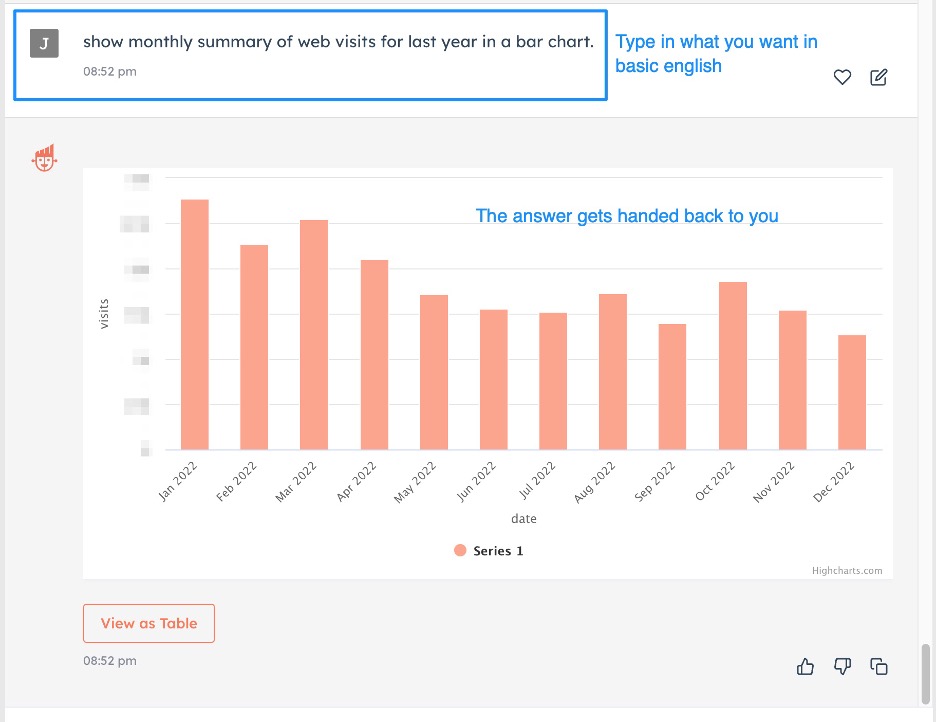
General-purpose CRM tools were some of the first to deliver those capabilities. Salesforce announced Einstein GPT in a video. Further along, Hubspot announced Chatspot.ai, which is in private alpha test. I am a test user of the Hubspot system. Even with its limitations, it is transformative. Type in, “Show me contacts over the last 12 months,” and the software returns a table by month of new contacts added to the database with buttons to allow you to graph the data.
Imagine this for you or your clients. A client could ask the software, "What is my current net worth?" and receive an answer in simple language and a table or graph. Clients can access relevant financial information quickly and easily, making it easier for them to partner with advisors managing their finances. Advisors could tell the software, “Show me all clients who’ve drifted outside of their model tolerance in order from most drift to least,” and the software will respond accurately.
A changed and better experience
Traditional interfaces won’t be replaced by these new chat interfaces. They’ll be enhanced. AI-powered natural-language-software interfaces will transform the wealth management experience, making it more accessible, user-friendly, and personalized. Life for wealth managers and clients will be vastly simpler and, dare I say, more natural.
John Prendergast is CEO and co-founder of Blueleaf, a leading all-in-one platform for RIAs and broker-dealers to deliver exceptional advisor and client experiences while simplifying operations. John also co-hosts The Augmented Advisor podcast, featuring industry leaders sharing tools and insights to succeed in a digital world.
Read more articles by John Prendergast
 Advisor Perspectives welcomes guest contributions. The views presented here do not necessarily represent those of Advisor Perspectives.