What’s the most important price in the global economy? The price of oil? The price of semiconductors? The price of a Big Mac? More important than any of these is the price of money. For more than three decades it was falling. Now it’s going up. Ask most people how the price of money is set, and they’ll say central banks. True, when it comes to direct control of US interest rates, the Federal Reserve calls the shots. But there’s a deeper logic at work. Fundamentally, the price of money—like the price of anything else—reflects the balance of supply and demand. Higher supply of saving pushes rates down. More investment demand pushes them up.
For the economics wonks, the price of money that balances saving and investment while keeping inflation stable has another name: the “natural rate of interest.” To see why this concept is central to policymaking, imagine what would happen if the Fed set borrowing costs well below the natural rate. With money too cheap, there would be too much investment, not enough saving, and the economy would overheat—resulting in spiraling inflation. Flipping that around, if the Fed set borrowing costs above the natural rate, there would be too much saving, not enough investment, and the economy would cool—resulting in rising unemployment.
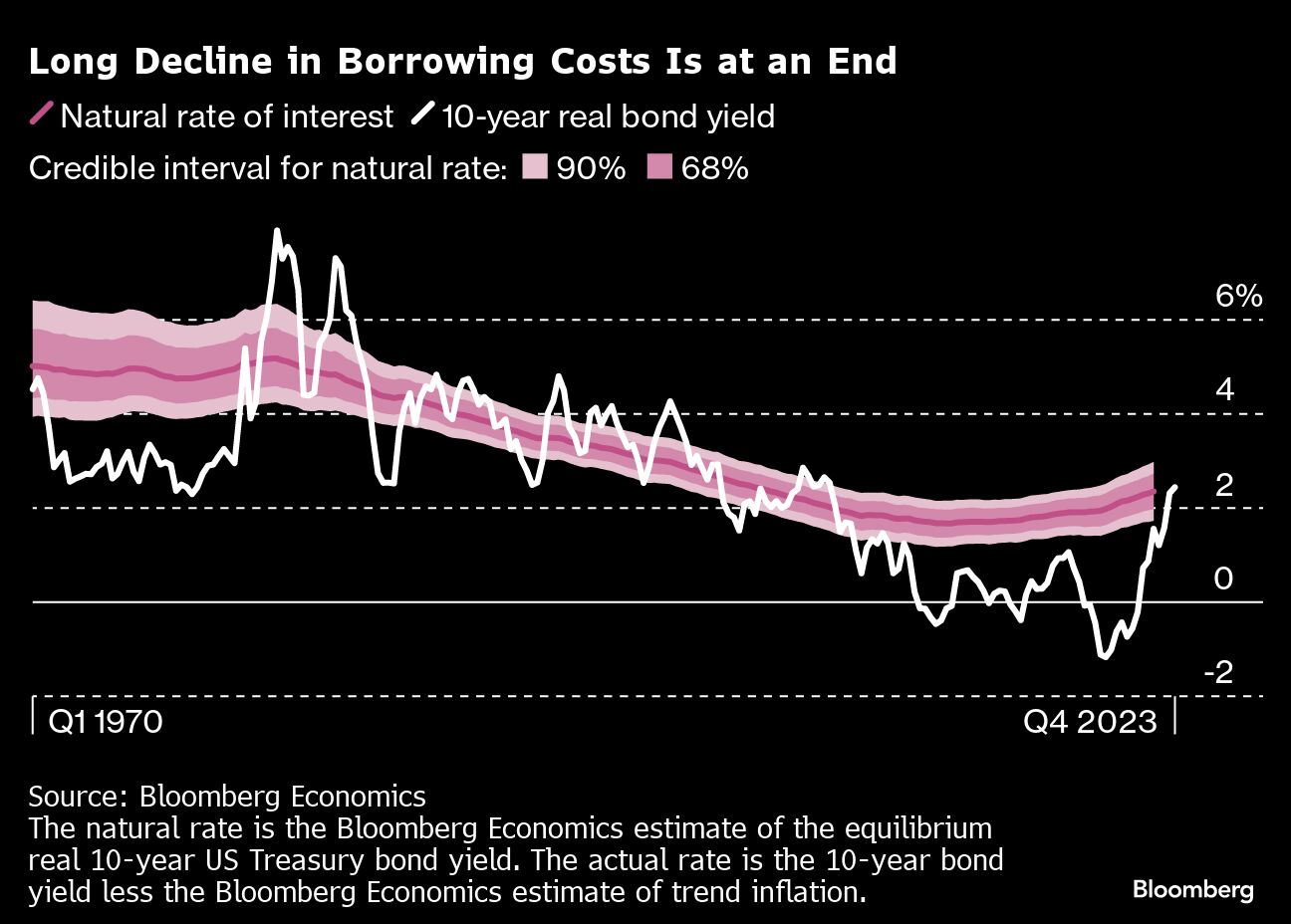
For more than three decades, borrowing costs in the US were trending down. By our estimates, and adjusting for inflation, the natural rate of interest for 10-year US government bonds fell from a bit more than 5% in 1980 to a little less than 2% over the past decade.
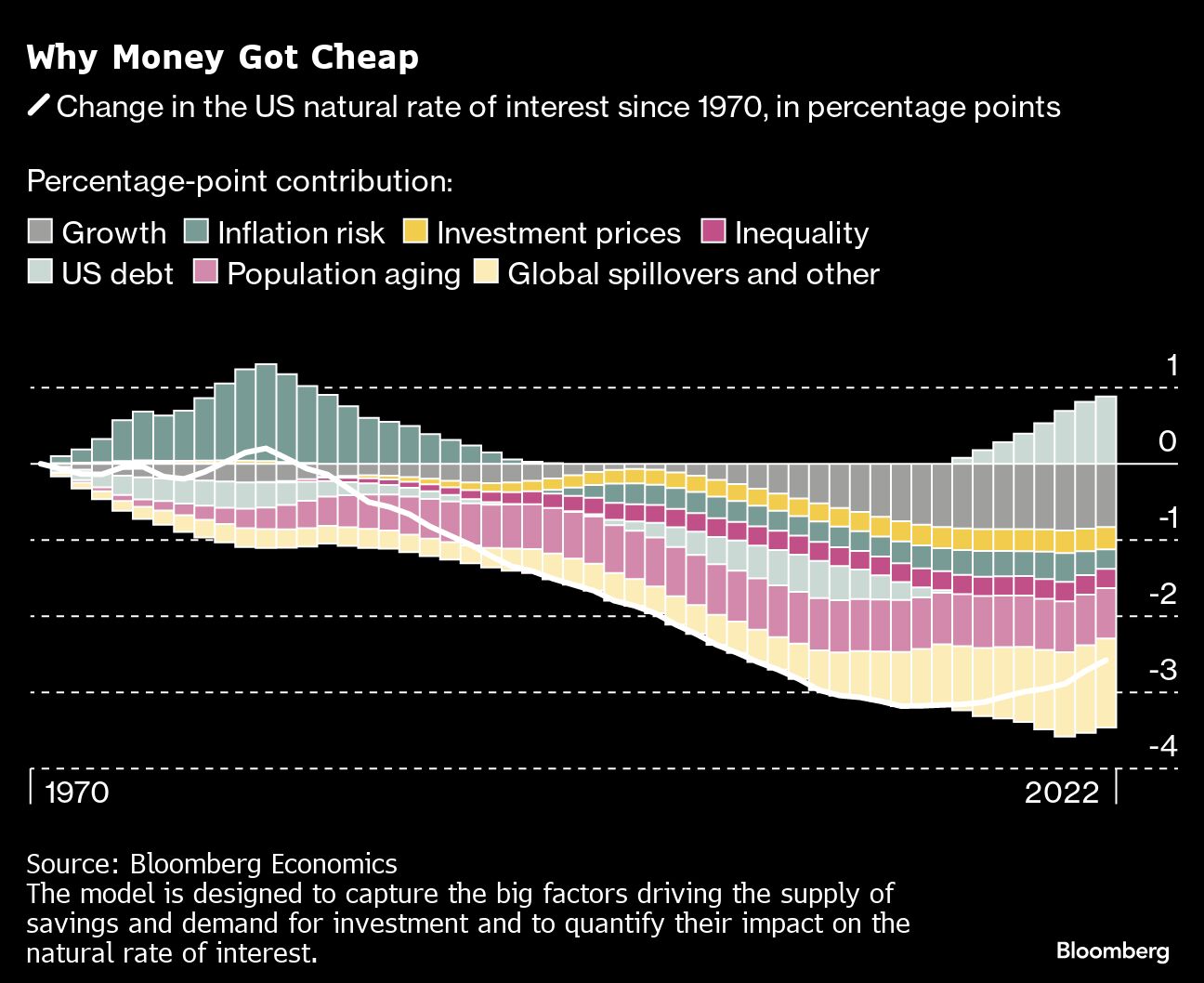
To find out what drove interest rates lower, and to forecast where the natural rate might go in the future, we built a model of the big factors driving the supply of saving and demand for investment. Our dataset spans a half-century and 12 advanced economies deeply enmeshed in the global financial system. The results show that one of the most important reasons for the drop in the natural rate was weaker growth. In the 1960s and ’70s, a swelling workforce and rapid productivity gains meant average annual growth of gross domestic product was close to 4%. Strong growth created a powerful incentive to invest—lifting the price of money.
By the 2000s those drivers were running out of steam. After the global financial crisis of 2007-08, average annual GDP growth slumped to around 2%. A more sluggish economy meant the attractiveness of investing for the future was weaker—dragging the price of money lower.
Shifting demographics contributed in another way. From the 1980s on, as the baby boom generation started squirreling away more money for retirement, the supply of saving went up—adding more downward pressure on the natural rate.
Other factors also contributed. On the saving side of the equation, China’s economy was growing fast, saving a lot and channeling those savings into US government bonds. And in the US, income inequality went up—high earners tuck away a higher share of their income, which further increased the supply of savings.
On the investment side, computers got cheaper and more powerful, meaning companies didn’t have to spend so much upgrading their technology—lowering investment demand and dragging the natural rate lower.
For the US economy, that fall in the price of money had profound consequences. Bargain-basement borrowing costs meant households could take on bigger mortgages. In the early 2000s many bit off more than they could chew. There were lots of reasons behind the subprime mortgage meltdown and global financial crisis; falling borrowing costs were one.
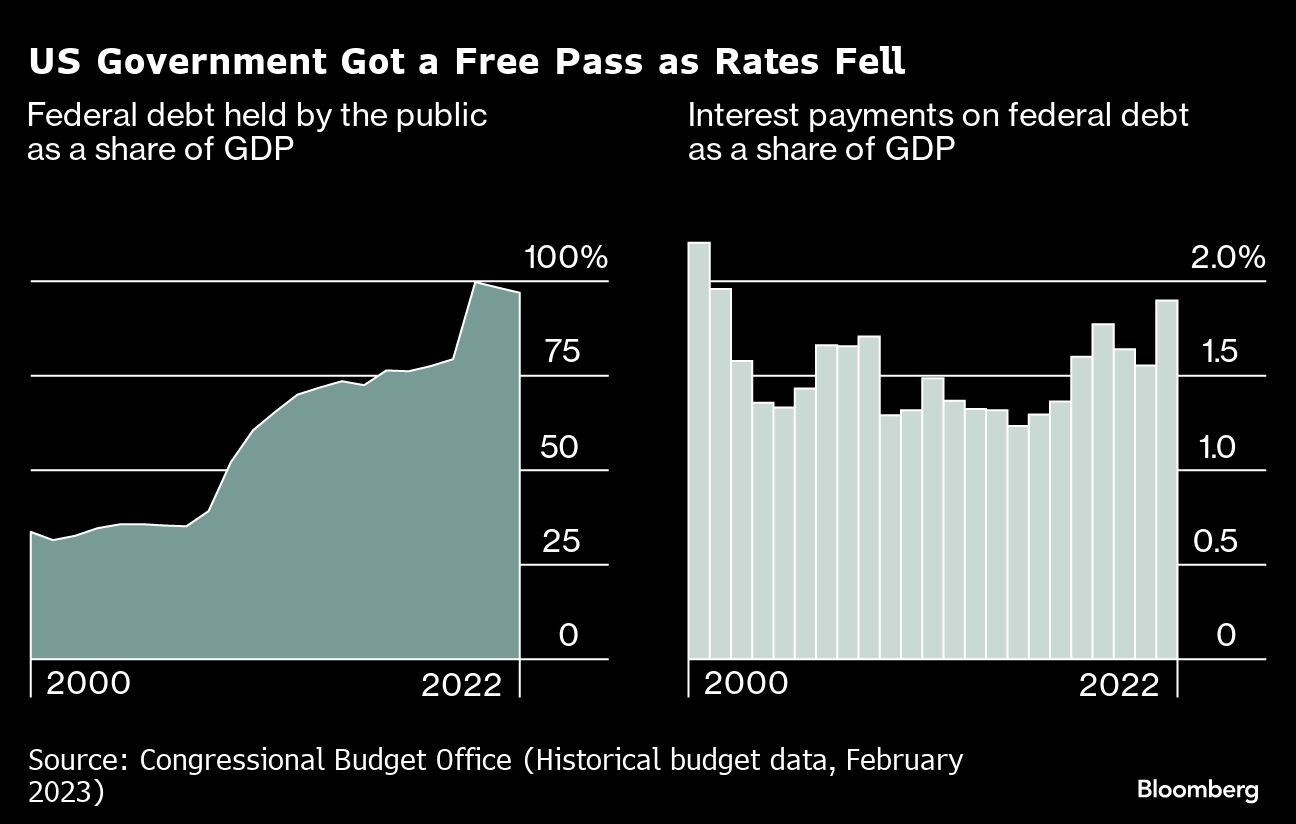
And cheaper money meant that even as US federal debt almost tripled, from 33% of GDP at the turn of the century to nearly 100% today, the cost of servicing that debt remained low, allowing the government to continue spending on education, infrastructure and the military.
For the Federal Reserve, a lower natural rate meant less space to cut rates during recessions, leading to much hand-wringing about the diminished firepower of monetary policy.
All that is changing. Some of the forces that drove the price of money lower are swinging into reverse. And other vectors are coming into play.
Demographics are shifting. The baby boom generation that helped push borrowing costs down is exiting the workforce—resulting in a smaller supply of savings. Fracturing relations between Washington and Beijing, and a rebalancing of China’s economy, mean the flow of Chinese savings across the Pacific into Treasuries has come to an end.
US debt leaped as the global financial crisis ripped through the economy and again as the coronavirus pandemic struck. Those episodes increased competition for savings, and the government has kept the taps open with the Inflation Reduction Act. Rising debt is already creating upward pressure on long-term borrowing costs.
How much higher will the natural rate go? Our model shows a rise of about a percentage point from a trough of 1.7% in the mid-2010s to 2.7% by 2050. In nominal terms, that means 10-year Treasury yields could settle somewhere between 4.5% and 5%. And the risks are skewed toward even higher borrowing costs than our baseline suggests.
If the government doesn’t get its finances in order, fiscal deficits will stay wide. The fight against climate change will require massive investment. BloombergNEF estimates getting the energy network in shape to achieve net-zero carbon emissions will cost $30 trillion. And leaps forward in artificial intelligence and other technologies might yet boost productivity—resulting in faster trend growth.
High government borrowing, more spending to fight climate change, and faster growth would all drive the natural rate higher. According to our estimates, the combined impact would push the natural rate to 4%, translating to a nominal 10-year bond yield of about 6%.
Even in our baseline projection, the shift from a falling to a rising natural rate will have profound consequences for the US economy and financial system. Since the early 1980s, house prices in the US have roared higher, with the decline in interest rates a major contributing factor. With borrowing costs now set to edge higher, that process may come to an end. There’s a similar story in equity markets. Since the early ’80s, the S&P 500 has surged upward, powered in part by lower rates. With borrowing costs on the rise, that impetus for ever-increasing equity valuations will be taken away.
Perhaps the biggest loser, though, will be the US Department of the Treasury. Even if debt rose no further relative to the size of the economy, higher borrowing costs are set to add 2% of GDP to debt payments annually by 2030. If that had been the case last year, the Treasury would have paid out an extra $550 billion to bondholders, which is more than 10 times the amount of security assistance the US has funneled to Ukraine so far.
Of course, higher rates create winners as well as losers. Savers with their money in bank accounts will get higher returns, and those piling into bonds will get a better rate of return. And a higher natural rate would also mean that—when recessions hit—there will be a little more room in the yield curve for the Fed to squeeze borrowing costs and stimulate growth, restoring some of monetary policy’s lost firepower. After years of falling rates, though, the US—and the world—needs to brace for a reversal. For everyone from homeowners to 401(k) equity investors to the US Treasury, that’s going to be a wrenching transition.
Methodology
The model we use to estimate the natural rate is a vector autoregressive model (VAR) with common trends. It’s similar in spirit to Del Negro et al. (2017) and Del Negro et al. (2019) and is estimated from 1Q 1968 to 4Q 2022 with spillovers between 12 advanced economies. Our model is underpinned by three main beliefs: that the natural rate is determined by fundamental economic drivers, that actual borrowing costs will eventually return to the natural rate over time, and that survey data contain useful information about where the natural rate may lie. The VAR model and the survey data are only used to sharpen our estimates of the relationships between the drivers and the natural rate. To project the natural rate forward, all we need is projections of the drivers—these forecasts are drawn from the wider Bloomberg Economics team. Much of the literature on the natural rate focuses on short-term interest rates. We focus on long-term rates because central banks have increasingly relied on lowering them to support the economy and because the 10-year Treasury bond yield is a crucial benchmark in global markets.
A message from Advisor Perspectives and VettaFi: To learn more about this and other topics, check out our podcasts.
Bloomberg News provided this article. For more articles like this please visit
bloomberg.com.