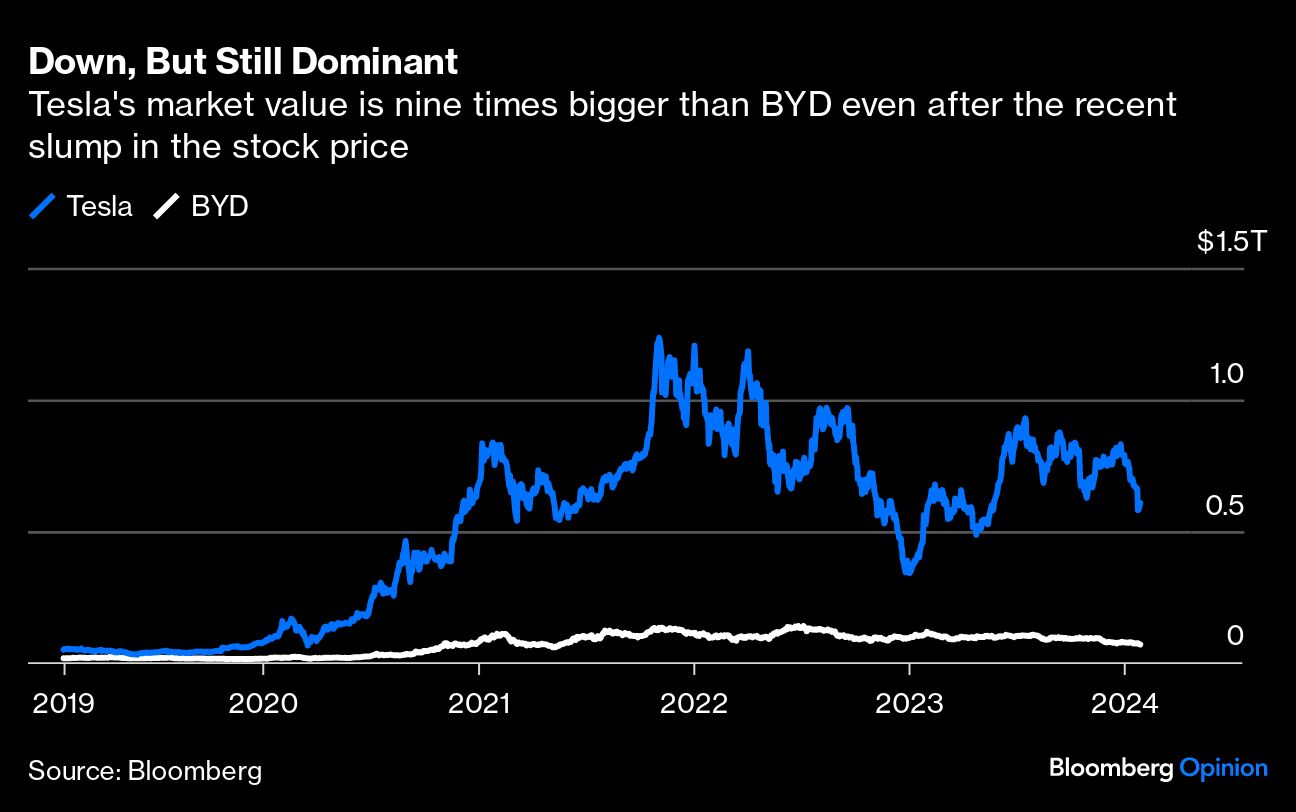
For Tesla Inc., being the tenth most valuable company with the greatest market capitalization and fastest growing profitability of any maker of cars and trucks, is seemingly atrocious.
Losing 50% of shareholder worth since the November 2021 all-time high in the stock price while suffering the longest consecutive weekly decline in seven years is a foreboding trend, especially when Austin, Texas-based Tesla is ceding its No. 1 zero-emission perch to China's BYD Co. amid slowing sales. Chief Executive Officer Elon Musk's antisemitic tweet last year on the X platform he rebranded after acquiring Twitter for $44 billion was yet another reason for the eroding confidence among his most loyal investors.
Analysts already retreated from Tesla to the extent almost 65% no longer recommend the shares. As my Bloomberg Opinion colleague Liam Denning summarized after Tesla's disappointing earnings call last week: “Tesla began 2023 valued at $341 billion. Over the ensuing 12 months, earnings fell by 24% (excluding the fourth quarter’s non-cash tax benefit) and the consensus forward earnings estimate for Tesla dropped by 27%. Valuation today: $660 billion. That wave needs to be a tsunami.” Or as Adam Sarhan, founder and CEO of 50 Park Investments, told Bloomberg News on Jan. 21, “If Tesla is lowering its forecast and not bullish in the near term, why should investors be bullish,” adding that “there is no floor in this stock in the near term.''
And yet, there doesn't appear to be a ceiling for Tesla shares either. While Tesla “may not be growing 50% a year as the company thought, this year in a tough environment” Tesla is “still growing volume by 15% to 20% per year and making us $7,000 per car of gross profit,” David Baron, manager of the Baron Focused Growth Fund, who predicted Tesla will appreciate 56% to $300 a share in about 12 months and 525% to $1,200 by 2030, said during a Jan. 26 interview with Bloomberg News.
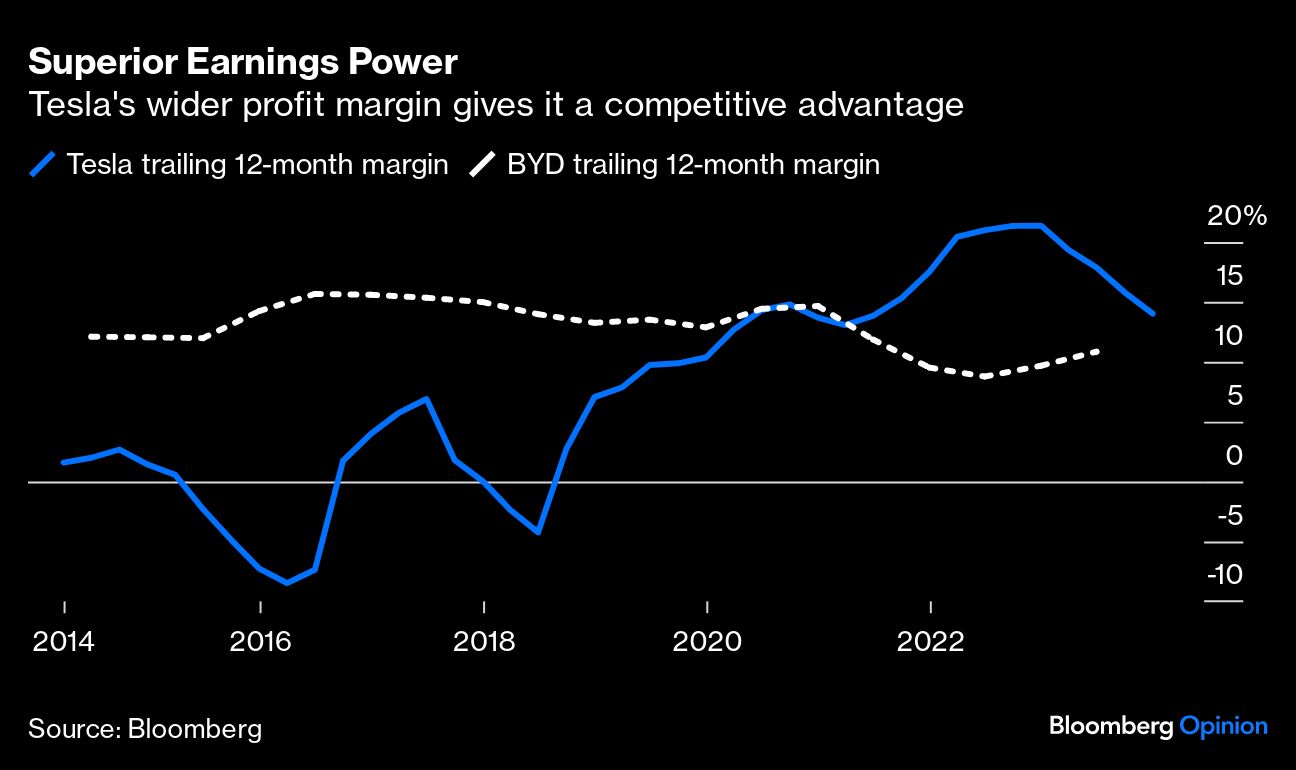
Although BYD may be attracting favorable attention in the media for overtaking Tesla as the global sales leader in the fourth quarter, profitability is another matter and one that is closely scrutinized by investors. The Shenzhen, Guangdong-based company led by Wang Chuan-Fu, turns $100 of sales into $11 of earnings before interest, taxes, depreciation and amortization expenses, for an Ebitda margin of 11%. The ratio fluctuated between 11% and 16% during the past 10 years, peaking in 2016. Tesla is turning $100 of revenue into $14 of earnings, delivering an Ebitda margin of 14%. Back in 2016, Tesla lost $8 for every $100 of sales, so its relative strength in generating earnings increased as BYD's declined, according to data compiled by Bloomberg.