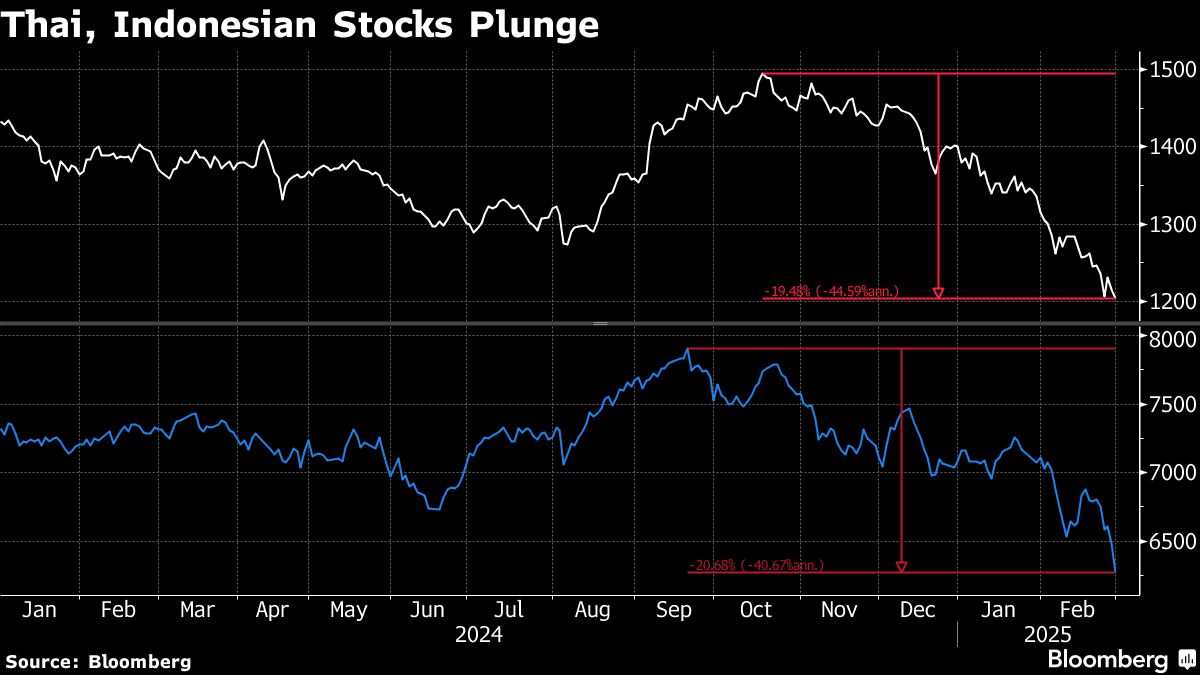
Emerging markets were swept up in the global equities storm Friday, with Asian stocks taking the heaviest beating after President Donald Trump’s latest tariff threats.
The equities market in Jakarta entered bear territory, with the nation’s central bank pledging strong intervention after the rupiah hit a five-year low. Thailand’s benchmark equity index also closed near a bear market. An index of mainland Chinese shares listed in Hong Kong slid 3.6%, the most since October, while an onshore benchmark dropped 2%.
“Trump tariffs threats are obviously on everyone’s mind and sentiments are fragile throughout, with the rebound in the dollar,” said Kok Hoong Wong, head of institutional equities sale trading at Maybank Securities Pte.
Emerging-market investors are grappling with uncertainty around Trump’s trade policies and the Federal Reserve’s rate path. The prospect of higher tariffs and sluggish global demand is weighing heavily on export-driven economies like Thailand, while Indonesia — despite net bond inflows — faces growing capital flight.
MSCI Inc.’s benchmark EM equities gauge fell 2.2% by 10:30 a.m. in London, the most since October, while the equivalent for currencies was down 0.3%.
Eastern European stock markets also fell, though currencies in the region rebounded. The Polish zloty, which briefly hit a 10-year high against the euro in the previous session, advanced again on Friday.
Trade-War Fears
Friday’s turmoil follows Trump’s declaration of further tariffs on China, along with plans for levies on Mexico and Canada in the coming week. The fresh duties on Chinese goods are stoking fears of an escalating trade war between the world’s two biggest economies, while economists warn that tariffs could push Mexico and Canada toward recession.
“Unfortunately, Trump pushing hard on tariff against China, Canada, Mexico and likely more to come, raises inflationary pressure in US and thus rates-higher-for-longer, thus we see the dollar spike,” said Xin-Yao Ng, a fund manager at abrdn. That’s “putting pressure on markets with more vulnerable currencies including several countries in Asean like Indonesia especially.”
The Bloomberg Dollar Spot Index has gained 0.8% this week while a gauge of Asian currencies is set for the worst week in more than three months.
“There is still time for deals to be struck, but FX markets have fully switched to defensive mode,” ING Bank said in a note.
A message from Advisor Perspectives and VettaFi: To learn more about this and other topics, check out some of our webcasts.
Bloomberg News provided this article. For more articles like this please visit
bloomberg.com.