Despite the talk of austerity — and amid the possibility of a global trade war, the reality of a stock-market correction and fears of a US recession — there is still a chance that President Donald Trump’s agenda could increase economic growth. As usual, it will depend on the execution.
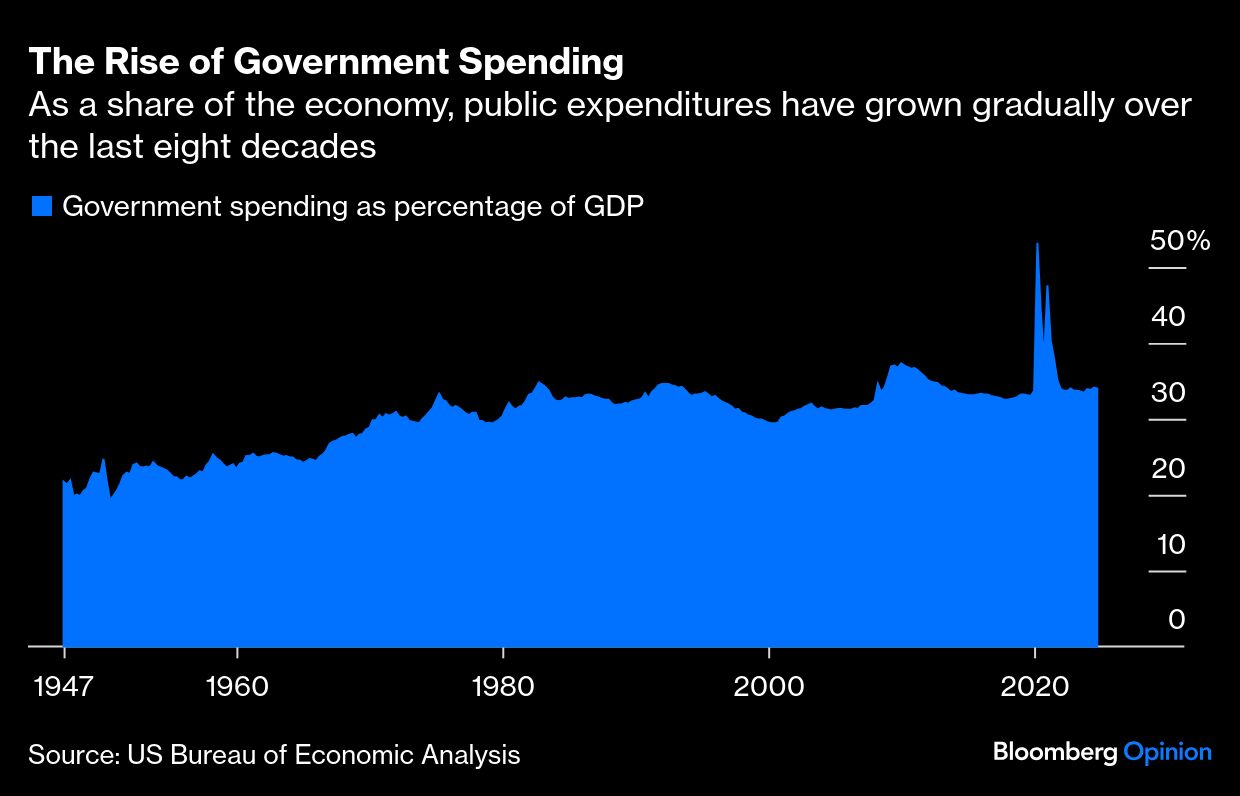
It’s true that the first item on the president’s agenda, shrinking the size of government, is usually associated with a policy of austerity. But while Elon Musk’s Department of Government Efficiency is causing major disruptions — firing people, cutting funding, eliminating agencies — it does not by itself amount to an austerity program. Austerity involves a policy, usually forced in times of crisis, that aims to shrink the economy by reducing both spending and deficits. This is not what DOGE is; it does aim to lower costs, but its effect is small and it has no say on revenue.
Stimulus, meanwhile, can come from either increasing spending or cutting taxes. If Congress approves tax cuts later this year, they could offset or overwhelm any spending cuts from the DOGE effort. If tax reform is productive (that is, does more than just making tips tax-free), then it would be reasonable to expect more growth.
It’s also worth keeping in mind Treasury Secretary Scott Bessent’s characterization of the administration’s overall strategy: to move resources from the public to the private sector. This can be good for the economy — especially if you believe, as I do, that the private sector is better at allocating capital and labor. And there is evidence that government spending has not been so great at increasing growth anyway.
Of course, whether the private sector can actually do better depends on the nature and level of tax cuts. There are plans to extend the 2017 tax cuts on households, which are currently in effect, and to restore provisions about such things as depreciation that make investing more profitable. These policies, which have proved to be expansionary, should be made permanent. Trump also proposed lowering the corporate tax rate to 15%, which would further shift resources from the government to the private sector. More deregulation, which was another campaign promise, would expand the private sector and make the economy more dynamic.
There are, however, two huge risks to this growth scenario: debt and uncertainty.
Any growth from cutting taxes and deregulation is not likely to offset the increase in the size of the debt, which is a drag on the economy. The uncertainty comes from tariffs.
Tariffs are not, in general, good for growth — but the details and the motives matter. There’s a lot that could go wrong: If the main goal is to make more things in the US and reduce trade with the rest of the world, that would reduce growth. It’s also the case that the costs of tariffs on imported goods are mostly borne by consumers, and the costs on production inputs are borne by businesses. These increased costs would hurt growth. Finally, revenue from tariffs would not help reduce the deficit if they were accompanied by a big corporate tax cut.
So what could go right? It’s possible that all this tariff talk is a bargaining ploy to force other countries to lower their tariffs, resulting in more fair and predictable trading relationships. If the US winds up with lower tariffs on non-Chinese countries and lower corporate taxes, that would definitely lead to more growth.
There is a third category of how tariffs could go: not as good as their proponents say, but not as bad as their opponents claim. America is mostly a service economy, for example, and trade is smaller share of its economy compared to other countries, so tariffs might not have as big an impact as many fear. Those corporate tax cuts could be structured in a way so that they offset some of the short- and medium-run cost of tariffs.
If everything aligns, the US could end up with better growth. It could also end up with more debt. It is a high-risk, high-reward strategy, and no one can know for sure how it will turn out. If the administration can work out a more organized and predictable plan for tariffs, it may be able to both calm the markets and put consumers and businesses at ease. Because uncertainty is never good for growth, even if tax cuts are.
A message from Advisor Perspectives and VettaFi: To learn more about this and other topics, check out some of our webcasts.
Bloomberg News provided this article. For more articles like this please visit
bloomberg.com.