An Advisor Road Map to the Corporate Trustee Industry
Membership required
Membership is now required to use this feature. To learn more:
View Membership Benefits Advisor Perspectives welcomes guest contributions. The views presented here do not necessarily represent those of Advisor Perspectives.
An ongoing avalanche of asset transfers between generations will continue over the next 30 years. That heralds the creation of a somewhat smaller avalanche of trusts to facilitate the transfer of those assets to the next generation. However, trusts require trustees, and despite the ancient nature of the trust concept, there have been many changes to practices, regulations and laws. Advisors have an opportunity to provide added value to their current clients by helping them navigate the process of creating a trust and establishing the trustee. This article provides information on the history and more recent developments of trust law and the corporate trustee industry. This information will help advisors to make informed decisions on clients’ generational planning choices, and to attract and retain assets.
A trust owns assets in trust for one or more beneficiaries that are administrated by a trustee. Over the past two decades the corporate trustee industry serving personal trusts has changed significantly. The evolution of the stodgy, roughly 700-year-old industry to the modern era stems from independent corporate trustees and several states modernizing their trust statutes (Holdsworth 1975, pp. 414–417). The large traditional corporate trustee has adapted by mimicking these smaller independent corporate trustees.
With the rise of the internet, the democratization of information, and the interconnectivity of information, the corporate trustee serving personal trusts is at a unique junction. What remains the same is the common thread of trust and fear that weaves through a client’s everyday financial life. The changes revolve around the need for innovation and collaboration in our information and technology age and around retaining the trust and personal touch of corporate trustee services. Financial advisors who provide generational planning need to understand the changes and opportunities in the corporate trustee industry.
At stake for financial advisors and their clients alike is the dependable execution of those generational plans and the $24 trillion of future bequest transfers (after taxes and charitable giving) (Srinivas and Goradia 2015, p. 6). Capitalist societies continue to evolve. This includes the corporate trustee industry.
History of Trust Law
To know how trust law has evolved, it helps to know where it began. Trust law has existed for 2,000 years. The foundation of current U.S. trust law is from Roman and British law. The Roman Empire established the legal concept of a testamentary trust (created within a will). The signing of the Magna Carta in 1215 in England allowed the legal concept of individuals owning property and assets.
The concept of a living trust (also known as a revocable trust) emerged due to the Crusades. Men left England to fight in the Crusades and retitled their property in “trust” managed by a trusted individual should they not return home. In a series of cases from the early 1300s, the law responded to trustees not fulfilling their fiduciary duties by codifying trustee legal responsibility (Maitland 2010). The basic tenets of those court cases are represented in any trust statute that modern trustees are regulated to follow.
A trustee has two key responsibilities: to provide for the distribution and the management of the trust assets. These responsibilities are described inside a trust document (testamentary, irrevocable, or living) that is essentially a contract between a trustee, beneficiary, and the creator (also known as the grantor or testator) of the trust. Over the past 20 years, there have been drastic changes in the trust industry (Maitland 2010).
Past and Present of the Corporate Trustee Industry
Our parents, grandparents, great-grandparents, etc. all had the same experiences with a corporate trustee. The trust officer of a local or large bank offered trustee services to banking clients. Clients did not have easy access to knowledge nor choices about investments and trust law. Technology was limited to the speed of copier machines.
Those trust officers were duty bound“to administer the trust solely in the interest of the beneficiary,”1 which began to be called the “sole interest rule.” The concepts of avoiding conflicts of interests, placing the needs of the beneficiary before the trustee, and other related fiduciary concepts were followed.
There was no real leap of faith for families dealing with their trust officers at the local or large bank. Decisions were made locally. The trust officers lived locally. Those banks custodied the trust investment assets, which is why trust documents had large capital and surplus requirements. (As an aside, estate planning attorneys are beginning to recognize the custodial powerhouses such as Schwab, Pershing, Fidelity, and TD Ameritrade, to name a few, that make the large capital and surplus requirements for corporate trustees irrelevant today.)
Independent financial advisors did not materially exist during this corporate trustee golden period, and families enjoyed solid customer service from their trust officers at these banks for a time. Clients of those banks felt comfortable having zero control over trust investments and distributions.
Financial services lurched into the modern era beginning on May 1, 1975.2 Known as May Day in the financial industry, on that date regulators removed fixed-rate stock commissions. Innovative and collaborative companies, such as Charles Schwab Corp., were founded and began to offer faster, cheaper, client-centric financial services from trading to custodial services. The democratization of information and the spread of information around technology platforms has only increased the trust that advisors and clients place on independent parties such as Charles Schwab.
On the banking side, with the Douglas Amendment to the Bank Holding Company Act of 1956 and a court case,3 banks were allowed to own banks in other states. This led to bank consolidations, which have continued to the present day. The effect on the “sole interest rule” was that decisions no longer were made locally. The trust officer at the large or regional bank trust company lost real decision power. Trust officer turnover began to grow at these banks. Trust committee decisions about distributions and investments began to be made far away in another state.
Yet the clients of these trust companies still placed their trust in these firms while having zero control. Local banks that were not swept up in the consolidation continued to offer good, old-fashioned trustee services. As the consolidations put earning pressure on the banks — something that continues to this day — the loyalty to the beneficiary became blurry through many court cases.4
In the late 1980s and early 1990s, certain states, beginning with Delaware — and followed shortly thereafter by Nevada and South Dakota — began to offer “modern” trust laws. These modern trust laws allowed the fiduciary risk and responsibility of trust investment and/or distribution decisions to be made by noncorporate trustees. For example, financial advisors now could manage trust investments at the custodian of their choosing. These states also removed the Rule Against Perpetuities—a legal concept that holds that trusts are not allowed to list forever — and added privacy and asset protection laws. Their innovation and collaboration on trust law continues to this day.5
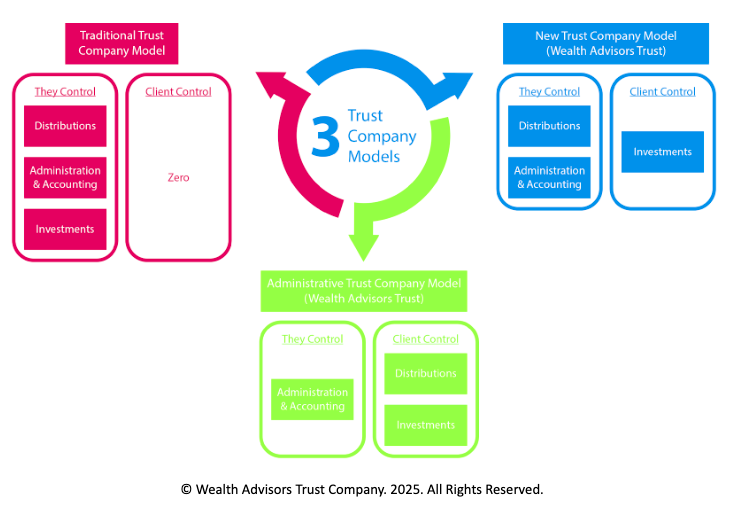
Also, by the mid-1980s, financial advisors began to leave the large national and regional brokerage firms and offer their services independently (O’Mara 2015). The consolidation of banks, founding of new custodians, and implementation of modern trust laws created an opportunity. Roughly, over the past two decades, we have seen the emergence of independent trust companies that are custodian neutral and choose not to compete against financial advisors. They are the corporate trustee industry innovators for clients and advisors (see figure 1).
Picking a Trustee for a Trust Fund
Clients, estate attorneys, and advisors today have more choices than ever before on the type of trustee and the state where the trust is established. The following sections describe the present ranges and outcomes of those choices.
Picking a trustee generally gets less attention and time than choosing a new smartphone.6 It’s just not exactly a fun moment. When discussing the potential trustee choices for their trust, clients are sitting with an estate planning attorney or — even better — having the discussion with their financial advisor. Advisors see the whole financial picture and ask questions about the “philosophy of a client’s money and their family.”7 For engineers and mathematicians this is a logical process. For everyone else, it is a winding road of emotions and what-ifs. To sum up, clients have to pick who will fill a few key roles in their wills or separate trusts. A trustee is one of those key roles (see figure 2).
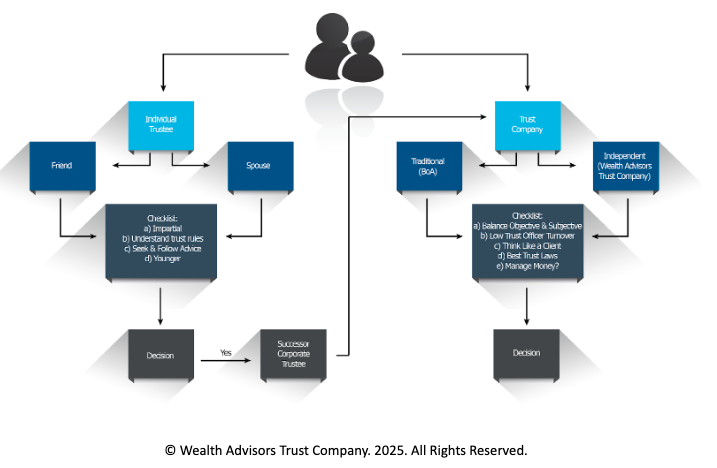
A client should consider an independent trustee (e.g., individual or corporate) when the beneficiary will have challenges with money, needs an impartial advocate, needs asset protection, or wants to keep the assets out of a future estate. Whatever the choice, all trust documents should allow for the trustee to be removed without cause, without filing with the courts, and allow the trust governing law to be changed based on the location of the successor trustee. Trustees should not have the ability to stymie change or remove the choices from a beneficiary.
The fiduciary needs and wants of beneficiaries are paramount to a trustee’s duty. Corporate trustees and advisors can and must work collaboratively. According to the “sole interest rule,” advisors and corporate trustees have the moral and legal fiduciary obligation to place their needs and wants second to those of the beneficiary. A beneficiary’s fiduciary needs are very simple — distribution and investment decisions must be made for their and future beneficiaries’ betterment. A beneficiary’s fiduciary wants are more subtle — to be kept informed, for decisions to be made quickly, not to be made to feel guilty when asking questions about distribution requests, and to be provided a collaborative experience with reasonable and customized responses and solutions.
A corporate trustee, acting as a fiduciary, is required to follow rules inside the trust document and have a clear process to determine who has the investment fiduciary risk and responsibility. Trustees, whether an individual or a company, want their services to have open communication between the advisor and the beneficiary. Corporate trustees who accept that their services are a solution — not the solution — will remain innovative, collaborative, and focused on the beneficiaries’ interests.
When a trust document delegates or directs for the use of an independent financial advisor, advisors want a seamless process. From the investment management to the mechanics of trust distributions, advisors want the trustee, whether an individual or a corporate trustee, to reduce and not add to their compliance concerns and daily workload. Advisors managing trust fund assets with an individual as the trustee are required, as a fiduciary, to be aware of the rules of the trust. Fiduciary roles and responsibilities around trust fund administration are paramount for advisors, so they need to use trustees who are well-schooled on these issues.
Advisors and clients are faced with multiple choices when choosing a corporate trustee. Additionally, advisors can hire firms to private label trustee services under the name of the financial advisory firm.8 This brings a few extra complications and benefits. The benefits allow those advisory firms to show they offer a full suite of wealth management solutions including trustee services. The complications involve clients being confused as to who is serving as the ultimate trustee (i.e., decision maker), a higher level of regulatory scrutiny, and risk of the financial advisory firm unknowingly acting in a trustee capacity (e.g., approving trust distributions, which is not in their purview).
Setting aside that complicated solution, there is one last issue for advisors to consider. When choosing a corporate trustee, advisors need to consider the following four key questions:
- Does the corporate trustee really understand the advisor’s business and clients?
- What legal and technological innovative solutions does the corporate trustee offer to make the advisor’s daily workflow and client experience better?
- Does the corporate trustee allow the advisor to choose the custodian and investment process?
- Apart from making a profit, why is the corporate trustee offering these services to advisors?
Present Trust Law
The present state of trust law in the United States has its roots in common law, which was adopted from England (Jay 1985). The establishment and maintenance of trust law has been left to individual states in the U.S. federal legal system per our founding fathers.9 Throughout the past century, with moving across state lines becoming easier and more common in the U.S., there have been strong calls from attorneys, judges, and beneficiaries to create a standard for trust laws that states could adopt or use as a basis for their own versions. The Uniform Trust Code10 (UTC) was established in 2000 and has been adopted by a large majority of states. However, several state,s such as Delaware, Nevada, and South Dakota, believed the UTC was not vibrant enough and have created trust laws that are industry leading (Worthington and Merric 2017).
The key areas separating the top trust states involve decanting laws, directed trusts, perpetual trusts, state income or capital gains taxes, privacy laws, self-settled trusts, and community property trusts.11 What remains constant is the focus of all trustees on the “sole interest rule.” Clients now can choose, within their trust documents (testamentary, living, or irrevocable), the best trust jurisdiction — or at the very least allow the governing law of their trust documents to be changed based on the location and administration of the trustee (individual or corporate). The top trust states desire to attract high-paying jobs. That ensures their continued thought leadership, along with a vibrant trust-industry community in those states pushing for cutting-edge trust law.12
Directed trusts: A trust law hallmark for present-day clients, advisors, and attorneys occurred in 1994, with the passing of the directed trust law in Delaware.13 Before directed trust laws, corporate trustees had the option to delegate investment management of trust assets to an independent financial advisor. Directed trust laws allow for the distinct fiduciary separation of trustee duties from a corporate trustee. Six states offer recognized leading trust law statutes (Worthington and Merric 2017).
Advisors and their clients now have access to all the top trust law states regardless of their residence. Advisors making use of the directed trust laws in Delaware, Nevada, or South Dakota have the flexibility to manage trust investment assets independent of trustee guidance or oversight. The advisor, and not the corporate trustee, bears the fiduciary investment risk.
This raises a legal issue: Should advisors be formally informed that they, and not the corporate trustee, have this fiduciary investment risk? Currently, few independent or even traditional trust companies offering independent trustee services have procedures in place to inform advisors of this fact.14 One popular opinion among corporate trustees, and not shared by this author, is that advisors are professionals and are aware, or should be aware, of the trust statutes governing a trust document. Advisors should understand the consequences of serving under a directed trust.
Delegated trusts: Formally known as discretionary trusts in the trust industry, delegated trusts are the majority of trusts in existence today. They generally state that the trustee may delegate to an outside advisor the investment of the trust assets. Traditional corporate trustees elect not to delegate this investment authority, keep the investment fees, and subsequently remove any current financial advisor when they are the successor trustee in a client’s will, or a revocable or irrevocable trust. Independent trust companies delegate that investment authority to the advisor but retain the fiduciary investment risk, as does the advisor.
Advisors and clients have the option to decant, or modify, the trust document when changing to a state with top-tier trust laws. There are inconsistent risk management practices among advisor-friendly trust companies regarding how to monitor the investment actions of those advisors. Some independent corporate trustees limit the advisor to certain investment models. Other corporate trustees are selective about which advisors they will work with based on SEC background checks or the investment approach they use for clients. The corporate trustee, not the advisor, has the final decision on those risk management processes.
Advisors who want the choice to invest the trust assets need to clearly understand their legal responsibility under a directed or a delegated trust. Advisors and their clients are looking for corporate trustees to provide easy-to-understand terms and conditions of their trustee services around the “sole interest rule.”15
Conclusion
This article has described the history and current status of trust law and the corporate trustee industry. Advisors and their clients have more control and choices with trusts than ever before. To summarize: (1) advisors need to be aware of the consequences of serving under a directed trust; (2) clients can use the best trust laws of a given state in the United States while living in another state; (3) advisors can invest trust fund assets; (4) advisors can be added into trust documents as the financial advisor in order to provide multi-generational advice for their clients; and (5) not all corporate trustees are advisor-friendly.
As much as the trust industry has changed and will continue to change, one tenet remains rock steady: The duty and responsibility to follow the “sole interest rule” for the beneficiary of a trust fund remains paramount.
Christopher N. Holtby, CPWA®, is co-founder of Wealth Advisors Trust Company. He earned a BA in psychology from University of Arizona and is working towards his Masters in History at Harvard Univserity. Contact him at [email protected].
A message from Advisor Perspectives and VettaFi: To learn more about this and other topics, check out some of our webcasts.
Endnotes
1 Restatement (Second) of Trusts §170(1) 1959; accord UTC §802(a) 2000.
2 Id.
3 See Northeast Bancorp v. Board of Governors, https://www.oyez.org/cases/1984/84-363.
4 See Ashby Henderson v. The Bank of New York Mellon, https://docs.justia.com/cases/federal/district-courts/massachusetts/madce/1:2015cv10599/167967/72.
5 See https://wealthadvisorstrust.com/leading-trust-states-comparison/.
6 Id.
7 Chuck Sharpe, Sharpe Law Group, personal communication (2018).
8 For example, National Advisors Trust Company, http://www.nationaladvisorstrust.com.
9 Tenth Amendment of United States Constitution, Ratified December 15, 1791.
10 See http://uniformlaws.org/Act.aspx?title=Trust%20Code.
11 As of July 2018 only in Nevada, Alaska, and South Dakota.
12 Id.
13 Directed Trust Statute, Delaware Code, Ann. 12 §3313.
14 Id.
15 2018 Edelman Trust Barometer, Financial Services Edition, https://www.edelman.com/trust-in-financial-services-2018, p. 28.
References
Holdsworth, W. S. 1976. A History of English Law, Volume 4, Methuen: 414–417. https://books.google.com/books?id=PqE8oAEACAAJ.
Jay, Stewart. 1985. Origins of Federal Common Law: Part Two. University of Pennsylvania Law Review 133, no. 6 (July): 1,231–1,333.
Maitland, Frederic William (ed.). 2010. Bracton’s Note Book: A Collection of Cases Decided in the King’s Courts during the Reign of Henry the Third. New York: Cambridge University Press.
McLean, Bethany, and Ethan Wolff-Mann. 2018. Wells Fargo Automated High-Net-Worth Wealth Management as Advisors Faced Sales Pressure (July 18). https://finance.yahoo.com/news/wells-fargo-automated-high-net-worth-wealth-management-advisors-faced-sales-pressure-151535558.html.
O’Mara, Kelly. 2015. How Many RIAs Are There? No, Seriously, How Many? (November 11). https://riabiz.com/a/2015/11/11/how-many-rias-are-there-no-seriously-how-many.
Srinivas, Val, and Urval Goradia. 2015. The Future of Wealth in the United States (November 9). Deloitte Center for Financial Services: 6. https://www2.deloitte.com/insights/us/en/industry/investment-management/us-generational-wealth-trends.html.
Worthington, Daniel G., and Mark Merric. 2017. Which Trust Situs is Best in 2018. Trusts & Estates (December 13): 1.
Membership required
Membership is now required to use this feature. To learn more:
View Membership BenefitsSponsored Content
Upcoming Virtual Events View All