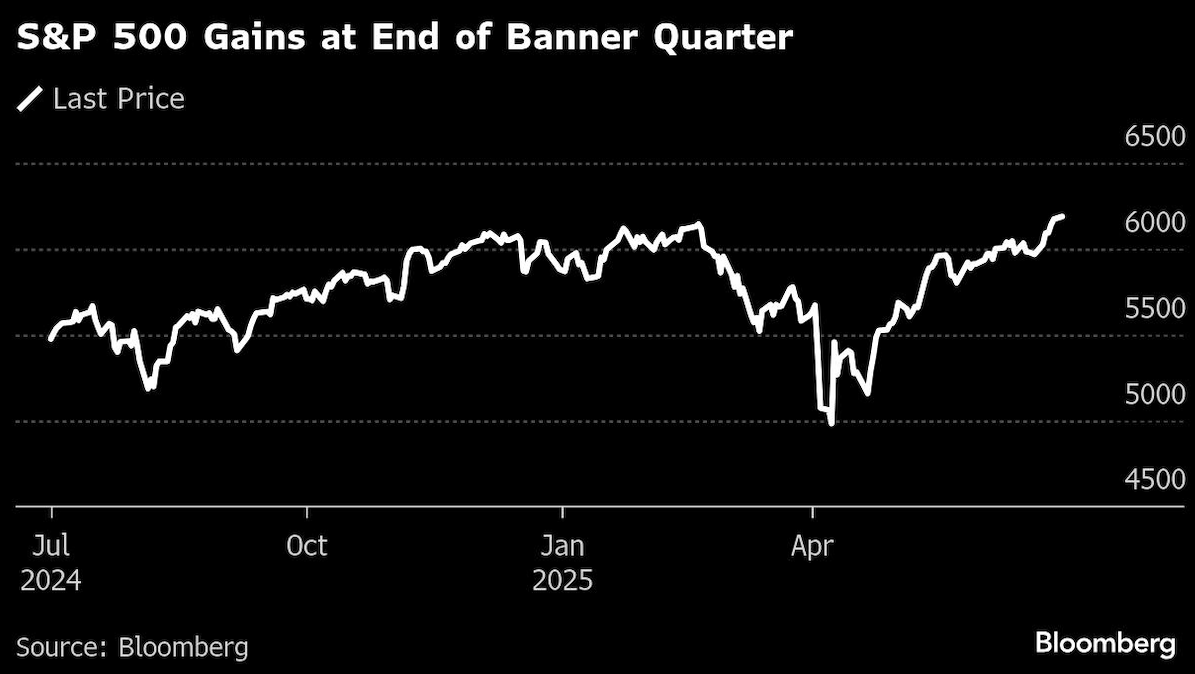
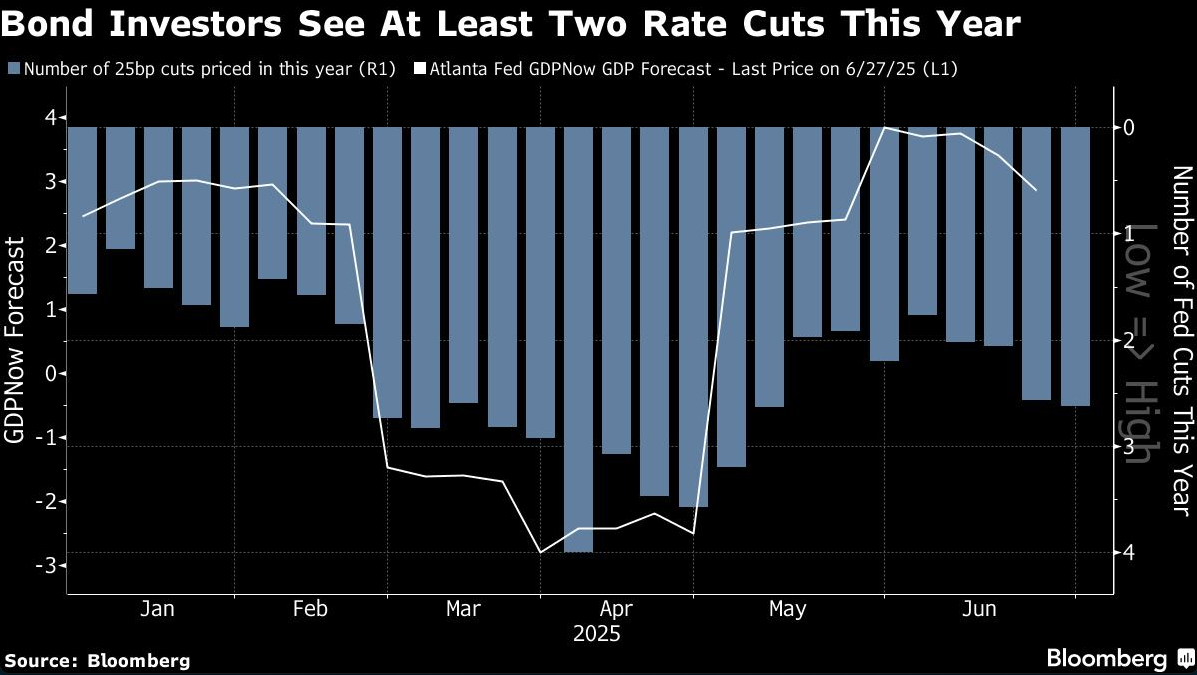
Stocks are wrapping up a stellar quarter at all-time highs amid signs of progress in US trade talks while hopes the Federal Reserve will resume its rate cuts drove Treasuries toward their biggest first-half stretch in five years. The dollar eyed its longest monthly slide since 2017.
The S&P 500’s 24% surge from the brink of a bear market put the benchmark on pace for its best quarter since December 2023. While gains were mild on Monday, optimism the US is close to reaching deals with top trading partners sent the gauge near 6,200. Big banks climbed after passing the Fed’s annual stress test, setting the stage for payouts. Oracle Corp. jumped on a cloud-services deal worth $30 billion a year.
Just days ahead of the US jobs report, bonds saw modest gains. Treasury Secretary Scott Bessent indicated it wouldn’t make sense for the government to ramp up sales of longer-term securities given where yields are today, though he held out hope that rates across maturities will be falling as inflation slows.
“Markets will stay glued to US economic updates – especially from the jobs sector – in the week ahead, though for as long as there are no major escalations again in the Middle East or in the trade war, you’d think stock markets may not suffer much on any macro data,” said Fawad Razaqzada at City Index and Forex.com. “Still, there is always room for surprises.”
With President Donald Trump’s July 9 trade deadline fast approaching, Canada withdrew its digital services tax on tech companies in a move to restart talks with the US. India’s trade team extended their stay in Washington to iron out differences. Officials earlier said negotiations with major partners such as China and the European Union were making progress.
While markets have been more focused on the administration’s trade talks ahead, the tax bill’s progress — and its estimated $3.3 trillion cost — has also been closely monitored. Trump remained in contact with lawmakers, according to an administration official who said the White House remains optimistic that the president would get the legislation to sign by Friday.

“While tariff headlines could periodically unsettle markets, we do not currently see them as a catalyst for a sustained market selloff,” said Ulrike Hoffmann-Burchardi at UBS Global Wealth Management. “For investors under-allocated to broad equity markets, we recommend gradually increasing exposure to diversified global stocks or balanced portfolios to position for stronger potential returns in 2026 and beyond.”
After the S&P 500 came back to all-time highs it may be up to the labor market to keep the momentum going, according to Chris Larkin at E*Trade from Morgan Stanley.
“So far, the market has shrugged off signs of a slowing economy, but with the tariff picture still up in the air, a negative surprise on the jobs front could have more of an impact, especially during what will likely be a light-volume holiday week,” he said.
US stocks could come under pressure if Fed rate cuts are accompanied by weaker economic growth, according to JPMorgan Chase & Co. strategists led by Mislav Matejka. As long as there isn’t a meaningful rise in the unemployment rate, American equities are likely to get a boost from Fed policy easing, said Morgan Stanley strategists led by Michael Wilson.
Economists forecast employers added 113,000 jobs in June, the fewest in four months yet still consistent with healthy labor demand. The Bureau of Labor Statistics report is due Thursday, a day earlier than usual because of the Independence Day holiday. It’s also forecast to show the unemployment rate crept up to 4.3%.
For a Fed awaiting more clarity on the potential inflationary impact from tariffs, any pronounced deterioration in the labor market would likely lead to more pressure on officials to lower interest rates.
“We don’t think that we will see a rapid labor market deterioration on Thursday, but the risk is not low,” said Oscar Munoz and Eli Nir at TD Securities. “We remain of the view that the Fed will begin easing in October, as we expect a sufficient weakening of labor market conditions to grant policy support by then, but the September meeting is also a clear possibility.”
Earlier on Friday, Bank of America Corp. strategists warned of the increasing risk of a speculative stock-market bubble as traders drive massive flows into equities on expectations of US interest-rate cuts. The upcoming earnings season could also test the foundation of the recent rally, especially with lackluster forecasts piling in.
US profit margins will face a big test in the upcoming reporting season as investors assess the damage from Trump’s trade war, according to Goldman Sachs Group Inc. strategists.
The team led by David Kostin said second-quarter earnings will “capture the immediate effects” of tariffs that have already increased by about 10 percentage points since the start of the year.
“Healthy economic fundamentals are an ultimate buffer for negative headlines, after all,” said Seema Shah at Principal Asset Management. “As such, equities should remain resilient unless an adverse event materializes into something larger that curtails household spending and company earnings.”
That said, Shah also notes that given the uncertain policy backdrop, a broader hit to market sentiment cannot be ruled out.
“In this environment, it’s essential for investors to maintain well-diversified portfolios designed to navigate periods of heightened uncertainty,” she said.
A message from Advisor Perspectives and VettaFi: To learn more about this and other topics, check out some of our webcasts.
Bloomberg News provided this article. For more articles like this please visit
bloomberg.com.
Read more articles by Rita Nazareth