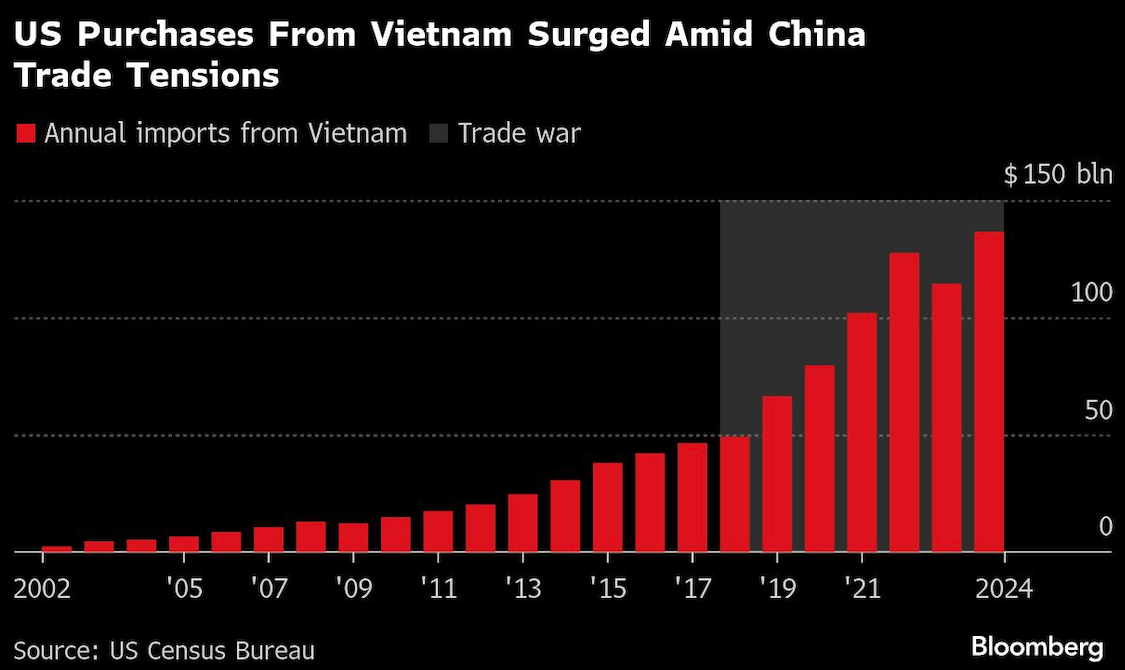
Vietnam’s trade deal with the US is a wake-up call for Asian governments grappling with the reality that higher tariffs are here to stay.
US President Donald Trump announced a 20% tariff on imports from Vietnam, and a 40% rate for goods transshipped through the country — a move mostly targeted at curbing Vietnam’s trade with China. In return, Vietnam is slashing import taxes on US goods to zero.
Although the US duties are lower than the 46% the US president had threatened to impose on Vietnam, the concessions made by the Southeast Asian nation and the higher rate for goods re-routed through the country have raised concerns in Asian capitals.
Officials in New Delhi, who are racing to clinch their own deal before a July 9 deadline when higher US tariffs kick in, say they view the Vietnam deal with a fair bit of caution. India had been seeking an exemption on reciprocal tariffs in its negotiations with the Trump administration, and Vietnam settling for a 20% rate was a worry, one of the officials said, asking not to be identified because the discussions are private.
India had also been pushing back against US demands to impose a higher tariff on goods with a larger proportion of foreign components, another official said.
The Vietnam deal suggests the US will play hardball in its negotiations with trading partners like India. New Delhi is seeking clarity on what kind of goods would carry higher levies based on foreign content, although it doesn’t expect to be hit with a rate as high as Vietnam, officials said.
India’s Ministry of Commerce and Industry didn’t immediately respond to an email seeking comment.
Asian nations like Vietnam and India are heavily reliant on China for imports and count the US as their biggest export markets.
The Lowy Institute think tank estimated that 28% of Vietnamese exports to the US were made up of Chinese content in 2022, up from 9% in 2018. In India’s electronic component sector, China accounted for more than 60% of the industry’s imports in 2024, according to an industry report.
In the negotiations, the US had been pushing Vietnam to get tougher on trade fraud and do more to prevent Chinese goods from being rerouted and repackaged through the country. Trump officials have also demanded India tighten rules-of-origin requirements in order to restrict Chinese goods being shipped to the US via India.
In Thailand, the Vietnam agreement was viewed as a sign of things to come. The tiered tariff system “isn’t just about taxes,” said Santitarn Sathirathai, an economist and member of the central bank’s Monetary Policy Committee. “It reflects that the new world of trade may reward countries that can actually create value domestically,” he said.
That means countries like Thailand — which is also under the spotlight as a transshipment hub for Chinese goods — will need to invest more and expand production bases.
“The Vietnam-US deal is not the end, but the beginning of a new approach to trade,” Santitarn said in a post on Facebook.

To ease trade tensions with the US, several Asian countries have vowed to buy more American goods to curb their trade surpluses with the US. Indonesia announced Thursday it will sign trade and investment pacts worth $34 billion with the US as part of its effort to secure a tariff deal.
The US had no concerns about transshipment involving Indonesia and hadn’t broached the topic in trade discussions, unlike in Vietnam, Coordinating Economic Minister Airlangga Hartarto told reporters.
China’s Interests
Much is still unknown about the Vietnam deal, including which goods would be deemed transshipped and carry a higher tariff rate. It’s also unclear how China would respond to the US’s measures to curb its trade with Asian nations.
On Thursday in Beijing, a spokeswoman for China’s Ministry of Commerce indicated the country will firmly protect its interests.
“My feeling is the Chinese will retaliate,” Abhisit Vejjajiva, Thailand’s former prime minister from 2008 to 2011, said in an interview.
“The Chinese might say to Vietnam that, ‘well, unless you’re offering us the same deal with the US, we’ll also charge you more tariffs,’” he said. “I think China will need to do that because otherwise it cannot deter the other countries from doing this kind of deal with the US.”
Singapore’s Deputy Prime Minister Gan Kim Yong said Southeast Asian nations will need to accept that higher US tariffs are here to stay and that businesses should expect greater scrutiny of their supply chains going forward.
‘No Choice’
“To benefit from lower tariffs – especially in sectors such as steel, autos and in time to come, pharmaceuticals – companies must be prepared to meet the US’ conditions over their production and supply chains, even if these requirements come at a much higher cost,” he said.
Kok Ping Soon, chief executive officer of the Singapore Business Federation, said firms will need to adjust to higher costs.
“If the US is going to impose a set of conditions that you have to fulfill in order to sell to the US, then you’re almost asking companies who operate a plant to bifurcate the plant,” he said in an interview on the sidelines of the Asean Conference 2025 in Singapore. “It just adds cost. But if your destination market is the US, you may have no choice but to do that.”
A message from Advisor Perspectives and VettaFi: To learn more about this and other topics, check out some of our webcasts.
Bloomberg News provided this article. For more articles like this please visit
bloomberg.com.
Read more articles by