Nvidia Corp. and Advanced Micro Devices Inc. plan to resume sales of some AI chips in China after securing Washington’s assurances that such shipments would get approved, a dramatic reversal from the Trump administration’s earlier stance on measures designed to limit Beijing’s AI ambitions.
US government officials told Nvidia they would green-light export licenses for its H20 artificial intelligence accelerator, the company said in a blog post on Monday — a move that may add billions to Nvidia’s revenue this year, restoring its ability to fulfill orders it had written off as lost due to government restrictions. Nvidia designed the less-advanced H20 chip to comply with earlier China trade curbs from Washington, which Trump’s team tightened in April to block H20 sales to the Asian country without a US permit.
AMD received similar assurances from the US Commerce Department and plans to restart shipments of its MI308 chips to China once licenses for sales are approved, the company said in a statement Tuesday. Shares of AMD jumped as much as 8.5% after markets opened in New York while Nvidia rose as much as 5%.
Chief Executive Officer Jensen Huang — who met with President Donald Trump last week and is currently in Beijing attending a government-sponsored conference — appeared on Chinese state broadcaster CCTV shortly after Nvidia announced the decision, saying the company had secured approval to begin shipping. The Commerce Department, which oversees US export controls on chips and the tools used to make them, did not immediately respond to a request for comment on whether the agency has already issued any H20 licenses.
The US move comes after weeks of thawing relations between Washington and Beijing, guided by an opaque trade truce that’s designed to see both sides approve exports of crucial technologies. After meeting his Chinese counterpart last week, US Secretary of State Marco Rubio said there’s a “strong desire on both sides” for a meeting between Trump and President Xi Jinping later this year.
Washington in recent weeks has lifted a spate of export controls — including on chip design software — imposed ahead of last month’s trade talks in London. That’s in return for China allowing more sales of rare-earth minerals needed to make a range of high-tech products, something US negotiators thought they’d achieved the month prior during talks in Geneva. Throughout and after those negotiations, Trump’s team insisted that controls on Nvidia’s H20 chips were not up for discussion.
Treasury Secretary Scott Bessent acknowledged Tuesday that the restrictions on Nvidia’s H20 chips were part of the London talks, despite his own earlier assertions that there was no such quid pro quo tying semiconductors and rare earths.
“You might say that that was a negotiating chip that we used in Geneva and in London,” Bessent said in an interview on Bloomberg Television. “It was all part of a mosaic. They had things we wanted, we had things they wanted.”
The about-face marks a massive win for Huang, who has branded US chip curbs a “failure” that fueled the rise of Huawei Technologies Co. as Nvidia’s top Chinese rival. H20 shipments also would be a boon to companies from DeepSeek to Alibaba Group Holding Ltd. that — despite Huawei’s semiconductor progress — seek Nvidia hardware to train, expand and operate the AI services they’re building to compete with the likes of OpenAI.

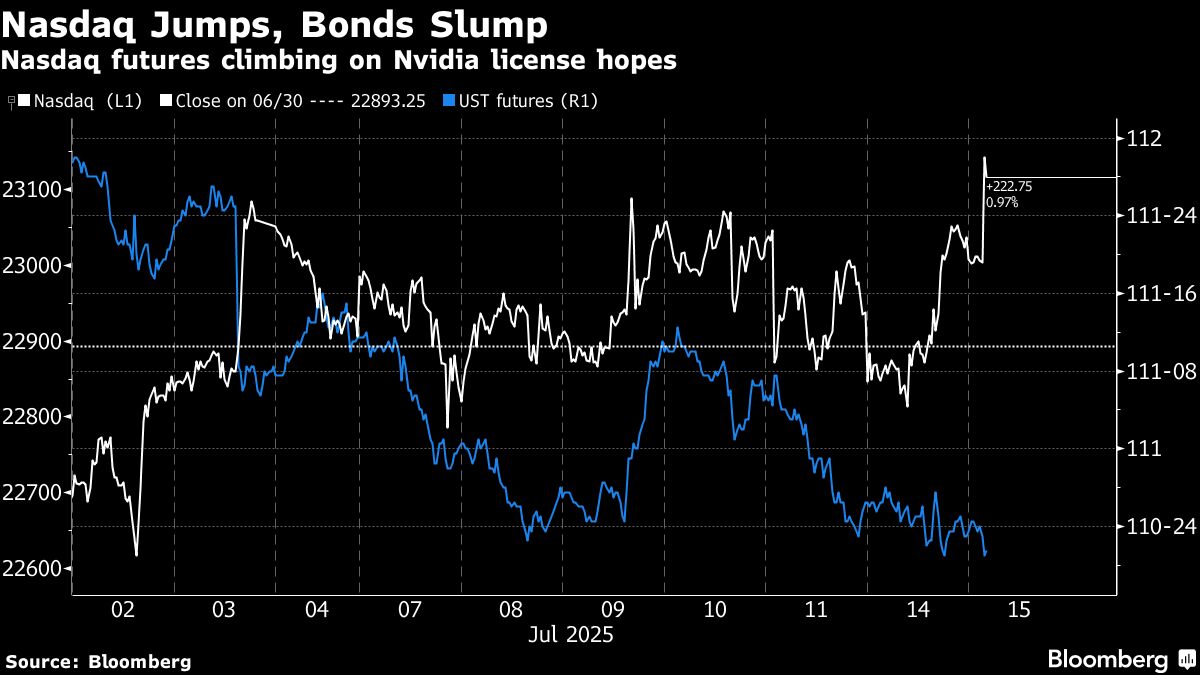
Nasdaq futures surged after Nvidia’s announcement, with Chinese stocks also reacting positively. Alibaba’s shares rose as much as 6% in Hong Kong on Tuesday, the Hang Seng Tech Index rose as much as 2.2% and data center operators like Beijing Sinnet Technology Co. jumped as much as 8.4%.
“Nvidia resuming the sale of H20 to China is obviously positive,” said Vey-Sern Ling, managing director at Union Bancaire Privee. “Not just for the company but also the AI semiconductor supply chain, as well as China tech platforms that are building AI capabilities. This is also a good development for US-China relations.”
The US first restricted Nvidia’s China sales in 2022, with sweeping curbs designed to prevent the Asian country from accessing advanced AI that could benefit the Chinese military. Nvidia has designed new processors for the China market several times to comply with those measures, which have become a central point of tension between Washington and Beijing.
Within months of the initial curbs, the chipmaker debuted the H800, which President Joe Biden’s administration effectively banned from sale to China in 2023. Nvidia responded with the H20, for which Biden officials weighed — but did not ultimately pursue — export restrictions. After Trump moved forward with H20 controls in April, Nvidia designed another China-focused product, the RTX PRO. The company described that chip as “fully compliant,” meaning that it falls below the technical thresholds that would necessitate Washington’s approval for export to the world’s second-largest economy.
“Let me stress that China opposes politicizing and weaponizing trade and tech issues,” Ministry of Foreign Affairs spokesman Lin Jian said at a regular briefing, when asked about Nvidia. Export curbs “will destabilize global industrial supply chains and will serve nobody’s interest.”
What Bloomberg Intelligence Says
The possibility that US officials will green-light Nvidia’s H20 exports to China reopens a key sales channel for the US chipmaker. The reversal could help recover a substantial portion of the $15 billion in fiscal 2026 data center revenue previously at risk, including $4-5 billion originally expected in 2H, and part of the $8 billion in unshipped 2Q orders.
— Kunjan Sobhani and Oscar Hernandez Tejada, BI analysts
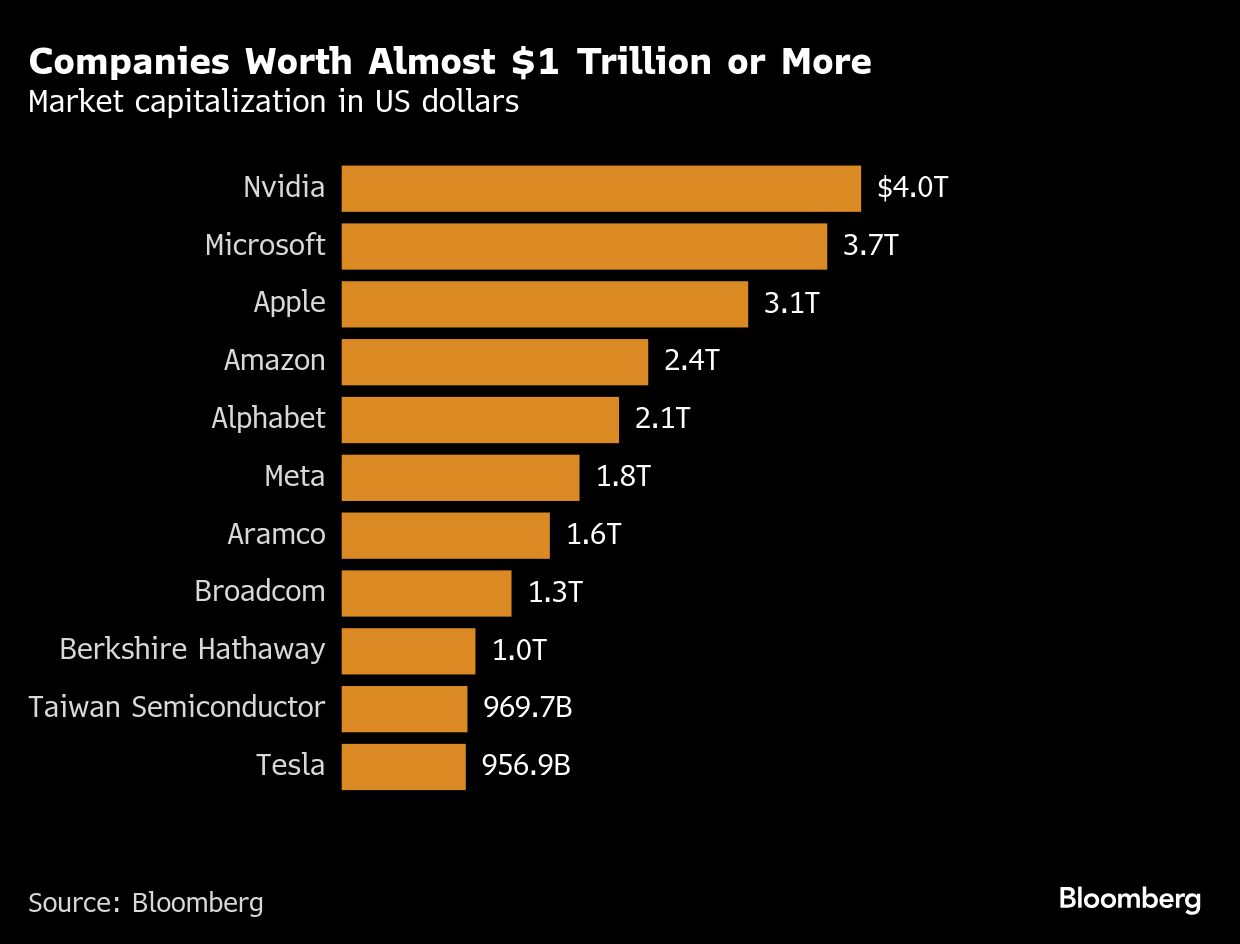
The back and forth reflects the importance of the China market for Nvidia, which made history last week as the first company to hit $4 trillion of market value — a testament to its central role in providing the hardware for a post-ChatGPT AI infrastructure building boom. Huang is currently seeking discussions with Chinese leaders, including the commerce minister, with Nvidia’s central role in the global AI rollout likely on the agenda.
Huang has also become increasingly vocal in Washington. He said recently that policymakers don’t need to worry about the Chinese military using Nvidia chips — one of the central justifications for US restrictions — since Beijing can’t rely on something that Washington could restrict at any point. He’s also warned that Nvidia’s loss of market share in the Asian country — from 95% to 50%, Huang said in May — directly benefits Huawei, the Shenzhen-based hardware giant at the center of Beijing’s tech ambitions.
For months, though, it seemed the tech chief was fighting a losing battle. While some Trump officials are keen to boost Nvidia’s sales in markets like the Middle East, they held the line on China curbs.
“We obviously have huge respect for Jensen,” Sriram Krishnan, senior AI policy adviser at the White House, said in May. But “there is still bipartisan and broad concern about what can happen to these GPUs once they’re physically inside” China, Krishnan said.
The next month, during US-China trade negotiations in London, White House National Economic Council Director Kevin Hassett said that Washington’s willingness to lift some chip-related export controls didn’t extend to the H20 measures. “The very, very high-end Nvidia stuff is not what I’m talking about,” he told CNBC at the time. Treasury Secretary Scott Bessent repeated that message to senators later that week, saying that “there is no quid pro quo in terms of chips for rare earths.”
Yet when lawmakers pressed Bessent on exactly which semiconductor curbs could be up for discussion, he stopped short of ruling out a possible easing on leading-edge chips and production equipment.
“What I’m saying is there’s no intent” to increase China’s access to advanced American semiconductors, Bessent said during congressional testimony in June. “In fact we have done just the opposite. We put export controls on the Nvidia H20, which I would regard as a very upper end chip, but not the highest end chip.”
A message from Advisor Perspectives and VettaFi: To learn more about this and other topics, check out some of our webcasts.
Bloomberg News provided this article. For more articles like this please visit
bloomberg.com.
Read more articles by Mackenzie Hawkins