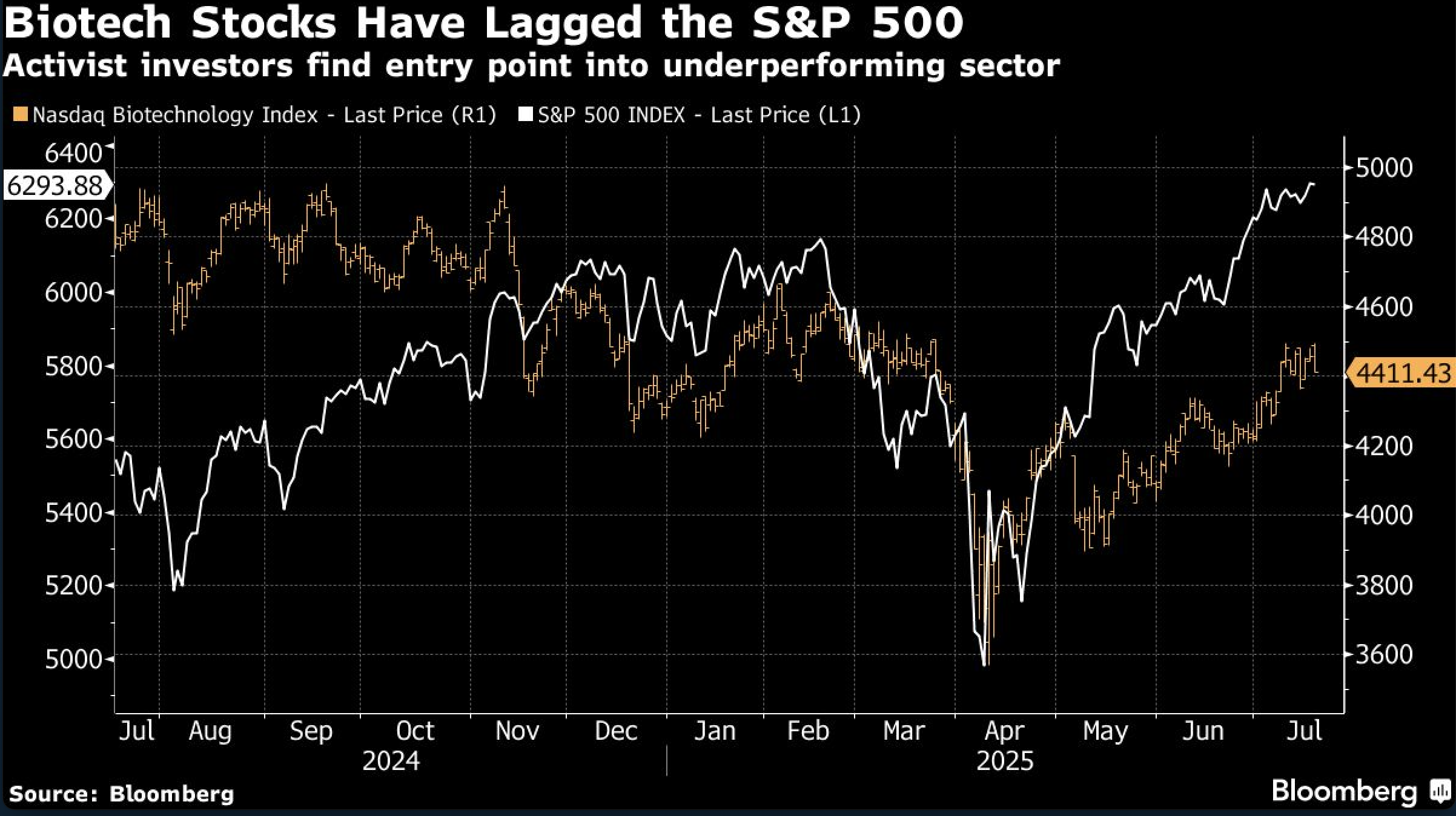
Every so often, activist investors swarm around underperforming companies in a certain industry and pressure them to change strategy. Right now, it’s biotech startups that are flush with cash but still years from successful drug approvals that are in the crosshairs.
Investors are going after what they see as a mismatch in the market: About one in every six companies in the Nasdaq Biotechnology Index is trading below its cash holdings, data compiled by Bloomberg show.
With tariffs looming, rapid turnover at top regulators and funds being drained from public health initiatives, some activists want early stage developers to cut their losses and the give capital that’s poured into the sector in recent years back to investors. One fund has said there’s as much as $30 billion tied up on biotech balance sheets.
Activist campaigns in the health-care sector jumped 61% year-on-year in the first half, according to Bloomberg-compiled data. One in every nine of all new activist campaigns targeted a biotech company, the data show.
“Companies are being forced to defend their capital expenditures,” said Avinash Mehrotra, global head of activism and takeover defense at Goldman Sachs Group Inc. “Return of capital will remain a top activist demand as we move through the balance of the year.”

Among the most active corporate agitators this year is little-known investment fund Tang Capital Management, founded by former Deutsche Bank AG analyst Kevin Tang. Since the start of the year, it’s gone after a number of US biotechs. Two of them — Allakos Inc. and Cargo Therapeutics Inc. — have been acquired by a Tang-backed shell company with plans to wind down their activities and return cash to shareholders. Another, iTeos Therapeutics Inc., started the liquidation process itself.
A fourth biotech, Acelyrin Inc., put up more resistance by implementing a poison pill to block Tang from acquiring more than 8.8% of its shares. It eventually managed to sell itself to a closely held rival, Alumis Inc., though not until a higher offer was made that Acelyrin said came after “extensive conversations with our stockholders.”
Because so many biotechs are in the initial phases of drug development and have lower market valuations, they’re an easier target for smaller investment firms that don’t have the funds on hand to go after giant companies.
New funds have also been raised to specifically target biotech. Alis Biosciences, launched in April by Nicholas Johnston, is focused on urging companies to return money to investors. The firm has claimed there are more than 300 listed life sciences and biotech companies tying up about $30 billion of capital — though its willing to meet some of them halfway.
“There is a definitive need to give cash back to shareholders,” Johnston said in an interview. “Our goal is to offer a bit more of a safety net than that — help the science to turn around but not to the detriment of hundreds of million of dollars sitting on balance sheets.”
Buoyed by the rapid development of vaccines during the Covid-19 pandemic, cash has poured into drug discovery companies from investors hoping to stumble on the next disease-curing, or transformative weight-loss, treatment. But many of those startups have seen research efforts and FDA approval processes go sideways, frustrating investors who’ve bet on the sector.
While the Nasdaq Biotech Index has bounced back from its April lows, it’s still down about 8% over the last 12 months, vastly underperforming the border equity markets. Goldman’s Mehrotra said that the volatility can create “opportunistic entry points for activists to build positions.”
Activists have a history of launching campaigns against highly specialized companies when they sense sector pressure. In recent years, Boaz Weinstein’s Saba Capital Management LP has gone after more than 140 closed-end funds, including those run by investment giants like Blackrock Inc. and Neuberger Berman, pushing for liquidation at many after share prices tumbled below the value of their underlying assets.
“If somebody latches on to an industry and has success, they can fundraise pretty well and get more capital to deploy,” said Elizabeth Gonzalez-Sussman, a partner at law firm Skadden, Arps, Slate, Meagher & Flom LLP.
‘Quick Window’
To be sure, there are still biotech success stories to be found, especially in firms that are closer to commercialization. Verona Pharma Plc, which counts activist Caligan Partners among its investors, agreed to be acquired by Merck & Co. this month in a $10 billion deal.
And despite the wider public selloff, private investments into the industry have largely held up. Venture firms poured $27.6 billion into drug discovery platforms last year, according to a JPMorgan Chase & Co. report, and funding in the first quarter of 2025 was on par with 2024. Still, federal funding cuts, particularly at the National Institutes of Health, could make companies even more dependent on private capital.
Like any activist campaign, timing is key for those targeting biotechs, according to Gonzalez-Sussman. If an activist strikes too late, there’s a chance the company could run out of cash to return to investors before the campaign is successful, she said.
“It’s a risky endeavor because it’s so capital intensive,” Gonzalez-Sussman said. “It’s a quick window for some of these companies that are not ready to give up.”
A message from Advisor Perspectives and VettaFi: To learn more about this and other topics, check out some of our webcasts.
Bloomberg News provided this article. For more articles like this please visit
bloomberg.com.
Read more articles by Crystal Tse