An avalanche of cheap Chinese stuff is landing on doorsteps across Latin America. Bargain-hungry consumers are giddy, local retailers are getting pummeled and customs agencies are swamped.
Enter the taxman.
Lea en español.
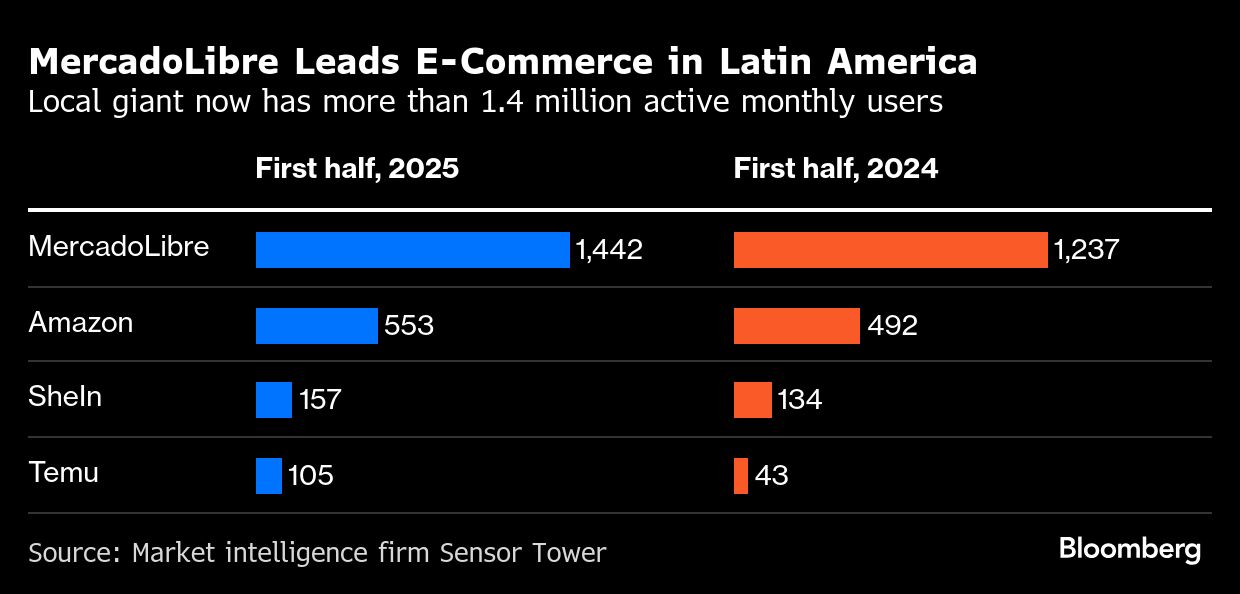
Governments from Mexico to Chile are starting to levy low-cost imports in a bid to protect local businesses from the glut coming out of China’s bloated factories. Spearheading the onslaught are Chinese e-commerce companies Temu, SheIn Group Ltd. and AliExpress, part of Alibaba Group. The aggressive trio is still dwarfed by incumbent MercadoLibre Inc. and Amazon.com Inc., but the trend is changing fast.
In the first half of 2025, Temu’s monthly active users in Latin America soared 143% year on year to 105 million, according to market intelligence firm Sensor Tower.
Governments are taking note. “These platforms are going to ruffle feathers and have ripple effects on local economies,” said Margaret Myers, director of the Asia and Latin America program at the Inter-American Dialogue.
The region’s new import taxes mirror pushback elsewhere. The US will start to tax low-value packages from Aug. 29, while the EU is investigating Temu for allegedly failing to stop the sale of illegal goods. Scrutiny of Chinese knock-offs is growing.
But commodity-exporting Latin American countries have less leeway to act against Chinese interests because of their lopsided trade dynamic with Beijing, said Evan Ellis, a Latin America scholar at the US Army War College.
China’s “leverage comes from implicit threats often not to buy the commodities that are important or not to provide a loan,” Ellis said.
At a time of geopolitical tension and rising trade tariffs, Beijing is not indifferent to the backlash. The Asian giant will need to walk a fine line between its pursuit of markets for its excess industrial capacity and managing how that trade policy affects the Global South’s view of China, Myers said.
The backlash is spreading. In Mexico, the government has increased an import duty on small parcels from China and other countries with which it doesn’t have trade agreements to 33.5% from a previous 19%. The higher levy is meant to shore up local factories and check the illegal resale of goods purchased over platforms like Temu, said Vidal Llerenas, deputy economy minister for industries and trade.
“Mexico could put more duties on goods if they are produced here or could be produced here,” Llerenas said in an interview.
The breadth of the commercial deluge was laid bare in recent raids across several states where the Mexican government confiscated Chinese goods, including toys and clothes copied from big brands, that it said dodged import taxes.
In Chile, a free trade champion that sends most of its copper to China, imports under $41 that are tax exempt will be subject to the country’s 19% value-added tax starting in October. Oil-exporting Ecuador in June began charging a $20 fee per package under its $1,600 per year duty-free courier regime.
And in Uruguay, the government will propose charging VAT on international e-commerce purchases shipped from countries other than the US in its five-year budget bill, Finance Minister Gabriel Oddone said Aug. 20.
Temu, a unit of PDD Holdings Inc., is incorporating local vendors to try to stave off such measures. This year the company opened its platform to domestic sellers in Mexico and stocks goods in local warehouses there and in Colombia, Chile and Peru to support businesses in the region, a company spokesperson said in an email. SheIn declined to comment through an outside PR firm. AliExpress didn’t respond to a request for comment.
Uruguay-headquartered MercadoLibre, Latin America’s most valuable company with a market cap of $118 billion, is hardly immune to scrutiny as it battles to defend its home turf. In Chile, for instance, the electricity and fuels regulator recently fined the firm for selling products like water heaters and power generators without safety certification.
MercadoLibre said in an emailed statement that its platform facilitates compliance with regulations in all Latin American countries where it operates.
Hooked on Temu
The popularity of Chinese e-commerce lies in the steep discounts it offers compared with the exorbitant markups that Latin Americans are accustomed to paying for imported goods in local shops. Duties, tariffs and taxes mean a Ninja cordless blender retails for $180 in Quito, as much as triple the price on Amazon delivered to the same destination. Temu offers a no-name version for less than $13. A Gillette razor blade costs more than $6.50 in a Montevideo supermarket. A Temu knock-off goes for $0.25.
Catalina Moncayo, a medical auditor for a private health insurer in Quito, is a typical Temu fan.
“I received a package June 30 that I’d ordered June 6, and I wasn’t billed any duty,” said Moncayo, who made her first order in August 2024.
Such sentiments highlight the tension between consumers and local businesses that countries like Chile are struggling to defuse.
The government’s move to tax courier parcels will only hurt cash-strapped consumers who already pay value-added tax on all other goods and services, said Hernán Calderón, president of Chilean consumer defense organization Conadecus.
E-commerce is “mostly for consumption by the same families who buy products that aren’t on the market or cost more in the local market,” he said.
As the e-commerce titans wrestle for market share in the region, even countries that already tax parcels from China are getting swamped. In Colombia, companies shipping parcels from China frequently route them through the US to take advantage of a free trade agreement or just ship them directly and pay the duties and taxes, said Lisandro Junco, the former head of Colombia’s tax and customs agency.
“In practice, a lot of these products are almost free and taxes are calculated on zero,” Junco said in an interview. “There are so many that control is impossible.”

At ports of entry, Latin America’s effort to police the parcel flow is often hampered by logistical constraints. Uruguay’s customs agency has five people checking the paperwork and contents of Temu parcels at the international airport when at least 20 people are needed to reduce processing times currently measured in weeks, said Roberto Valdivieso, chairman of the union representing customs workers.
“It’s impossible for customs to provide good service when the human resources aren’t there. We at the union continue to demand that more workers be hired,” Valdivieso said.
In recent years, Chile’s customs authority more than doubled the number of front-line staff controlling low-value parcels to about 40, said Alejandra Arriaza, who heads the agency.
She doubts that charging VAT will dent parcel volumes. “We don’t expect to see any drop,” she said. “The selection and price of products is still very attractive even charging VAT.”
For now, it’s brick-and-mortar stores, especially in countries that don’t tax courier parcels, that are suffering the most.
Sales at Andrea Tejera’s clothing and shoe store fell about 10% in the first half of 2025 after Temu became a buzzword last year in San Ramón, a city of around 8,000 people 50 miles (80.5 kilometers) north of Montevideo. Tejera purchased a bathroom fixture on Temu to better understand what she was up against.
“It arrived faster than my clothing supplier in Montevideo,” she said in a telephone interview. “People just keep buying more and more and more of everything that Temu offers with its aggressive marketing. It’s impossible not to get hooked on Temu.”
Many Uruguayans agree. Parcels entering the country under the $600 annual duty-free allowance more than tripled to almost one million valued at about $93 million in the first half of 2025. About 37% of those parcels originated in Hong Kong, compared to just a couple hundred parcels a year ago, according to customs data.
The scale is also evident in Ecuador, which took in about 6.5 million duty-free parcels valued at about $502 million last year, compared to 879,000 packages worth almost $103 million in 2020, according to official data.
Chile’s national chamber of commerce says it can’t determine whether Chinese e-commerce firms are selling products below cost, but their low prices are raising eyebrows, research director Bernardita Silva said. The chamber wants the government to step up supervision of parcels to reduce tax evasion and contraband, she said.
“Unfair competition by international platforms is a matter of concern for retail members,” Silva said in an interview.
In a statement, Temu said it “can offer competitive prices because of economies of scale and our streamlined supply chain, which removes middlemen markups and costs and passes on the savings to consumers.”
Back in Uruguay, Herminio Castro is unconvinced.
The businessman paused plans to remodel some of the more than 40 clothing and footwear stores his firm Abiler operates across Uruguay because of a hit to sales he attributed to Temu. Castro, who imports goods from China, questions how Temu makes money offering free delivery of a $15 product that probably costs $25 to $30 to ship.
“There is something wrong with that cost,” Castro said. “I don’t know if there is a subsidy or dumping.”
A message from Advisor Perspectives and VettaFi: To learn more about this and other topics, check out some of our webcasts.
Bloomberg News provided this article. For more articles like this please visit
bloomberg.com.
Read more articles by Ken Parks, Stephan Kueffner