Emerging markets are becoming more attractive as the prospect of an upcoming US rate cut — combined with softer local inflation and relatively low public debt — strengthens the investment case, according to Navin Hingorani, Singapore-based portfolio manager at Eastspring Investments.
“Emerging markets are trading at a 65% discount to the US, so we’re seeing opportunities across different markets, across different sectors,” Hingorani said in an interview, adding he’s looking for opportunities in the Philippines, Indonesia and South Korea, as well as Latin America.
“One of the key things is real rates are still very high across emerging markets — they’re as high as they’ve been since the financial crisis,” he added. “As the US moves into a rate-cutting cycle, that will be very positive for emerging markets.”
The Federal Reserve is widely expected next week to ease monetary policy for the first time this year, after data showed US jobs growth cooled notably in August and unemployment climbed to the highest since 2021.
Hingorani also pointed to increasing political instability in the developed world from Japan to the US and France, exacerbated by skyrocketing public debt.
As a long-term investor, Hingorani said, he can look through the recent unrest in Indonesia, which was rattled by its worst unrest in years and the sudden departure of Finance Minister Sri Mulyani Indrawati.
“We do not react to short-term market events until we understand the event’s longer-term implications,” he said. “There is therefore no change to our view or allocation at present.”
He recalls delegates at an investment forum in Chile last year were asked to sum up “emerging markets” in a poll. “Political risk” dominated the response, reflecting unease ahead of a packed election calendar across Indonesia to South Africa, Mexico and India.
Fast forward to now: Hingorani says the narrative has flipped. Politics is increasingly becoming a fresh source of risk in the developed world, as debt piles strain budgets and political demands, particularly those of President Donald Trump, threaten central bank independence.
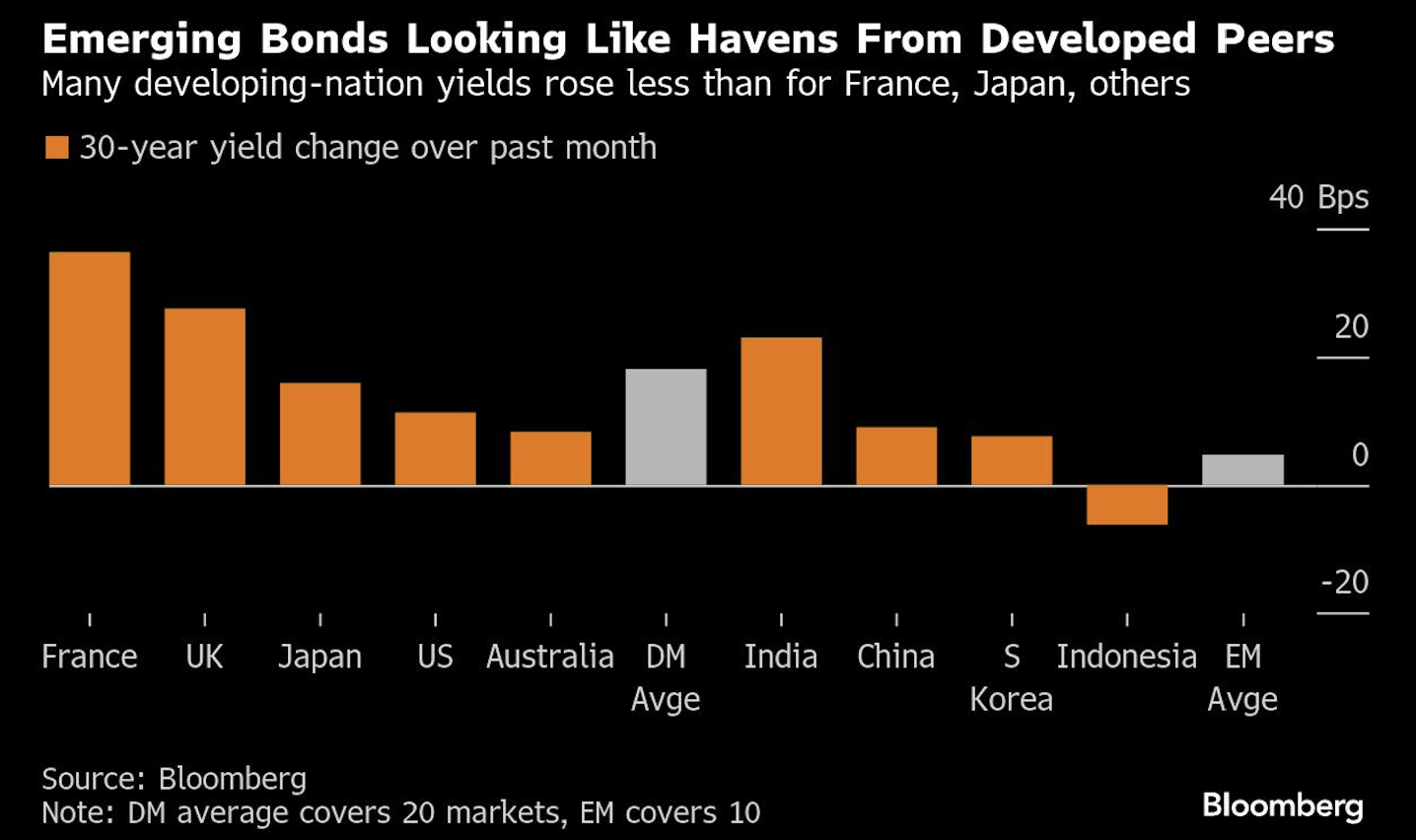
That’s also being reflected in asset price performance. Yields on 30-year government debt for advanced economies, as of Friday, have jumped an average 16 basis points over the past month, a sign of growing investor angst, compared with about 4 basis points for developing nations. Equities tell a similar story, with emerging-market stocks outperforming US shares this year for the first time since 2017, after eking out a meager 5% return last year.
Gross debt as a share of annual economic output in developing markets is forecast to average around 75% this year compared with roughly 125% for the Group of Seven developed countries, according to the International Monetary Fund. For Indonesia, the figure is around 40%, while in Vietnam it’s just 33% — all well below the anxiety-driving levels in parts of the developed world.
That fiscal prudence is reinforced by inflation that’s either low or falling, and by ample foreign-exchange reserves that give central banks room to smooth volatility. Emerging market outperformance has made his conversations with clients and prospects “a little bit easier” in recent weeks, he added.
“There’s this realization that the perception that emerging markets tend to be riskier may not be warranted,” Hingorani said.
A message from Advisor Perspectives and VettaFi: Thinking about starting your own RIA, making a move to a different firm, or specializing in a new area? Read our latest articles on financial advisor transitions.
Bloomberg News provided this article. For more articles like this please visit
bloomberg.com.