Tesla Inc. shares climbed 33% in September as investors rallied around Chief Executive Officer Elon Musk’s renewed focus on the company. That’s drawing attention to whether the key third-quarter sales figures coming later this week will be strong enough to sustain the momentum.
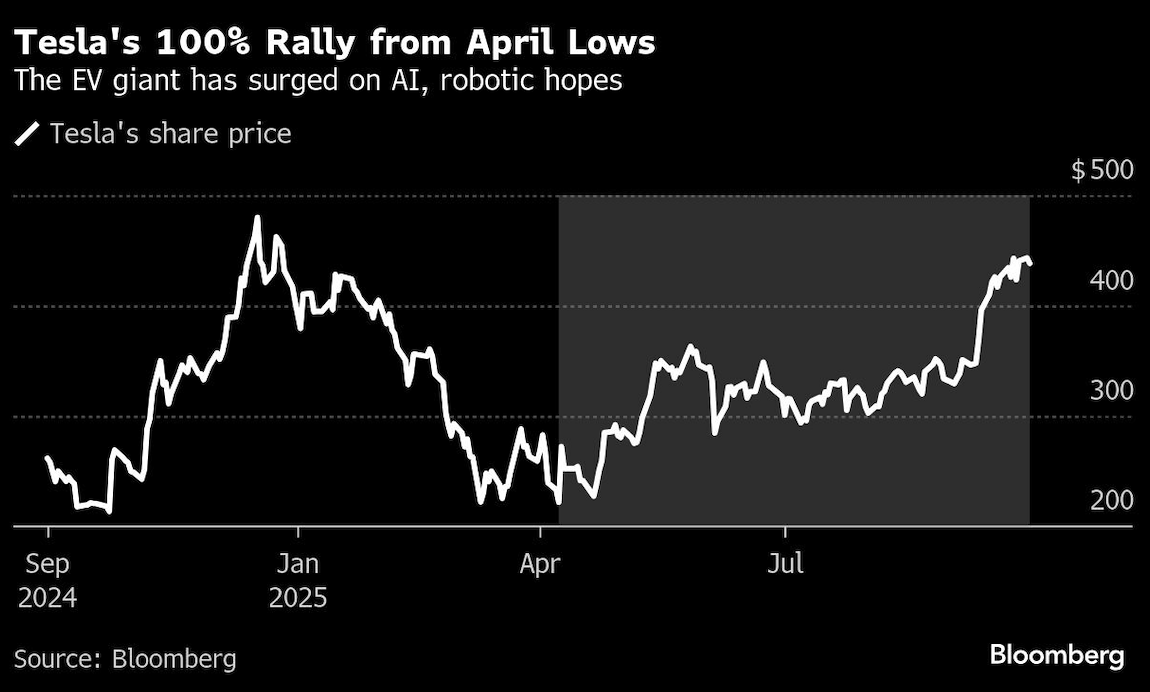
The electric-vehicle maker’s shares notched their best month in almost a year, putting them among the 10 best performers in the S&P 500 Index this month. Even more striking is Tesla’s vertical ascent in the market since hitting a low in early April after President Donald Trump paused his sweeping global tariffs. Since April 8, the stock is up 100%, making it the best performer in the high-flying big tech cohort known as the Magnificent Seven.
The bet on Tesla is that Musk can transform it from a car manufacturer into an artificial intelligence powerhouse that makes robots and self-driving taxis. That goal is reflected in the unprecedented $1 trillion pay package the company’s board proposed for the CEO earlier this month.
But with the stock trading around $445, not far from the all-time high of $479.86 it hit on Dec. 17, the question is what will its sales for this quarter look like — and is the company at a peak in deliveries, at least in the short term.

“Tesla trades at an eye-watering multiple, its earnings are shrinking amid softening EV demand and cutthroat competition, and EV credits are about to expire, further dampening sales,” said Irene Tunkel, chief US equity strategist at BCA Research.
The issues surrounding Tesla’s revenue and outlook are real. Tuesday is the last day car buyers can access tax credits for electric-vehicle purchases because the Trump administration eliminated the incentives. Analysts expect third-quarter EV sales to show a jump across the board after consumers rushed to take advantage of the disappearing discount. From here, however, EV sales are likely to slow considerably, they say.
Leaders within the industry have expressed their own concerns. Ford CEO Jim Farley said Tuesday that US EV sales are likely to be cut in half, dropping from roughly 10% of the market to 5% as a result of Trump’s pro-gas policies.
“Tesla’s core business is worth $150 a share” said Ross Gerber, president and CEO of Gerber Kawasaki Wealth & Investment Management and a long-time Tesla investor. “Anything investors pay over that for robotaxis and robots is ‘Elon hyperbole.’”
Buying In
Still, as the rally in Tesla keeps going, Wall Street analysts have started joining in. The stock has received a slew of upgrades and increased price targets recently based on its potential AI prowess. Wedbush’s Dan Ives raised his price target to a street high of $600 from $500 on Friday, saying it is ready for “the next stage of its AI autonomous path.”
Musk has only encouraged this line of thought, saying that the company will soon “feel almost like it is sentient being” on his social media platform X last week. He also thinks 80% of its revenue will ultimately come from AI robots.
“Tesla is the retail investors’ darling,” Tunkel said. “Tesla’s sharp rally has been fueled by these investors’ enthusiasm for its future beyond EVs, as they are envisioning a company that mass-produces robotaxis and humanoid robots, potentially tripling in value along the way.”
Right now investors are buying “more on hope than fundamentals,” Gerber said. “Tesla’s core business has deteriorated fundamentally over the last six months.”
To that point, electric vehicle sales have struggled, and Tesla’s burgeoning autonomous vehicle business is off to a stumbling start. In response, Musk shifted the company’s focus away from its core business and toward its Optimus robots venture.
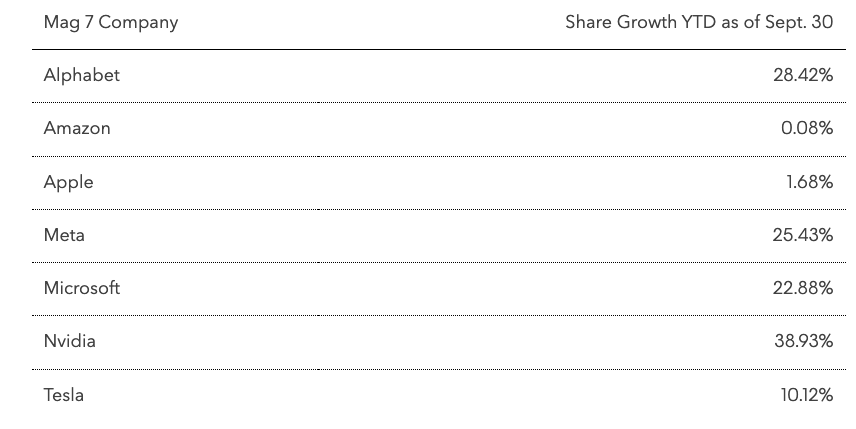
A big reason for that transition is AI has become the driver of US economic growth and stock market returns. Looking at the Magnificent Seven companies this year, Tesla shares lag AI beneficiaries like Nvidia Corp., Alphabet Inc., Meta Platforms Inc. and Microsoft Corp.
Musk’s challenge, however, is that while those rival firms have clear AI operations that are already generating profits, Tesla’s plans are very much a work in progress with little to show so far.
“A dose of skepticism is likely warranted,” said Dave Mazza,, chief executive officer of Roundhill Financial. “But the market is rewarding AI leadership, and Tesla has an early lead in embodied intelligence. Right now, the results matter less than the vision.”
In other words, Tesla’s underperformance means the stock has more room to run if it can legitimately catch the AI wave.
The company has “real momentum behind it” and could break out to a new high since AI has offered investors “a fresh dream to chase,” Mazza said. But it needs to show tangible progress on it’s projects.
So while this week’s sales numbers may provide short-term fuel for Tesla’s rally, it’s the potential for long-term gains, or a reckoning, that has Wall Street on edge.
“Elon is selling a dream, and many retail investors are buying it,” BCA’s Tunkel said. “Can the rally continue? Sure — powered by momentum and FOMO. Yet if there’s a bubble in today’s hot market, Tesla is ‘it’.”
A message from Advisor Perspectives and VettaFi: Discover something new! Click here to register for our upcoming webcasts.
Bloomberg News provided this article. For more articles like this please visit
bloomberg.com.
Read more articles by Jordan Fitzgerald