There’s no official read on how fast the US economy grew last quarter, thanks to the government shutdown. But almost everyone reckons it was a healthy pace — and that’s largely thanks to AI.
The technology has emerged as a crucial engine of growth, at a time when hiring is slow and traditional drivers like housing have stalled. Business investment in equipment and software are soaring. Data centers are a rare bright spot for US builders. And the juggernaut keeps rolling: just three tech titans racked up $78 billion of capital spending between them in the third quarter, almost double the year-earlier figure.
Consumption is getting a lift too, via a stock market propelled by bets on artificial intelligence, even as warnings of a potential bubble grow louder. Add all this up, and “in a mechanical sense it’s fair to say that AI has been the main driver of US GDP growth this year,” says Karen Dynan, an economics professor at Harvard University.
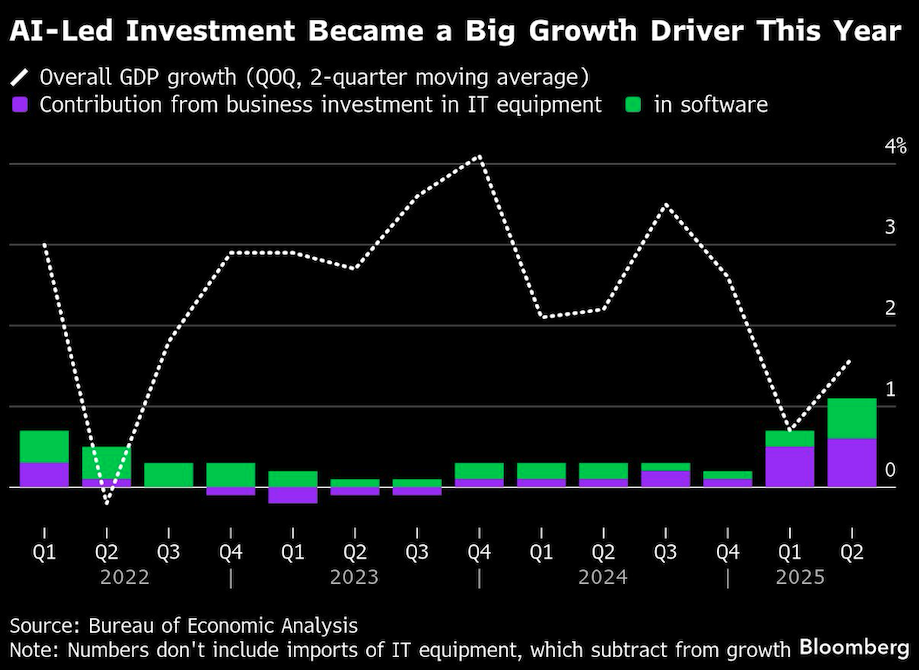
The numbers aren’t clearcut, but many economists calculate that the AI boom accounted for more than half of America’s 1.6% growth rate over the first six months of 2025 – and see the trend continuing into the third quarter at least. Data for that period would have come out this week, if the agencies that publish it weren’t shuttered amid a budget deadlock in Washington.
Cheerleaders say this year’s liftoff is just the beginning, because AI will ultimately make the whole economy more productive and bump growth onto a faster path. There are plenty of skeptics too, warning that piling so much cash into the technology — before businesses have really figured out how to use it — echoes past episodes when corporate America over-invested in shiny new things.
For now, AI spending and its spinoffs loom large. Following is a breakdown of the ways they’re impacting the economy.
Giant Sheds
If there’s a physical venue for the AI boom, it’s the data center. New ones are springing up across the country. Meta Platforms Inc., Microsoft Corp. and Alphabet Inc.’s Google are among the big investors — and all three increased their forecasts for future outlays when they reported earnings this week.
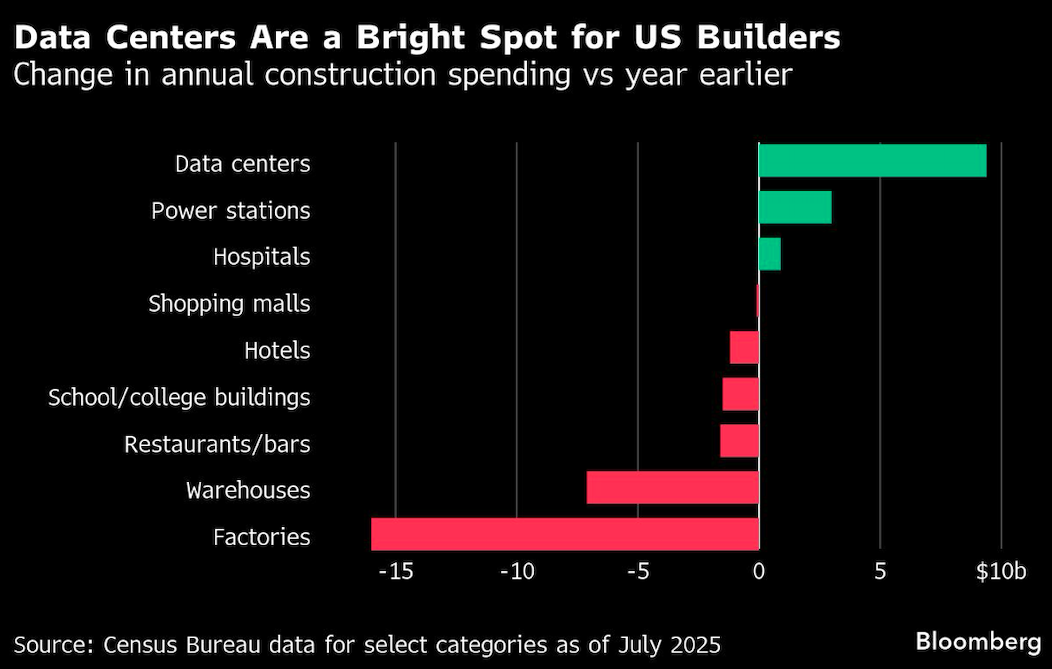
As of July, annual spending on the construction of data centers — which in aerial pictures often resemble giant farm sheds – was running around $41 billion. Even when you exclude housing, that’s less than 5% of total private construction. Still, it’s been a good earner for the building industry, posting the biggest increase over the past year – enough to add roughly 0.1% of GDP – while most other areas were shrinking.
What Goes Inside
It’s what goes into the data centers that’s providing the biggest AI boost to the economy right now. Investment in information-processing equipment, along with software, has skyrocketed this year. The two categories taken together posted their biggest contribution to GDP growth for decades in the first half – roughly matching the levels hit in the late-1990s dotcom boom. The Atlanta Fed’s GDPNow model sees spending on business equipment topping the second quarter’s 8.5% rise.
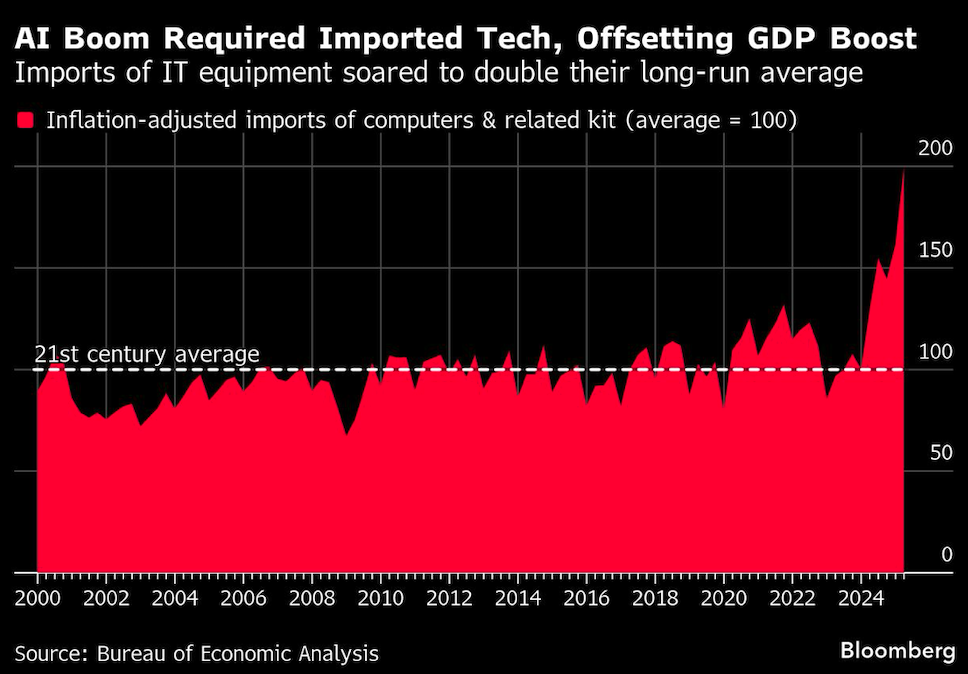
In GDP terms, though, all these numbers come with an offset. A large portion of the computer kit that America’s AI boom requires is sourced from abroad – adding to a trade gap that subtracts from growth.
President Donald Trump’s trade war might have proved a drag here. It hasn’t, because the administration granted tariff exclusions for circuit boards, servers and other hardware that data centers typically need.
“The current AI boom would simply be impossible if tech companies had to pay the same tariffs that car manufacturers or homebuilders currently face,” according to Joseph Politano of Apricitas Economics. The administration likely recognizes what a big growth driver it’s become, and doesn’t want to “kill America’s golden geese,” he wrote.
Wrapping the math, Bloomberg Economics estimates a net contribution to growth from AI-related capital spending of around 1 percentage point in the first half. It predicts that number will hold steady through the rest of 2025, then climb to 1.5% next year.
Others arrived at similar numbers for 2025 but are more cautious about the outlook. “Industry projections imply that this year’s growth impetus may well be the peak,” Barclays economists wrote.
Enough Power?
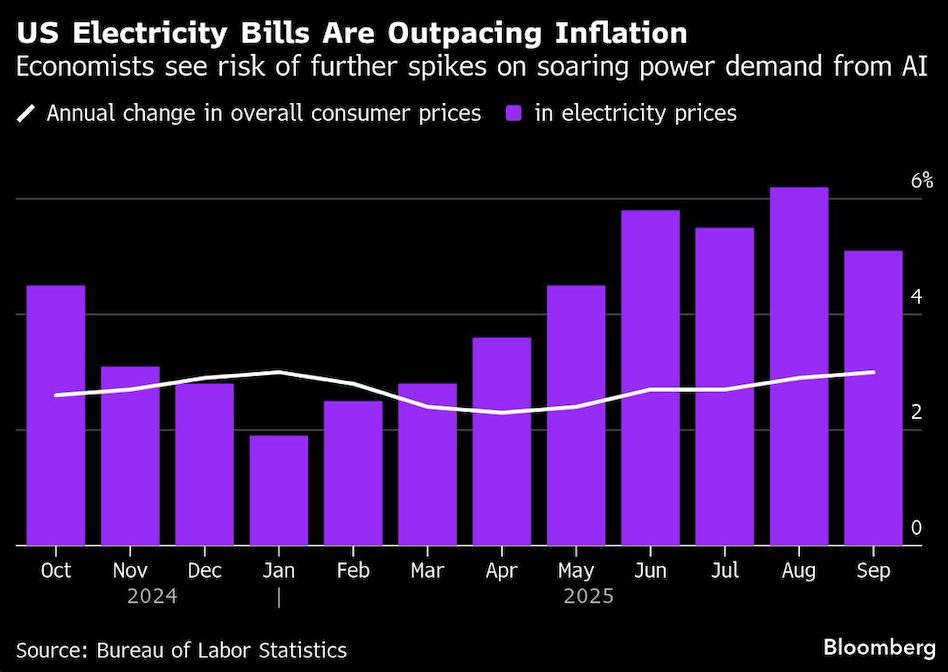
Beyond these direct investments in AI, there could be knock-on boosts for other industries – especially electricity generation, since data centers require lots of power. Just this week, an Iowa nuclear plant announced plans to reopen, chiefly to supply Google. But there are risks too: if generation capacity doesn’t keep pace with AI-driven demand, electric bills could rise for everyone and drag on the economy.
What’s more, America’s power industry hasn’t gotten the same generous trade-war treatment as AI. Wood Mackenzie estimates tariffs have raised capital costs by 8-10%, as the price of equipment like transformers and wire goes up.
There’s enough capacity today, but real concerns over the coming years, according to Rob Gramlich, founder of Washington-based research firm Grid Strategies. He forecasts a 15.8% increase in US demand by 2029, led by power-hungry data centers, and says it’ll be “very hard to meet that growth.”
Wealth Effects
While the AI impact shows up mainly on the investment side of GDP, there’s also a channel that leads to higher spending by US consumers – at least richer ones, who are increasingly driving the economy, and likelier to own exuberant tech stocks.
It’s known as the wealth effect. When asset prices rise, owners feel empowered to spend more. The top one-fifth of Americans by income own more than 85% of US equities. The S&P 500 is up almost 20% in the past year, and most stock-watchers say the bulk of that gain comes from AI.
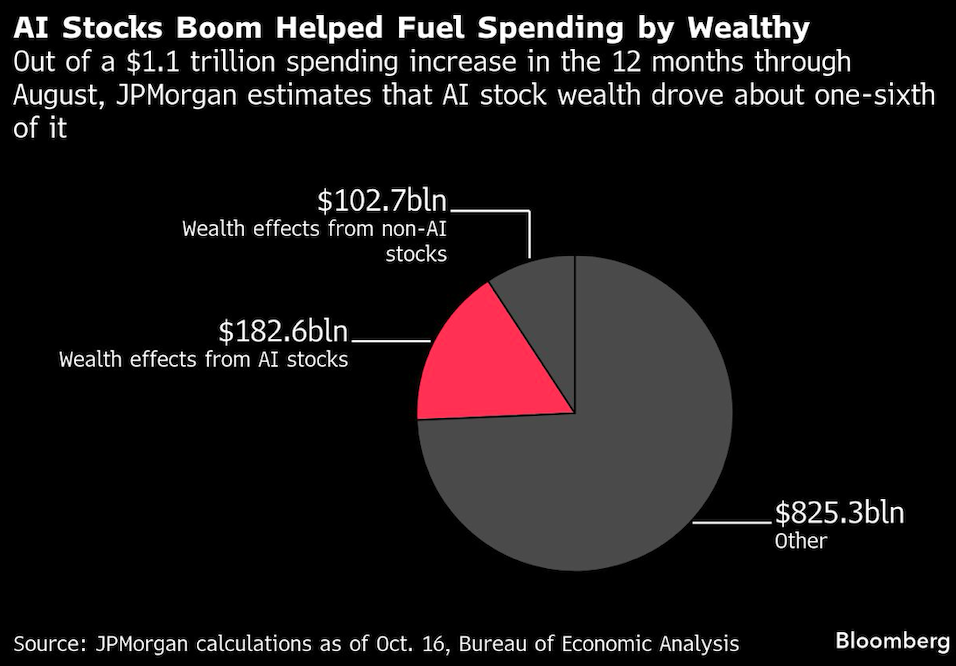
JPMorgan Chase researchers calculated what that means for the economy. They found that a basket of just 30 AI-linked stocks generated more than $5 trillion in new wealth over the period, and likely fueled some $180 billion in extra consumer spending – enough to account for about one-sixth of the increase in the past year. “A reversal in AI enthusiasm” could turn this dynamic around and lower consumption, they added.
Jobs at Risk?
One big concern around AI is that it will replace human workers, who’ll struggle to find other employment.
Those fears get inflamed when big companies announce layoffs. Amazon.com Inc., whose chief executive had warned that AI would shrink the workforce, cut 14,000 corporate jobs this week. General Motors Co. laid off hundreds of salaried staff a few days earlier. The carmaker said it had examined white-collar positions in search of efficiency gains.
Absent up-to-date numbers for the labor market, it’s hard to identify any broad trend. Bank of America Institute scoured survey data last month and found no obvious link between increased use of AI and weak job growth. If anything, white-collar industries more prone to use the technology have been adding to payrolls. But “firms may adopt a different strategy if an economic downturn were to happen,” the BofA economists cautioned, “with AI allowing for larger layoffs.”
Holy Grail
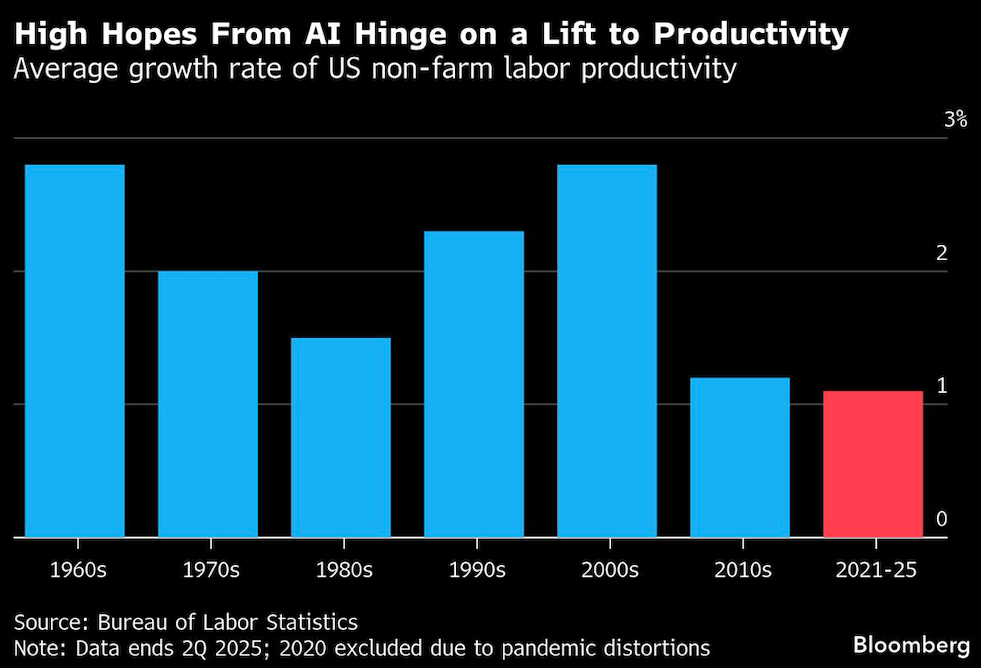
All these are early reverberations of a technology still in its infancy. There are far-reaching claims for what AI will ultimately deliver: governments, for example, reckon it’s key to gaining a military edge. For the economy, the holy grail is higher productivity – allowing firms to ramp up output and workers to earn more.
Productivity numbers jump around a lot and they’re notoriously hard to parse. There’s evidence of a pickup over the last couple of years, perhaps helped by AI. Projections by the Penn Wharton Budget Model suggest the AI boost will peak early next decade with an extra 0.2 percentage point of annual productivity growth, adding a cumulative 3% to US GDP by 2055.
Whatever the long-run prospects, there’ll surely be bumps in the road. Jerry Kaplan, a Silicon Valley veteran who’s founded several technology companies, says it’s unlikely that current AI investments will pay off in an economically meaningful way. He’s reminded of the 1990s dotcom bubble and the preceding period, when hopes were high that new technology would deliver a sustained productivity surge.
“Everybody thought it was going to require more computing power and more bandwidth than it actually did,” Kaplan says. “The same same thing’s happening today.”
A message from Advisor Perspectives and VettaFi: Discover something new! Click here to register for our upcoming webcasts.
Bloomberg News provided this article. For more articles like this please visit
bloomberg.com.