With a new boss at the helm and expectations of billions in surplus gas revenue, the Qatar Investment Authority spent the past year telegraphing a step-up in dealmaking. Iran’s attacks on the country’s energy infrastructure and Doha’s inability to ship products risk hampering that push.
At the center of that strategy was the expectation that Qatar’s massive expansion in liquefied natural gas production would deliver roughly $30 billion in additional annual revenue to the state, providing fresh financial firepower for the country and its sovereign wealth fund.
While the $580 billion QIA has kept up the pace of its dealmaking in the near term, the conflict has dented prospects of a substantial surplus flowing into the fund, according to people familiar with the matter. That’s raising questions over the QIA’s ability to increase deployment as sharply as planned, they said.
A year ago, Mohammed Al Sowaidi, the fund’s chief executive officer, committed an additional $500 billion in the US over the next decade. That, and his plans to steer the QIA toward larger investments, signaled a return to the kind of big-ticket dealmaking that years earlier had propelled the fund into the top ranks of global investors.
But Iran struck Ras Laffan, the world’s largest liquefied natural gas plant, in March, impacting about 17% of Qatar’s exports. The attacks are expected to cost about $20 billion in lost revenue, with repairs taking up to five years. Tehran also shuttered the Strait of Hormuz, leaving Doha, which produced almost a fifth of global LNG supply last year, struggling to move shipments out since the end of February.
“Gas revenues are clearly linked to the QIA’s financial resources,” said Robert Mogielnicki, founder of Polisphere Advisory. “The QIA still wields substantial financial firepower, but hampered gas exports will certainly impact the nature and scale of potential government transfers.”
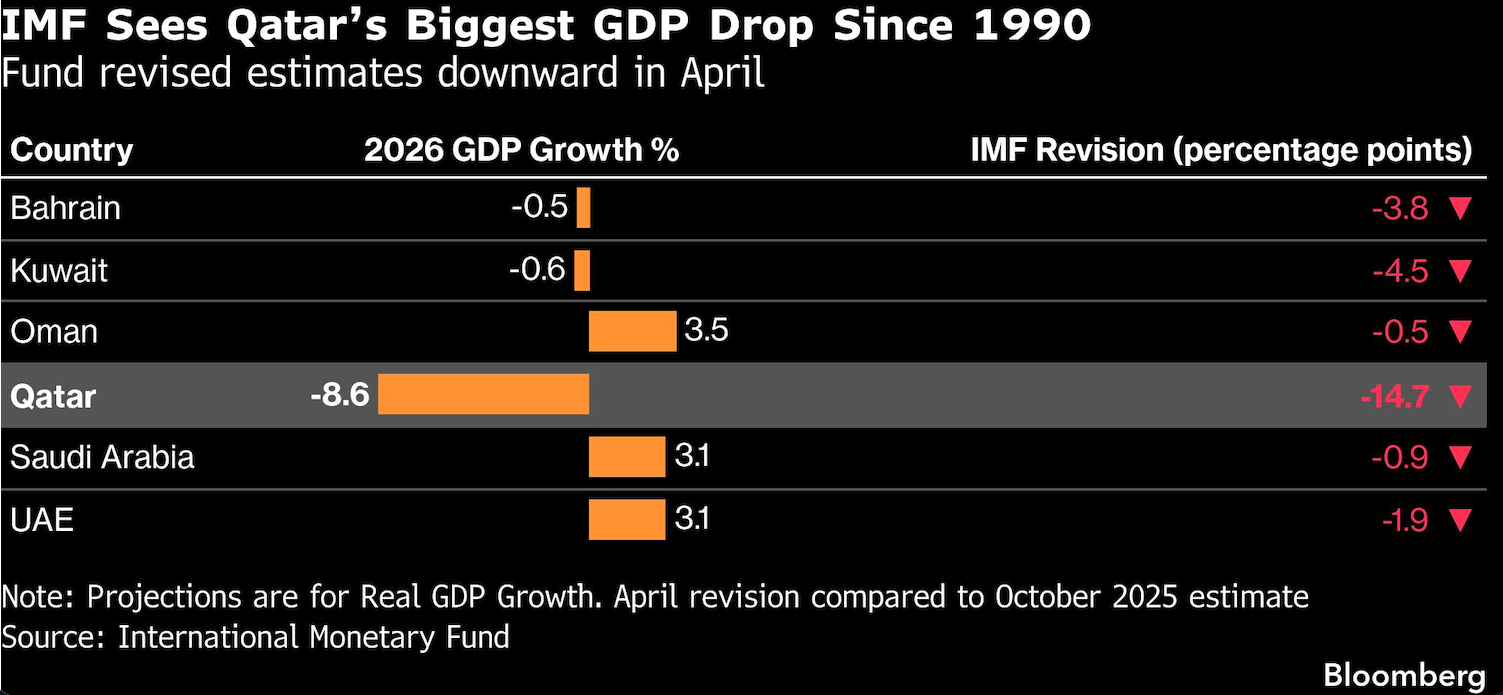
Unlike Abu Dhabi, which can reroute some crude exports through its Fujairah pipeline, or Saudi Arabia, which has Red Sea export facilities, Qatar remains dependent on the narrow strait. Given those constraints, Doha’s economy is projected to be one of the hardest hit in the Gulf.

Mogielnicki said he expects more “optimization than rationalization” of deployment, especially until the region’s geopolitical risk picture becomes clearer. Indeed, amid the war, the QIA has pursued some global deals.
Since the war started, the fund has committed $500 million to General Atlantic, joined funding rounds for fitness-tracker startup Whoop Inc. and satellite-intelligence firm Iceye Oy, and participated in a $10.7 billion deal to acquire US utility AES Corp.
It also retains a strong pipeline of deals, according to one person familiar with the matter, who declined to be identified as the information is confidential. Alongside other regional heavyweights, QIA is also expected to remain a major backer of the artificial intelligence buildout and is likely to make a significant commitment to SpaceX’s initial public offering.
“QIA continues to deploy capital at pace and scale across sectors and geographies aligned with our long term strategic priorities,” a spokesperson for the fund said. “While regional developments are being closely monitored, investment activity continues in line with our mandate, and alongside our many global partners.”
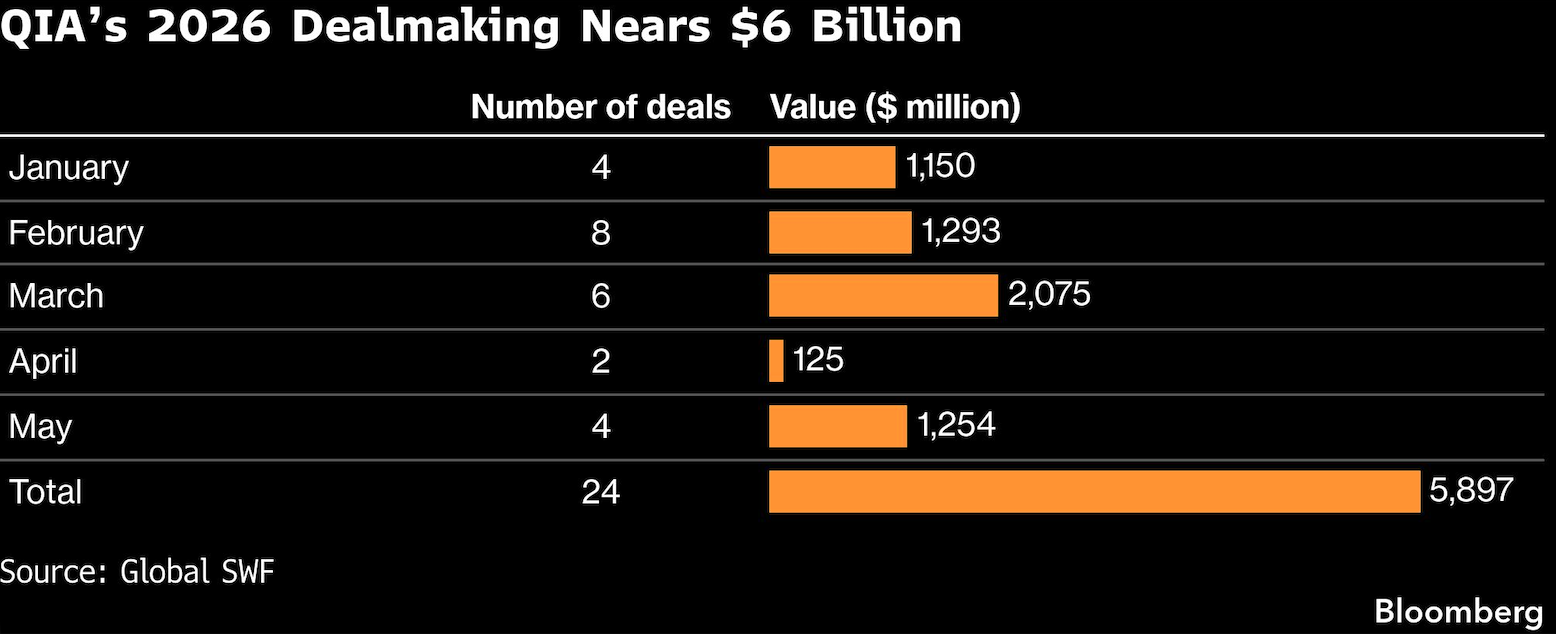
The fund spent about $1.2 billion a month through May, 14% below its 2025 monthly average, according to Global SWF data. Still, in one sign of how QIA’s spending has evolved in recent years, its average monthly capital commitments were up sharply from $376 million in 2024.
“The reality is that the deal flow of most Gulf SWFs has not decreased, yet,” Global SWF Managing Director Diego Lopez said. “It takes time for governments to run their fiscal accounts and potentially withdraw sovereign wealth funds, and many of the deals closed since late February were likely already in the pipeline before the war.”
In recent days, Qatar has managed to load some LNG tankers through the strait even as US-Iran peace talks drag on and both sides maintain a de facto blockade of the waterway. But weakness in the country’s public finances is likely to persist, with the fiscal deficit projected to widen significantly to about 9% of GDP in 2026, according to Alia Moubayed, managing director at Jefferies International.
The shortfalls are already having an impact. Some government-funded entities have seen their budgets cut, according to people familiar with the matter. Amid those pressures, the QIA is now expected to play a bigger role in efforts to shore up the domestic economy and help with reconstruction.
“It will likely shift local priorities, with QIA doing more domestically, including infrastructure,” said Rachel Ziemba, founder of Ziemba Insights. She expects some “some global deal focus” for QIA and QatarEnergy, since investments abroad can bring new revenue flows.
While Qatar’s foreign exchange reserves of about $72 billion and relatively low debt levels could help cushion any economic shock, the sovereign and leading banks — typically infrequent issuers in the global bond market — have raised billions of dollars through private sales since the war started, Bloomberg News has reported. The central bank has also allowed lenders to offer borrowers payment deferrals.
The wealth fund, too, has options to support the financial system and shore up liquidity, including repurchase transactions or small stake sales in some of its most liquid holdings.
The QIA is the world’s eighth-largest sovereign wealth fund, with a broad portfolio that spans stakes in Glencore Plc, Barclays Plc and Iberdrola SA, bringing the value of its listed holdings to about $85 billion, according to Bloomberg compiled data. That is in addition to trophy assets such as London’s Harrods department store and the Shard skyscraper.
It has been helmed by the likes of Ahmed Al-Sayed, a dealmaker who played orchestrated some of the Gulf state’s biggest overseas investments, and Sheikh Hamad bin Jassim bin Jaber Al Thani, who played a key role in Glencore International Plc’s takeover of Xstrata Plc. But the fund shifted focus under former boss Mansoor Al Mahmoud as Doha spent $300 billion preparing for the FIFA World Cup held in 2022.
That changed soon after Al Sowaidi took over in late 2024. In the months since, the QIA backed artificial-intelligence firms Anthropic and xAI, teamed up with Carlyle Inc. on an $8.9 billion deal and even participated in Paramount Skydance Corp.’s bid for Warner Bros. Discovery Inc.
Al Sowaidi has steered the fund toward high-profile partnerships with Wall Street giants, including Brookfield Asset Management Ltd. on a $20 billion AI infrastructure venture and the QIA committed $25 billion to Goldman Sachs Group Inc.’s asset management arm. Senior executives at both firms have signaled those plans remain on track.
Meanwhile, the fund has been instrumental in Qatar’s push to attract global financial firms to Doha and in helping the city catch up with more established Gulf financial centers such as Dubai, Abu Dhabi and Riyadh.
Polisphere’s Mogielnicki said the QIA is likely to take an active role in helping the economy rebound from the conflict, though executives will want to do so in a way that complements the existing portfolio.
“QIA is a major asset in the government’s economic policy toolbox.”
A message from Advisor Perspectives and VettaFi: Discover something new! Click here to register for our upcoming webcasts.
Bloomberg News provided this article. For more articles like this please visit
bloomberg.com.
Read more articles by Dinesh Nair, Alex Dooler