David Solomon, decked out in full academic garb, bobbed his head happily and wagged his index finger to the beat of his own AI-generated music.
The Goldman Sachs chief, who played the thumping bassline for graduating MBA students in May as a motivational anthem, may not be the only Wall Street boss dancing. With a record-smashing start to 2026, the biggest US banks are all rediscovering their swagger.
Goldman’s stock price jumped to its highest level after the bank topped its own record for equities-trading revenue by more than $2 billion. JPMorgan Chase & Co., Morgan Stanley and Wells Fargo & Co. each earned more quarterly profit than ever before. Bank of America Corp., meanwhile, notched its best six-month start to a year.
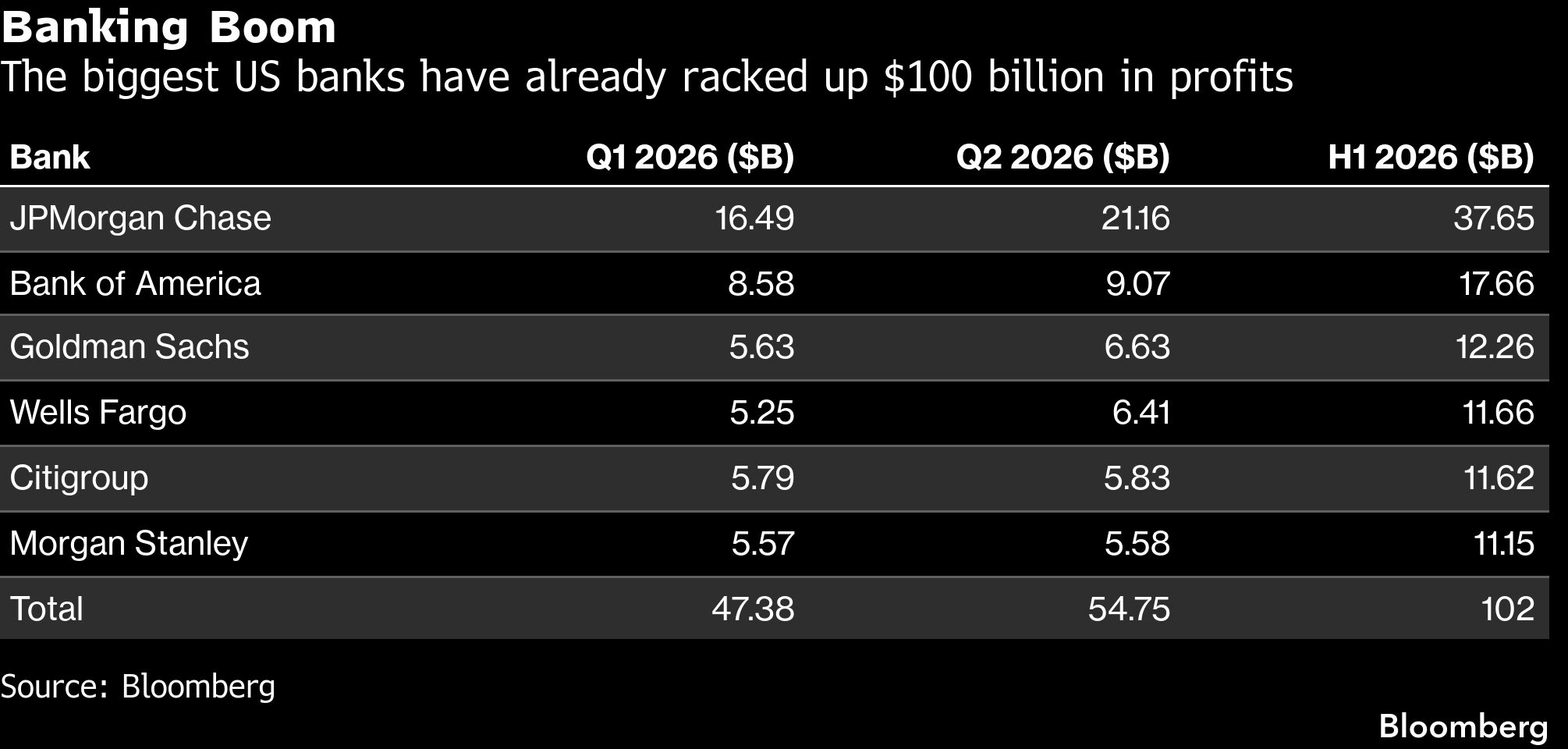
The first Trump administration gave the six biggest US banks their first $100 billion year. Now, his return to the presidency has handed them their first $100 billion half.
What makes this frenzy especially sweet for bankers is that they are thriving while other corners of finance — namely the private equity shops that have poached their talent and muscled in on more of their turf — face their own struggles.
Bankers no longer feel sidelined.
“For a while, as a banker, you were the butt of all jokes,” said Euan Rellie, co-founder of the boutique advisory firm BDA Partners. “Somehow, once again, it’s socially acceptable. It’s a cool thing to do.”
For years after the 2008 financial crisis, dull markets and stringent rules reduced bankers to schlubs in the world of high finance. The glory and money swiftly shifted to private markets. So did many dealmakers seeking bigger bonuses.
But rising interest rates in 2022 made it harder for buyout shops to enter and exit deals. And over the past year, Trump’s many inflationary moves, including surprise tariff announcements and bombing of Iran, have delayed rate cuts while sending more action to traders.

The result is that shares of the country’s top six banks — JPMorgan, BofA, Citigroup Inc., Wells Fargo, Goldman Sachs Group Inc. and Morgan Stanley — are up an average of almost 80% since the 2024 presidential election.
Blackstone Inc., KKR & Co., Apollo Global Management Inc. and Carlyle Group Inc. are all down.
‘Mojo Back’
The artificial intelligence boom threatening many white-collar workers, the continuing creep of inflation and war in the Middle East are whipsawing markets and reshaping the economy. They’re also proving to be highly lucrative for banks.
The momentum from AI “will mean more of the companies will be tapping both equity and debt markets,” Goldman partner Mahesh Saireddy said on Bloomberg TV.
Sachin Khajuria, a former Apollo partner who got his start in the industry at Morgan Stanley, contrasted the current situation with a couple of years ago, when JPMorgan CEO Jamie Dimon declared his nonbank rivals were “dancing in the streets” over the onslaught of bank regulation that had made it easier for private equity firms, hedge funds and other investors mop up talent and cash.
“Wall Street banks have their mojo back,” he said. “They are finding opportunities in a polycrisis from geopolitics to the impact of AI.”
Now, there’s insatiable demand for bank services, and their executives can dance, Khajuria said.
Nothing captures Wall Street’s exuberance like the summer’s blockbuster wave of equity offerings. SpaceX’s recent record-breaking $86 billion debut ignited the frenzy, with investors shrugging off its losses and embracing Elon Musk’s grand ambitions for an AI-rocket-social-media conglomerate.
Morgan Stanley CEO Ted Pick stood on his firm’s trading floor, addressing Musk adoringly on a video call after the bank collected roughly $100 million leading the offering. Days later, JPMorgan’s Midtown headquarters glowed with a giant South Korean flag as bankers celebrated another marquee listing: AI chipmaker SK Hynix.
Still, the party could pause. Reports last month that OpenAI may delay its massive initial public offering sent several bank shares lower.
“I don’t know that there’s anything to gloat about,” said former Goldman partner Dinakar Singh, who founded and runs investment firm Axon Capital as the banks later reported earnings. “Capital-markets banks have turned into AI plays.”
Banks are also finding lucre and relief on other fronts.
At JPMorgan, which just beat its own record for the highest quarterly profit in the history of American banking, the windfalls were multifaceted. Its commercial and investment bank, sprawling consumer arm, and asset and wealth management unit all earned more revenue than ever. Dimon passed the 20-year mark atop the firm and plans to stick around for a while, using his perch to take on matters as vast as national security and the American dream.
Turnarounds are also taking hold at Wells Fargo and Citigroup. Wells Fargo, free from a yearslong Federal Reserve growth restriction, has grown its balance sheet 15% over the past year. At Citigroup, four of five main divisions beat expectations in the second quarter.
Meanwhile, Trump appointees are dialing back rules. While the president hasn’t entirely withheld his criticism of bankers, the proposals he has put in motion are widely seen as favorable.
Dimon praised new Federal Reserve Chair Kevin Warsh and Vice Chair for Supervision Miki Bowman during his firm’s earnings call.
The pair “are taking a step back and looking at the broad range of changes, which have been extensive over 20 years and never-ending and often with no ultimate intent or intended consequence,” the CEO said. “I actually believe it can make the system much safer, much safer, and that should be the real goal, not just adding layer upon layer of bureaucratic reporting.”
The changes can have a direct impact on profit.
Morgan Stanley took extra capital that was freed up after US regulators relaxed a key rule last year, and plowed it into its trading business. That helped it rack up more than $11 billion in stock trading revenue in the first six months of 2026, more than it had made in any full year before 2024.
One former member of Goldman’s management committee, who left years ago for an important perch in private markets, was asked Tuesday if he regretted his departure. In response, he pulled up the firm’s stock chart and traced the price as it doubled and then tripled in recent years. He sighed. He sure wished he still had his old stake, he said.
“The relative dynamic has changed,” Rellie said. “You are making more than enough money in banking and PE is harder than it ever used to be.”
A message from Advisor Perspectives and VettaFi: Discover something new! Click here to register for our upcoming webcasts.
Bloomberg News provided this article. For more articles like this please visit
bloomberg.com.
More Emerging Markets Topics >