As prediction markets draw record trading around events like the World Cup, Jump Trading Group is betting the once-niche contracts are becoming a lasting corner of Wall Street.
The high-frequency trading firm has doubled its prediction markets team this year to about 20 people and plans to keep hiring, according to Simon Johansen, the firm’s head of prediction markets.
Jump is among the first major market makers to embrace prediction markets, which have brought an exchange-style trading model to event contracts about everything from sports and politics to economic data. As activity surges on platforms such as Kalshi and Polymarket, the business is beginning to attract the kind of institutional attention that earlier transformed crypto from a digital Wild West into a mainstream asset class.
In building its prediction markets team, Jump has relied on a different talent pipeline than traditional quantitative trading firms. For example, the firm is hosting a free World Cup forecasting contest, with a 10-week fellowship as the top prize.
“We’ve given offers to and hired people who are just trading in their dorm room in college and we’ve found people who are like me, in their mid-30s, and worked in a white-collar corporate job,” said Johansen, who has spent his whole career at proprietary trading firms, including a few years running Jump Crypto.
Illustrating how the firm is recruiting expertise from outside Wall Street’s traditional quant pipeline, one recent hire is a researcher who joined after building up his expertise betting on sports in his free time. Until recently, he was working at a Big Four accounting firm.

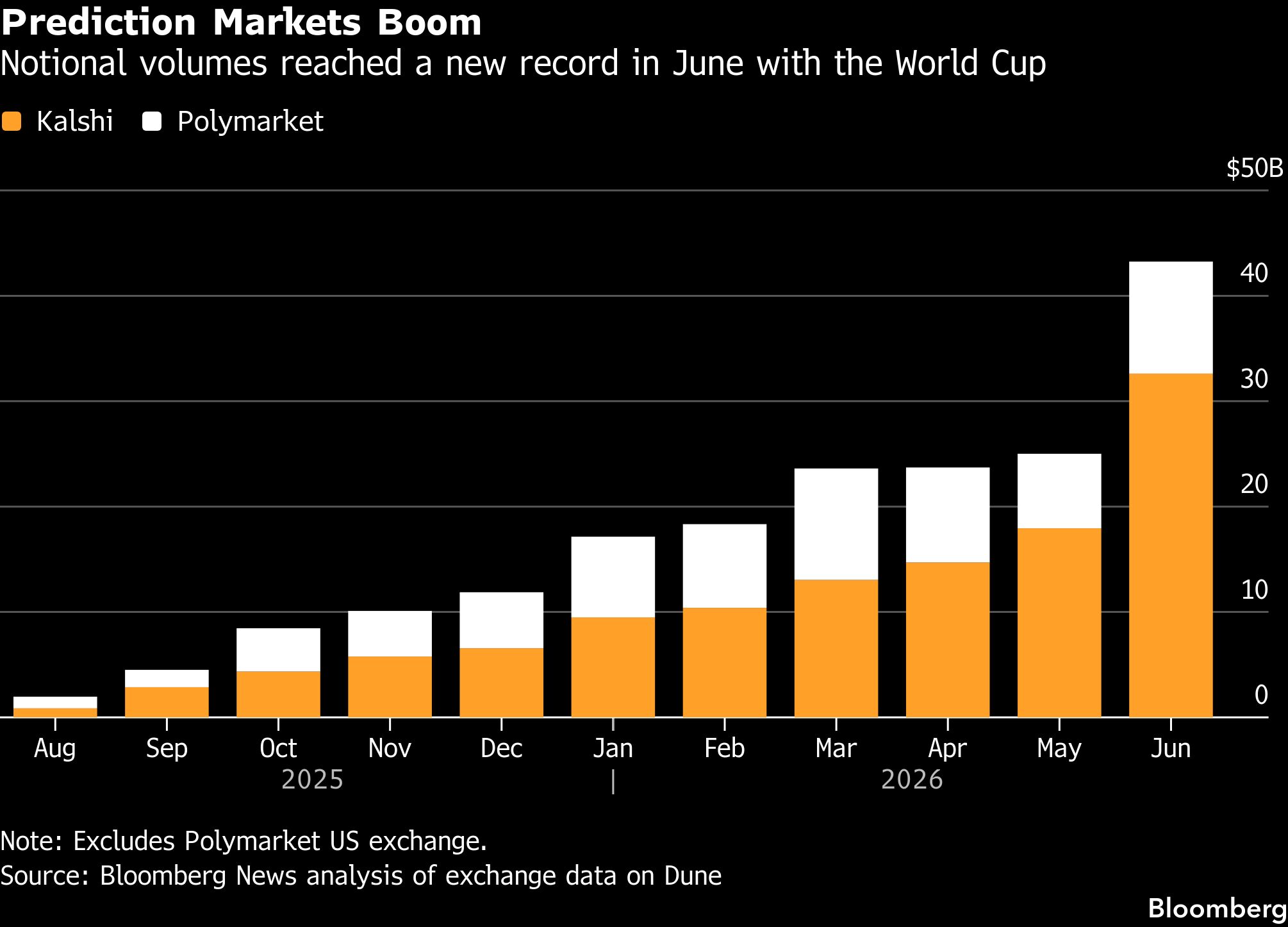
Jump’s hiring push comes as prediction markets continue to boom, boosted by intense interest in this summer’s NBA Finals and the World Cup. Combined volumes on Kalshi and Polymarket nearly doubled from May to reach a record $44 billion in June, user-compiled data on Dune show. On Polymarket, wagers on which country will win soccer’s biggest prize have drawn $4 billion of trading. Spain is the frontrunner, with a 58% chance.
Johansen expects this growth to continue. Trading volume for this year’s Super Bowl, he noted, was ten times higher than in 2025, when prediction market trading on the game was allowed for the first time in the US.
“At the 2027 Super Bowl we’re probably due for another 10X,” said Johansen. “It’s probably the most AI-resistant industry that exists. People are always going to want to watch sports.”
While Jump has the World Cup showing live on television at its offices, that’s mainly because employees like to watch it. Its sports trading, like its main business, is largely automated.
Yet even compared to other sporting events, taking the firm’s usual quantitative approach has been harder for the World Cup, given the dearth of historical data for a tournament that happens once every four years, says Johansen. That’s why odds can move sharply once a match starts.
“It’s not nearly as easy to simulate compared to the Champions League, for instance,” he said, referring to the annual contest between top European football clubs. “It’s a bit less data-reliant in terms of how you build and train a model, and it’s a bit more heavily weighted on real-time data and feedback of what you’re actually seeing on the field.”
Jump started trading on Kalshi and Polymarket late last year and has deals with the platforms to gain small stakes in the two booming startups in exchange for providing liquidity. Susquehanna International Group, another proprietary trading firm, has also been an early adopter and advocate.
Jump had experimented with sports gambling before, but prediction markets brought a more familiar structure. As a market maker, the firm trades both sides of many of the yes-or-no wagers offered by exchanges. Its performance depends, in part, on the biases of retail traders.
Recreational bettors, for instance, tend to bet on one team winning rather than on draws, so in the group stages of the World Cup, ties were often a boon for the firm’s profitability.
But when outcomes go as expected, it “tends to result in less interesting trade conditions and therefore lower P&L,” said Johansen.
Beyond sports, the firm also has ambitions to trade event contracts on a wider range of topics, says Johansen.
“The way that we’re building the business is that we want to be able to trade anything and everything where there’s opportunity,” he said.
A message from Advisor Perspectives and VettaFi: Discover something new! Click here to register for our upcoming webcasts.
Bloomberg News provided this article. For more articles like this please visit
bloomberg.com.
More Liquidity Topics >