Strong economic momentum is a double-edged sword for US equity traders. Solid growth is an earnings tailwind. But let it run too hot, and it turns from blessing to curse.
That’s been the case lately, when better than expected data on the labor market, retail sales and regional manufacturing failed to convince investors to pump money into stocks.
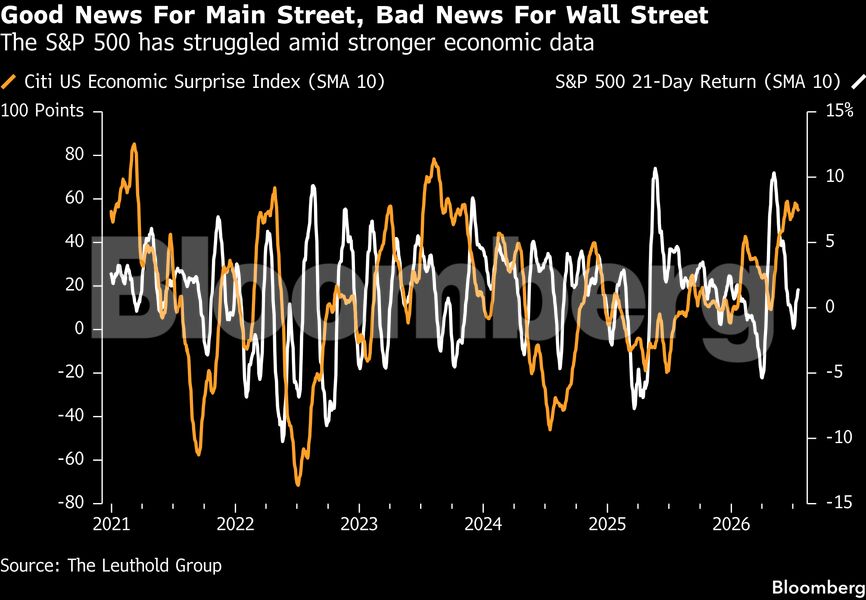
Leuthold Group strategists analyzed the relationship between the Citi US Economic Surprise Index, which measures the degree to which releases outpace consensus views, and the S&P 500 Index. The Citi index’s current reading above 40 — generally considered a strong level — has recently led to losses in the equities benchmark in the next three weeks, with an average of three months to recoup the declines, the analysis shows.
The study offers one way of tracking sentiment among investors trying to maintain a balance between the data that’s not too hot to fuel inflation — and subsequently a strong response from the Federal Reserve — and not too cold to slow down economic momentum.
“We definitely noticed this change in market dynamic where good news has been greeted with weaker equity market performance lately, especially over the last two-three months,” said Chun Wang, director of multi-asset strategies at Leuthold, adding that several factors behind the “good news is bad news” environment are likely at play.

The Citi Economic Surprise Index has been in a positive territory all year, but the recent decline in oil prices has propelled. It’s sitting at 50.3 after surpassing 63 in June, the highest since 2023.
Since Citi introduced its index in 2003, there have been 28 cases where good figures for Main Street — which translates into a reading of 40 and above, according to Wang’s calculations — have led to negative 21-day returns for the S&P 500. It usually took three months to recover the losses.
Several reasons are driving the weakness, according to Wang. For one, a stretch of stronger than expected macroeconomic data has likely caught traders dealing with the on-again, off-again geopolitical tensions off guard.
Then, there’s the Fed, which is balancing to sustain steady growth without pushing prices or unemployment to extremes. If the economy has more positive surprises in store, it may complicate policymakers’ goal of reining in inflation toward their 2% target.
“Monetary policy may shift next week and into the Fall reflecting a more aggressive stance to fighting inflation,” said Bob Lang, founder and chief strategist at Explosive Options.
To Ken Mahoney, chief executive officer at Mahoney Asset Management, economic data that’s just better than expected may not be enough to justify the stock market’s multiples following a 17% rally since late March.
“Best-case outcomes may already be reflected into stock prices and solid economic reports now may have a chance of actually pressuring equities,” he said by email. “There is that asymmetric shift in how news is perceived.”
Sameer Samana, head of global equities and real assets at Wells Fargo Investment Institute, is unsure the recent struggles of the S&P 500 can be linked to economic data as much as it is tied to the ongoing rotation out of technology and artificial-intelligence names.
“That being said, it’s possible some are seeing the durable economic data as a reason that the Fed’s more likely to hike interest rates,” Samana added.
What stands out to Wang about this particular instance of good news being bad for Wall Street is the Iran war. The “additional noise” from hostilities has been the biggest departure from historical patterns, and impacted both oil and breakeven rates.
In fact, he recommended investors to stay wary. While the short-term dynamic “is not too bad,” the different circumstances warrant being “extra cautious going forward,” he added.
“We’ve been saying that the stock market is the economy right now, so the biggest risk to the economy is the stock market because of the wealth effect,” Wang said. “We should take a middle of the road approach in terms of asset allocation, in terms of our attitude towards risky assets.”
A message from Advisor Perspectives and VettaFi: Discover something new! Click here to register for our upcoming webcasts.
Bloomberg News provided this article. For more articles like this please visit
bloomberg.com.
More ETF Topics >