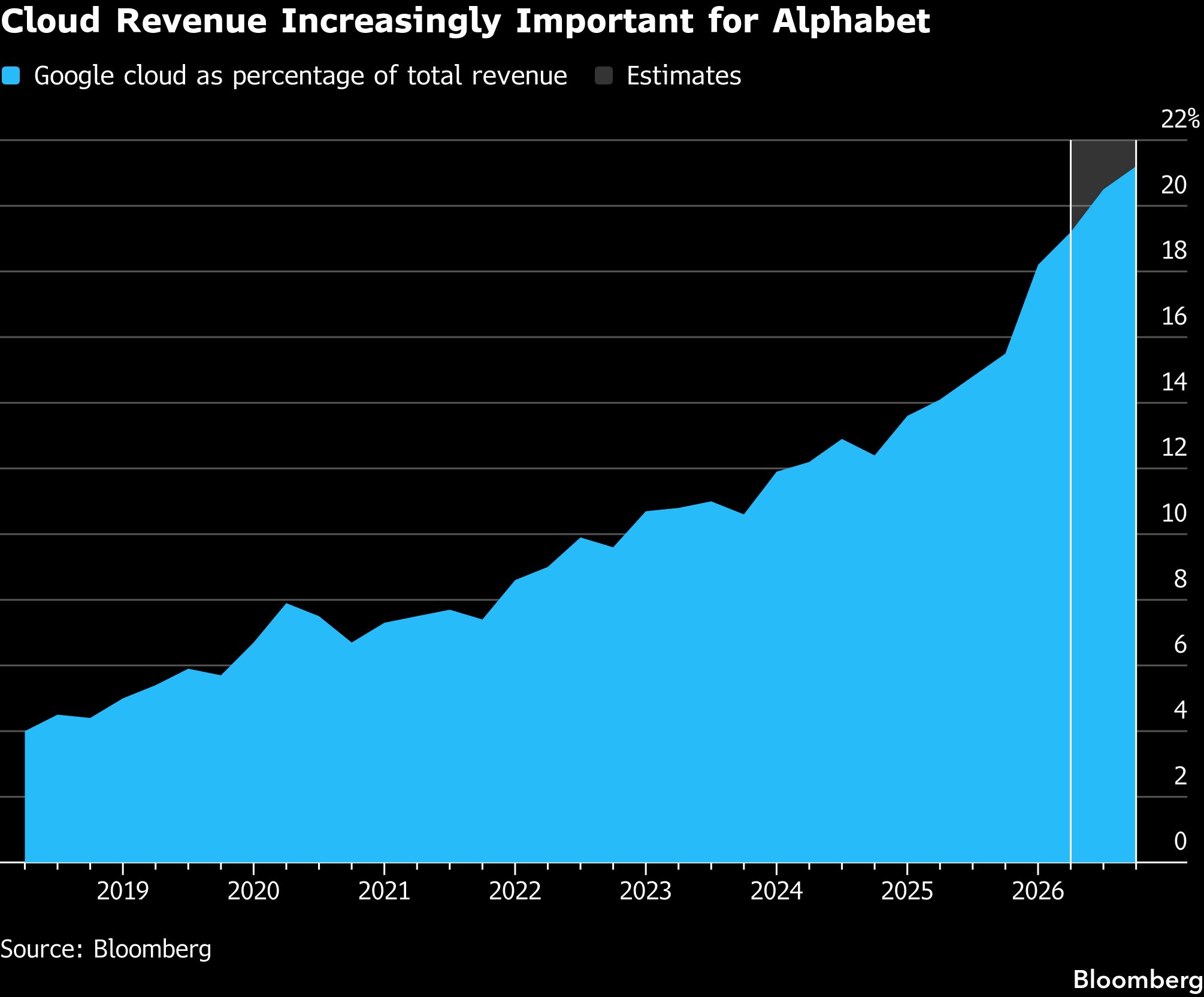
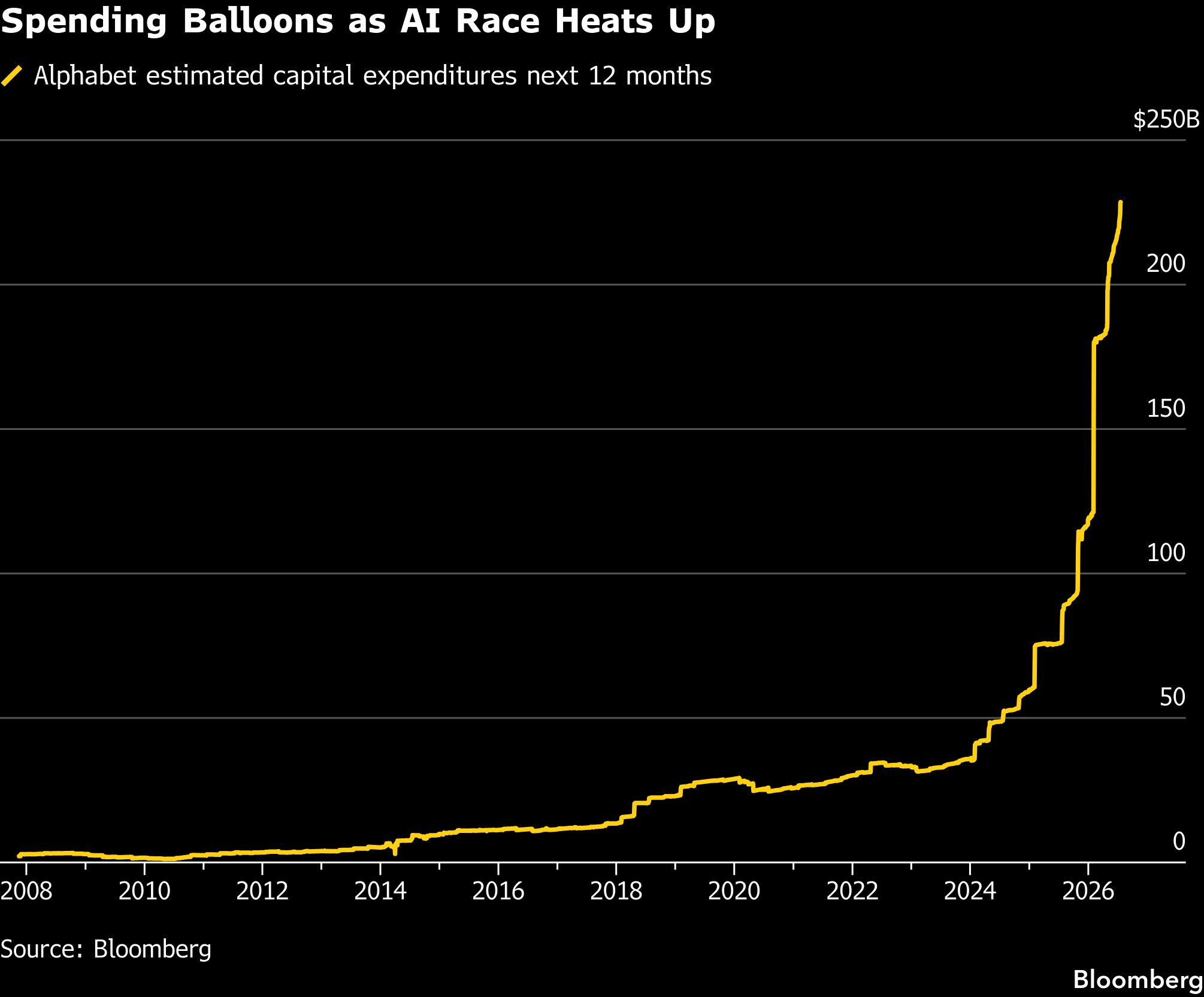
With AI spending skyrocketing, investors are looking for Alphabet Inc.’s earnings to show strong growth in its cloud-computing business, which would demonstrate a clear return on the company’s investments.
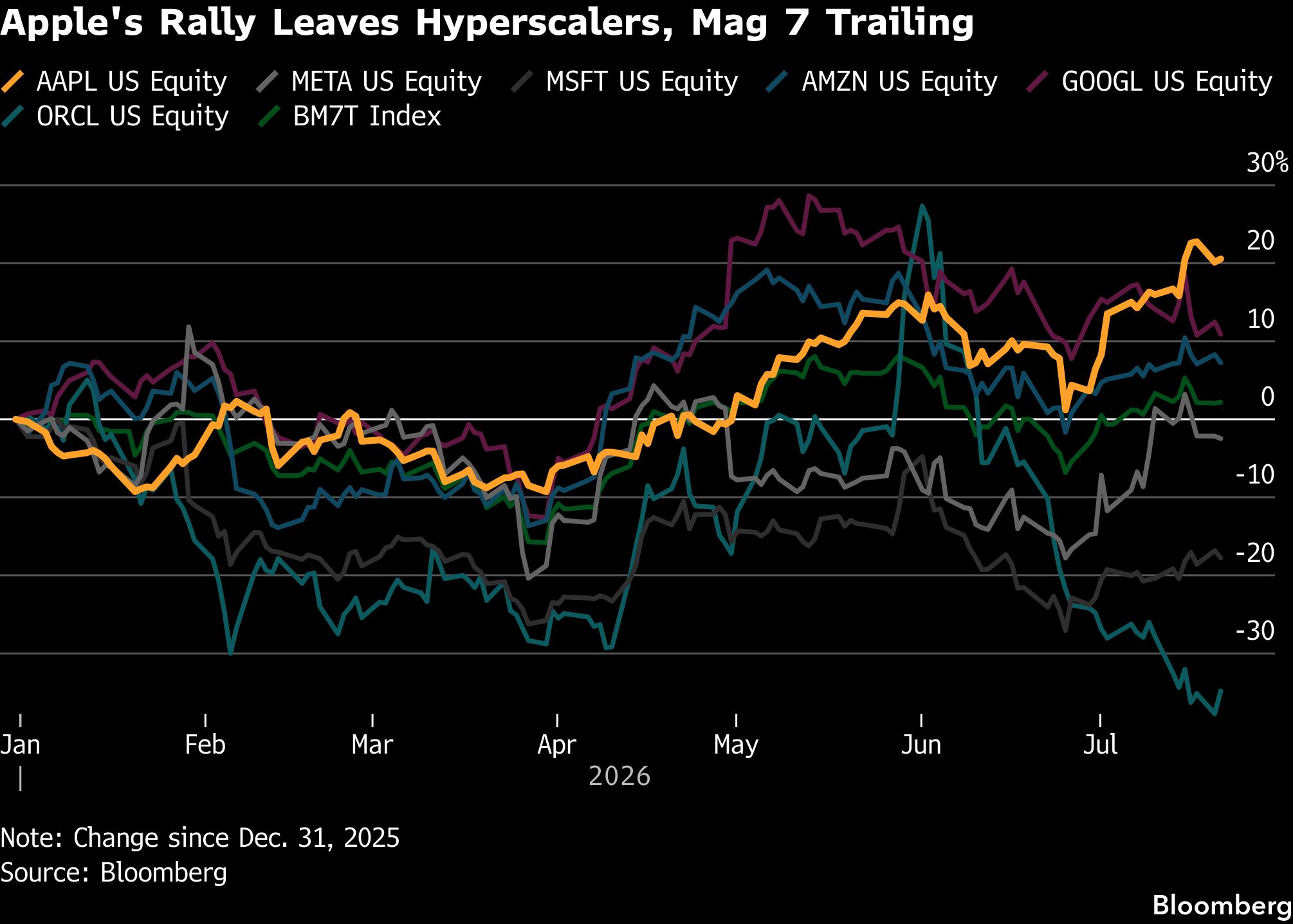
The shares are up a relatively modest 11% in 2026 after soaring 65% in 2025, as investors grow increasingly concerned about how much Big Tech firms are spending to build out their artificial intelligence capabilities. Chipmakers have soared as the main beneficiaries of the largesse, while the Magnificent Seven behemoths — which are providing much of that cash — have barely moved.
That’s why the key to Alphabet’s earnings report, due after the close on Wednesday, will likely be its cloud growth. The business has accelerated in recent quarters, and showing that the trend remains intact will be essential, especially as Google’s parent has telegraphed that the results will feature yet another boost to its spending plans.
“Alphabet has shown it can get good returns on its spending, but there is a question about whether it can keep getting those good returns,” said Jonathan Cofsky, portfolio manager at Janus Henderson Investors, who owns the stock in multiple portfolios.
Shares are up slightly in early trading on Wednesday.
“If it shows an acceleration in cloud and continued strength in search, that would give investors greater comfort with its spending and the overall return profile of the stock,” Cofsky said.
Alphabet is generally considered to be among the best positioned AI spenders. In addition to Google Cloud, its search operation has posted strong results. It has unveiled a number of well-received AI tools. And Wall Street remains positive on its semiconductor business.
The stock got a boost on Monday from a report that the company is developing a server chip designed to optimize its Gemini AI model, which is considered among the industry leaders, even though the latest edition reportedly has been delayed as the company seeks to improve its capabilities, particularly in coding.
Alphabet shares are down 14% since hitting a record in May. But among Mag Seven stocks, only Apple Inc., which has steered clear of the AI spending spree, and chip giant Nvidia Corp. have done better this year, and it’s still beating the other big AI spenders in the group. Amazon.com Inc. has gained 6.8% in 2026, while Meta Platforms Inc. has slipped 2.8% and Microsoft Corp. has lost 18%, making it by far the biggest drag on the S&P 500 Index this year.
Second-quarter results are expected to show a roughly 25% increase in revenue and net income. Google Cloud’s sales are expected to jump nearly 65% from a year ago to $22.4 billion, compared with an expansion of 63% in the first quarter. The projection looks “highly reasonable with likely material upside, given industry commentary around continued very strong demand for AI Infrastructure,” Evercore ISI analyst Mark Mahaney wrote in a note on July 19.
However, the results will undoubtedly be viewed within the context of its capex ambitions. Last quarter, Alphabet said it plans to spend as much as $190 billion this year and that the outlays will be “significantly” higher in 2027.
A recent $85 billion equity raise, which was upsized soon after being announced in early June, has Wall Street anticipating an even bigger number. Alphabet’s capex is expected to hit $262 billion in 2027, nearly three times what it was in 2025, according to the average of estimates compiled by Bloomberg.
“These capex levels are enormous, but right now investors still think the spending makes sense so long as the numbers tell us that we’re going to see a payback,” said David Miller, chief investment officer at Catalyst Funds, which holds Alphabet shares in multiple portfolios. “If Alphabet can beat last quarter’s Cloud growth number, that would be an indication the spending remains fairly prudent.”
Alphabet’s stock is priced at about 23 times earnings estimated over the next 12 months, a modest premium to its 10-year average of 21. By comparison, the S&P 500 trades at 20 times forward earnings, and the tech-heavy Nasdaq 100 Index’s multiple is 23. So while the company’s shares are the most expensive among the big AI spenders, their valuation isn’t considered excessive, especially within the context of Alphabet’s growth prospects.
“The multiple looks pretty reasonable in terms of the margins we expect and the growth we see,” Miller said. “I don’t think many investors will have a problem paying this valuation for this kind of high-margin revenue growth. The value seems pretty straightforward.”