The arithmetic of doom on America’s debt and budget shortfalls has been a favorite parlor game for fiscal conservatives since 1971, when Richard Nixon removed the last constraint on federal borrowing by ending the dollar’s convertibility to gold. Those voices have gotten louder of late as growing debt absorbs ever-larger shares of federal revenue, with net interest now near $1 trillion a year, more than the defense budget.
Sooner or later, the doomers predict, buyers will refuse to fund the US government at rates Congress is willing to pay, and only disastrous exits will remain: have the central bank print money, debauching the currency; refuse to honor the debt; or submit to a humiliating negotiated restructuring. Any of the three wrecks federal finances, the dollar and the economy together — the last through financial disruption, lost confidence and forced austerity.
Optimists reply that Congress always finds enough discipline to keep debt below some critical fraction of gross domestic product, although they keep revising the critical fraction upward as the debt sails past each old red line: 60%, then 90%, now somewhere north of 120%. The debt will never be repaid, they concede, but it need never cause a crisis either.
Both camps assume that what happens to the Treasury happens to the dollar and the economy. Neither foresaw the third way now emerging, engineered not by Congress but by the world’s investors: a debt-for-equity swap on America’s national balance sheet.
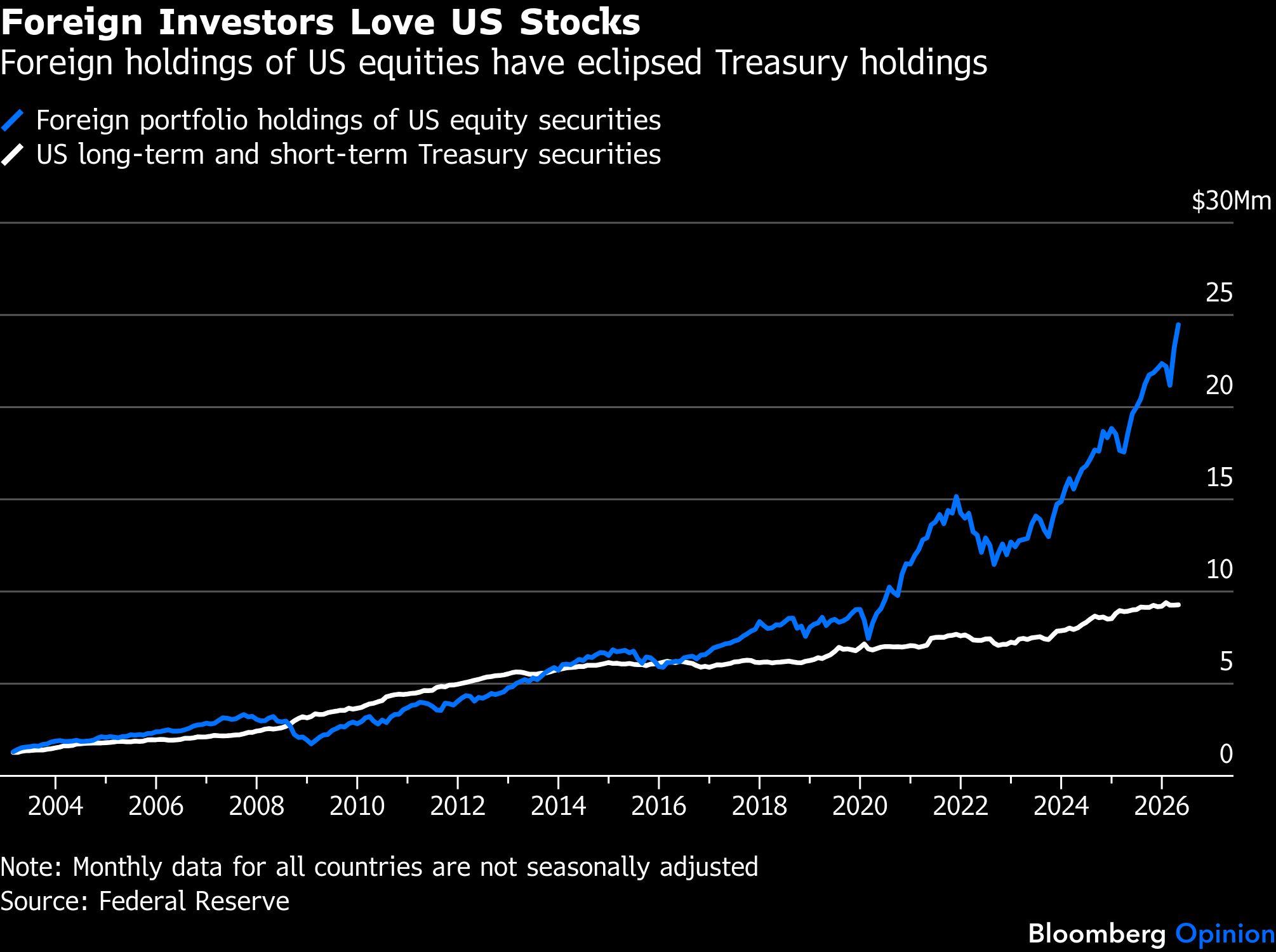
Foreign investors hold $24.5 trillion of US equities against $9.3 trillion of Treasuries — more than 2.6 times as much corporate America as government America. Net foreign purchases of US stocks ran at double the flow into government bonds in the year to March, the widest gap on record. The foreign share of publicly held federal debt has fallen to about 30% from 49% in 2008. The world has stopped lending as much as it once did to Washington and started buying Silicon Valley.
For an optimist, that’s reassuring: As long as American companies deliver, the foreign money keeps arriving, and Washington’s debt problem stays Washington’s problem. The catch is that the hedge is gone — a technology disappointment now costs you twice, once in the stocks and again in the currency they’re priced in, and Treasuries no longer offer protection.
The decoupling shows up in the trailing year’s numbers: a deficit around 6% of GDP with unemployment near its lows, record corporate profits and foreign purchases of US equities eclipsing demand for Treasuries.
It wasn’t always so. Foreign holdings of US stocks and Treasuries were roughly in balance in the early 2000s. Equity holdings pulled ahead by the eve of the financial crisis, only to fall back in its aftermath. By 2011, after the crash cut equity values and China’s reserve managers gorged on Treasuries, foreigners held more US government debt than US stock. The zero-rate years see sawed near parity. The gap only began yawning after 2019, powered by spectacular US equity returns, central bank reserve managers retreating for geopolitical reasons, and a mountain of new federal debt, absorbed mostly at home.
The old regime made the dollar a shock absorber: When stocks fell, money fled into Treasuries, and the dollar held or gained. That reflex assumed the marginal foreign dollar was looking for safety. Today the marginal foreign dollar is looking for AI returns, and its owner responds to a bear market not by switching US assets but by going home.
We saw the preview in April 2025: The S&P 500 Index fell 12% in a week after President Donald Trump’s initial tariff announcement; the 10-year Treasury yield jumped from 4% toward 4.6% and the dollar dropped 4% in a month. Stocks, bonds and the currency all down together.
The natural objection to this scenario repeating is that a US bear market would drag down the rest of the world, too, so the dollar would be trading against other weakening currencies. But exchange rates move on relative flows, not absolute misery. In that same April, developed markets outside the US rose 4.7% in dollar terms while the S&P 500 fell. The asymmetry is structural: Foreigners own $64.6 trillion of American assets while Americans own $43.4 trillion abroad. When fear sends everyone home, more money runs out of the US than into it.
For the economy, the swap is insulation. Debt-funded systems break through refinancing risk. A buyers’ strike means failed auctions, spiking rates and forced austerity in the middle of a crisis — the doom loop the pessimists have predicted since 1971.
Equity funding has no rollover risk. If the S&P 500 falls 30%, no auction fails and nothing must be refinanced; investor wealth is marked down, with foreigners absorbing trillions of the loss. Even within the government-debt book, only about $1.4 trillion of foreign holdings sit in short-term bills that must be constantly refinanced; the rest won’t come due for years.
A long bear market would eventually bite by making us all feel poorer, but the financing channel that turns downturns into crises is sturdier than at any time since the US government’s borrowing binge began.
Could the old balance return as rates stay high and equity returns fade? The gap has closed before — but through equity bear markets, not renewed foreign appetite for Treasuries. Higher yields since 2022 haven’t rebuilt the foreign share of the debt, and reserve managers have been buying gold instead.
The swap quarantines the fiscal problem; it does not cure it. None of that equity money funds the Treasury. Record foreign enthusiasm for American capitalism does nothing for a debtaholic government now selling $2 trillion net new debt a year, in large part to domestic buyers, including hedge funds and banks, who demand compensation. Watch the extra yield they demand for longer-term debt, not the dollar index. The pessimists’ endgame has been contained, not canceled: It is now Washington’s problem, not Wall Street’s or Main Street’s.
The dollar hasn’t lost its crown; it has changed jobs. For half a century, it was the world’s insurance policy; now it’s the world’s growth stock. Insurance pays off in bad times, growth stocks in good ones. Position accordingly — and stop reading the deficit, the dollar and the economy as one story. Fifty-five years after Nixon, they have finally gone their separate ways.