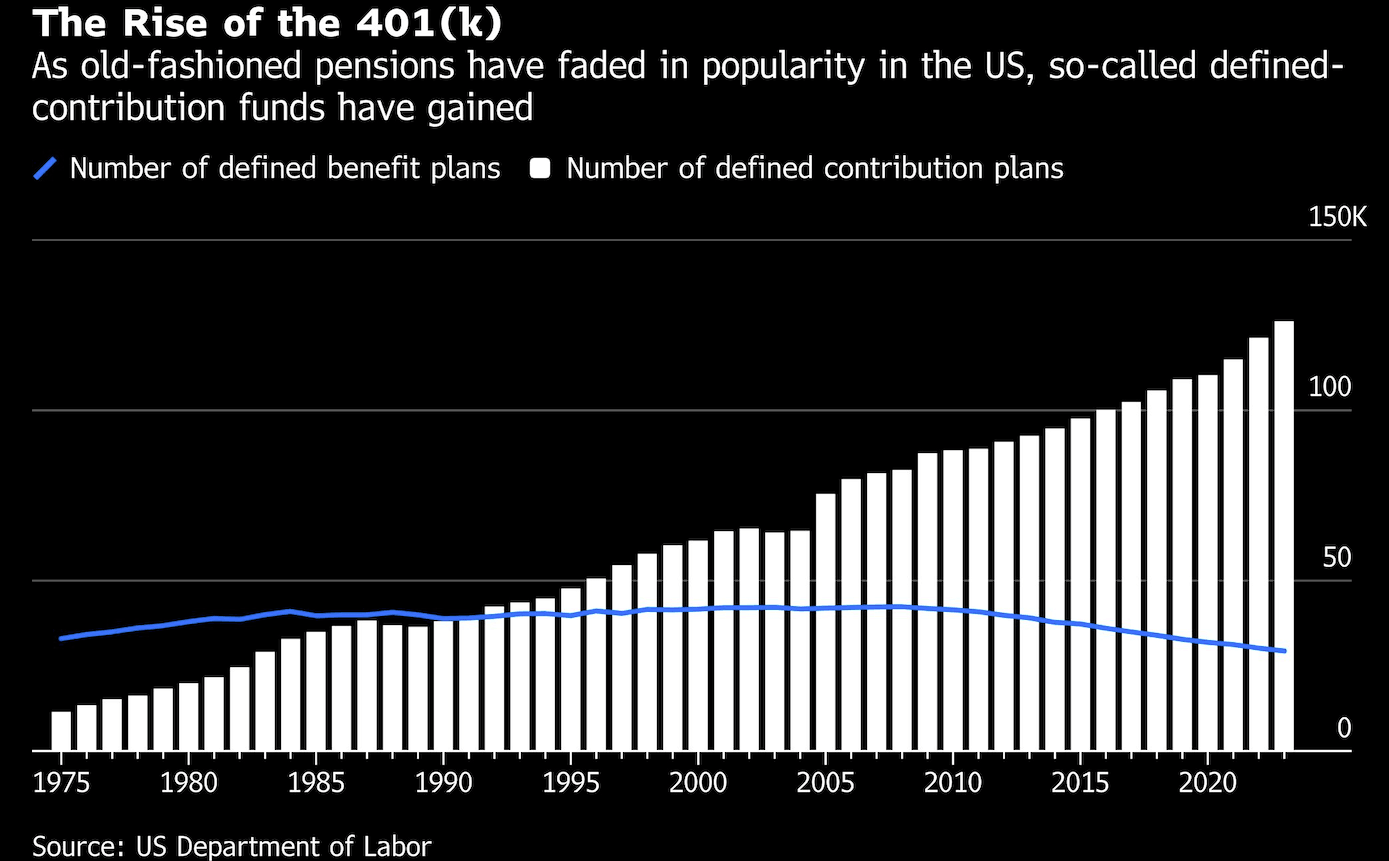
One of my most controversial opinions is that the 401(k) is one of the great financial inventions of the 20th century. It is not a view shared by many people — including, apparently, the inventor himself, Ted Benna, who argues that the 401(k) has mainly benefited the wealthy.
The opposite is true: The 401(k) has been one of the most effective tools for widespread wealth creation ever devised. Yes, it has weaknesses, but it may be the best such system in the world.
Benna, the so-called “father of the 401(k),” says these plans have become too complex and mostly benefit wealthier savers. He worries that low-income people don’t participate because they either don’t have access to an account, or can’t afford to contribute if they do. It is also true that some rich people use 401(k)s and other retirement accounts to lower their tax bills.
At the same time, more Americans than ever also have retirement savings — and 401(k)s are a big reason why. They are much cheaper to administer than traditional pensions, and they have made it possible to expand coverage.
As a result, nearly one fifth of American households have a net worth of a million dollars, like this Costco cashier, largely because of they have been contributing to their 401(k)s. The great triumph of the 401(k) is that it democratized stock ownership right before one of the best periods for stock returns in history. In 1989, when stocks were just about to take off, just 32% of households owned any stock. By 2022, 58% did.
The simple fact is that the 401(k) has increased financial wealth for many middle-class Americans. That it will allow some very rich people to end up with a lower tax bill — how much lower depends on their income when they withdraw the money — doesn’t change this reality.
Of course, the 401(k) is not without flaws. For one, there can be better investment options to manage risk. The next 40 years of returns may not match the last 40 years. And Benna is right that too many lower-income people have been left out. About one third of Americans, most of them lower-income, don’t have an account.
Benna’s suggestion to address this defect is a new program by which employers offer employees accounts financed with discretionary pay, based on performance or tenure goals. But this would not necessarily be better for workers. One of the benefits of a 401(k) is that it frees workers from having to stay with their employer to get a retirement benefit. This is not insignificant, since many pay increases come from changing jobs. The arbitrariness of the performance bonuses also adds an element of risk to retirement planning, since it is an unpredictable income stream.
Another option to increase coverage could be a universal IRA: Instead of employers, the government administers retirement accounts, and all workers participate and contribute. This is what Australia does, and it has some of the highest retirement saving rates in the world.
As I have noted before, saving and investing for retirement is primarily about managing risk. When assessing a retirement system, investors need to think about each source of income and how it contributes to overall risk the same way they would look at the various asset classes in an investment portfolio.
A 401(k) is only one part of a larger retirement system that includes Social Security. It offers a stream of risk-free income (assuming the government gets it act together). For lower-income people, it replaces a high share of their working income.
Low earners do not always need to save more, especially if they are struggling to meet their daily expenses, and they are already saving in the form of Social Security. Workers of all income levels already contribute 12.4% of their income to Social Security (up to the taxable maximum and including the employer contribution). The returns on this, when adjusted for risk, are already very good.
For low-income workers, saving more than 12% may not be possible or optimal. That is how much people in Australia contribute to their accounts, but they don’t have a large Social Security benefit. Adding a universal IRA or special program for low earners in the US would mean they have to save even more.
The beauty of the American system is it offers different sources of income with different risk profiles, which creates a natural source of hedging. Social Security is low risk, which means that people who can afford to invest more can put their money in risker assets. Those risks have paid off, creating a generation of 401(k) millionaires. It seems wrong to call that a mistake.