Long TIPS Yield 3%. Time to Buy?
Membership required
Membership is now required to use this feature. To learn more:
View Membership Benefits The views presented here do not necessarily represent those of Advisor Perspectives.
In late 2008, TIPS yields rose past 3.0%, a juicy rate that lasted barely a month. By 2010, yields had fallen below 2.0%; by 2011, below 1.0%; and just before inflation exploded and the Fed tightened in 2021, the 5-year TIPS yield fell to -1.76%, and even the 30-year sported a negative yield.
As we write this, long TIPS yields once again yield 3.0% and, as in 2008, these rates may not last long. That means: You snooze, you lose. The time to buy TIPS is now.
You likely must sell something else to buy TIPS. Below, we lay out the options and make recommendations.
Treasury Inflation Protected Securities
TIPS are government bonds that enjoy a double guarantee: The Treasury pays coupons on schedule and returns principal at maturity, the same as any other Treasury bond; plus, the government adjusts both principal and coupons to inflation.
If consumer prices triple between now and 2056, a bond bought for $1,000 in 2026 dollars will be paid with $3,000 in 2056 dollars. If the first semiannual coupon was $15 plus a few pennies (the coupon at the 3.0% yield at issue plus six months of inflation), the last coupon in 2056 will be $45.
Put another way, inflation does not ravage this fixed income asset. Purchasing power is maintained. There’s nothing else like TIPS.
Sell Nominal Bonds to Buy TIPS?
With nominal bonds, maybe you get a real return, or maybe you don’t. It depends on how the yield at issue compares to the rate of inflation during the bond’s term. Current issue yields on a nominal 30-year Treasury bond are about 5.0%; if inflation clips along at the 3.5% average seen after the government confiscated citizens’ gold coins in 1933,1 the real return on that bond will be about 1.5%.
Relative to this bond, a TIPS of the same maturity issued with a coupon of 1.5% and trading at par would be a wash. The rational investor will be indifferent between the two . . . assuming expectations are met. If inflation skyrockets, the nominal bond may produce a negative real return. However, at maturity the TIPS bond will still return its real rate at the time of purchase, no matter how high inflation climbs.
Today, you can get 3.0% real on long TIPS. The rational bond investor now prefers the 30-year TIPS over today’s 30-year nominal bond. Inflation would have to fall from its current level of 3.5%–4.0% down to about 2.0% — and stay there for the next 30 years — for the bond investor to be indifferent between the nominal 5.0% Treasury bond and TIPS yielding 3.0% real. Good luck with that.
Then again, perhaps today’s nominal bond yields are depressed or unusual in some way. Just how often have nominal bonds delivered a real return of 3.0% or more over a multi-decade holding period? Is 3.0% real from a nominal Treasury bond a usual, customary, and reasonable expectation — or a heavy lift?
Scholars have data on long U.S. bonds going all the way back to Alexander Hamilton’s time. Figure 1 shows real returns over 20- and 30-year rolls for these government bonds, with a horizontal line drawn at 3.0%.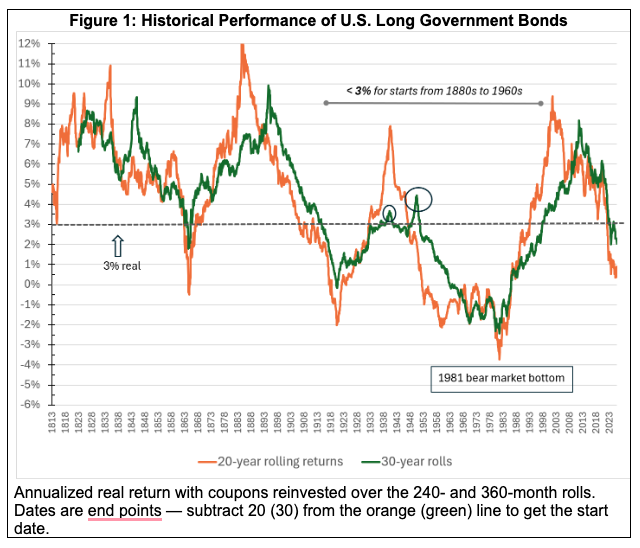
Real returns on U.S. bonds, it turns out, have been all over the map for 20- and 30-year holding periods. Sometimes investors did better than 3.0% real — but all too often, they did so, so much worse. Focusing on 30-year rolls (green line) and excepting two brief bounce backs in the 1940s (circled), every 30-year holding period, from a beginning in the early 1880s through a mid-1960s start, saw real returns below 3.0%. And if you had the misfortune to own long bonds during the Great Bond Bear market that ran from 1946–1981, you saw negative real returns.
Recommendation #1 (bonds): Replace long- and intermediate-term nominal bonds with TIPS. If you are rebalancing out of some other asset into bonds and expect to hold for decades, buy long TIPS. If you have cash burning a hole in your pocket and want to preserve its purchasing power over the long term, buy long TIPS.
The U.K., 1753–2025
Whoa, you say. Two hundred and thirty-three years is a nice sample, but that’s just in the U.S. Among markets, the U.S. is nonpareil, an exceptional case.
Fine. To get comparable historical depth and stick to hegemon status (avoiding bonds from governments like Argentina), we have to look to the U.K., where we have a 272-year historical record from 1753. Figure 2 shows how often the British bond investor earned more than 3.0% real.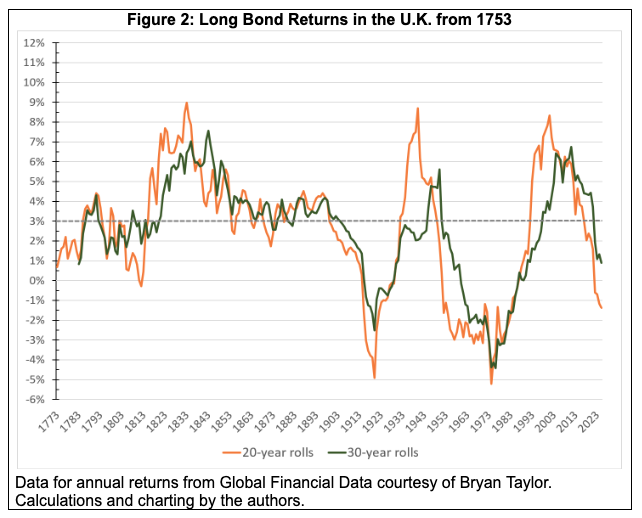
The pattern over time is similar: British bond buyers from the 1870s through the late 1960s saw subsequent 30-year returns below 3.0% real, often much lower, again excepting a brief uptick for rolls ending about 1950.
Stepping back, there’s a ready explanation for the contrast between the 19th and 20th centuries seen in Figures 1 and 2: Nominal bonds make sense under the gold standard and in the absence of inflationary wars. Once fiat currencies replaced gold, governments regularly screwed the nominal bond investor. Sorry, but it has to be said: Nominal bonds aren’t about safety, but are a device for slow and steady expropriation. Governments have learned that the investor frog placed in a warm bond pot rarely bestirs himself in time.
Given fiat currency and a powerful state capable of financial repression, a real Treasury yield of 3.0%, locked in for three decades, is historically very attractive — a plum to be snatched on sight.
Bond Summary
In their annual yearbook compilation of global asset returns, Dimson, Marsh, and Staunton report that since 1900, across 23 developed markets, the annual real return on long government bonds has averaged 1.4%.
Get moving, bond investors. Buy long TIPS. Grab this deal now!
Sell Stocks to Buy TIPS?
Here in the U.S., things are less clear. As everyone knows: It’s stocks for the long run, not bonds.2 The long-run real return on U.S. stocks is typically reported as between 6.5% and 7.0%.
But the annual standard deviation for U.S. stocks runs between 15% and 20%. In other words, over shorter periods stocks bounce around a lot, soaring and plunging. Stock investing has worked out well — if you were a vampire capable of sleeping through the centuries. Nonetheless, given a few badly timed runs of negative returns, you might not get 6.5% real on stocks held over your time horizon. Which is all that matters in your one mortal life.
So just how often did U.S. stocks come up short of 3.0% real?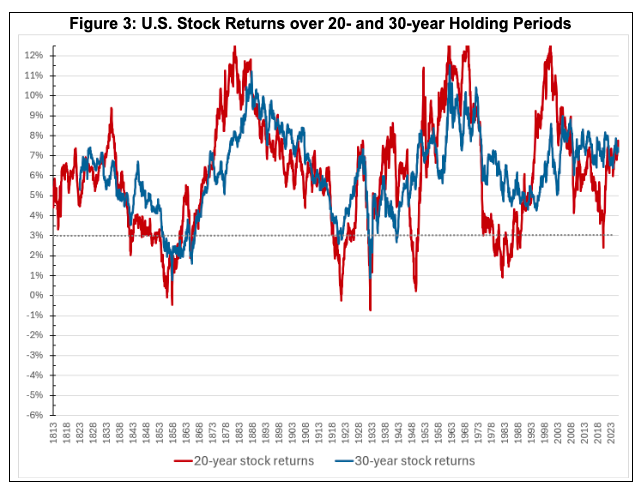
Figure 3 looks at real returns on U.S. stocks over 20- and 30-year rolls and again draws a dashed horizontal line at 3.0%. Looking at the 30-year rolls first (blue line), long TIPS at 3.0% can’t hold a candle to stocks over a 30-year horizon. There have been a couple of flubs, but these occurred at generational bear market bottoms, before the Civil War and in the vicinity of the Great Depression. It’s rare for U.S. stocks to return less than 3.0% real over a 30-year span.3
Matters are not so straightforward over 20 years. Here, shortfalls below 3.0% occur with some frequency, perhaps once in a generation. That pattern continues to hold at still shorter intervals: See Figure 4 with 10- and 15-year rolls.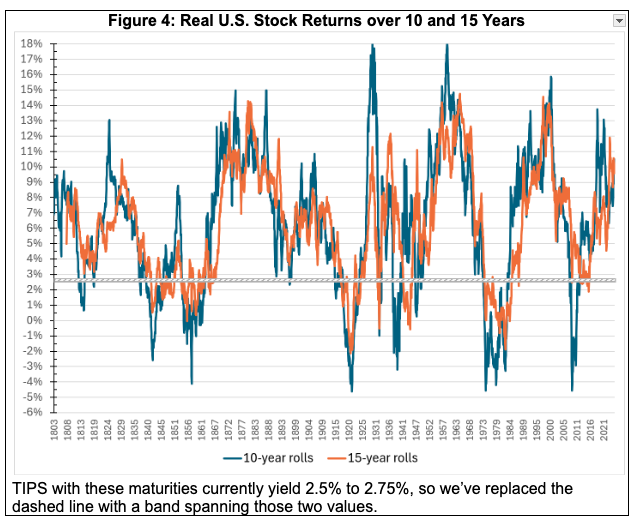
Over 10 years, stocks have repeatedly suffered disastrous pratfalls. You’ve not read a book titled Stocks for the Intermediate Term, and for good reason. Stocks can do well over the very long term because you have to assume so much risk over the short term. Risk means you can expect to lose money over shorter intervals.
The intermediate-horizon investor should consider whether they want to lock in 2.5% to 3.0% with TIPS or gamble with stocks. The highs with stocks are so much higher that many stock investors will probably take that risk and eschew TIPS. That’s not irrational — especially if you are young.
The key question is, as always: What’s your time horizon? If you are opening an account for a new grandchild, it’s 100% stocks for their annual gifting. On the other hand, if you just retired at age 65, even though the joint life expectancy of you and yours is pushing 30 years, the duration of your average spending dollar is less than half that: Draw bad returns during the first decade, and you might be toast. Sure, the odds are still good that stocks will beat TIPS over any given 10- or 15-year period. But so, too, are the odds of winning a single round of Russian roulette.
Recommendation #2 (stocks): The stock investor with a truly long-term horizon of 30 years or longer need not be tempted by enticing 3.0% yields on TIPS. Stay the course. But as the horizon shortens to 20 years, TIPS start to become a reasonable alternative. As the horizon shortens further to 15 or 10 years, stock returns become more likely to fall short of 2.5%–3.0% real, and TIPS become a more compelling alternative.
But Wait!
To this point, we’ve treated TIPS as a buy-and-hold investment to be evaluated in terms of total return over some horizon.
This ignores the superpower of TIPS: the capacity to lock in not a total return, but a real income year by year. Like in retirement.
You can ladder TIPS, with one bond maturing each year, and with the maturing bond plus coupon income guaranteeing a steady real income year after year. That income is a function of the yield across the maturity curve and not just the yield on long TIPS.
Go to TIPSladder.com to see how much real income you can get for how long. In the first week of August 2026, as this was written, with the yield curve stretching from about 2.0% to 3.0%, you could lock in an amortized payout of 4.9% real over a 30-year ladder.
That’s rather better than the 4% rule. More to the point: 4.9% is more than can safely be withdrawn from a target-date retirement fund. These often drop to a 30/70 stock/bond mix by age 72. Why so little in stocks? Theory holds that retirees who start making withdrawals are very sensitive to volatility. Retirees dread sequence-of-return risk. In a word, the typical retiree is almost painfully conservative. All they can manage is half the stock allocation seen in the famous 60/40 portfolio.
Do you consider yourself a conservative senior citizen? Listen up: At current yields, the true conservative choice is a 30-year TIPS ladder — not a 30/70 blend using those crappy nominal bonds that we condemned earlier (known in the 1970s as “certificates of confiscation”).
We ran the numbers as follows: From 1890 (near the end of the deflation following the Civil War but early enough to capture the mini-depression of 1920–21), we constructed a 30/70 portfolio for each start year and examined whether it could sustain inflation-adjusted 4.9% withdrawals for 30 years.
As Figure 5 shows, the 30/70 portfolio failed half the time. Many of the failures were excruciating: Retirees in the 1960s might have sustained as little as 17 years of real income of $49,000 off a million-dollar starting value. Ruined at age 89. Ouch.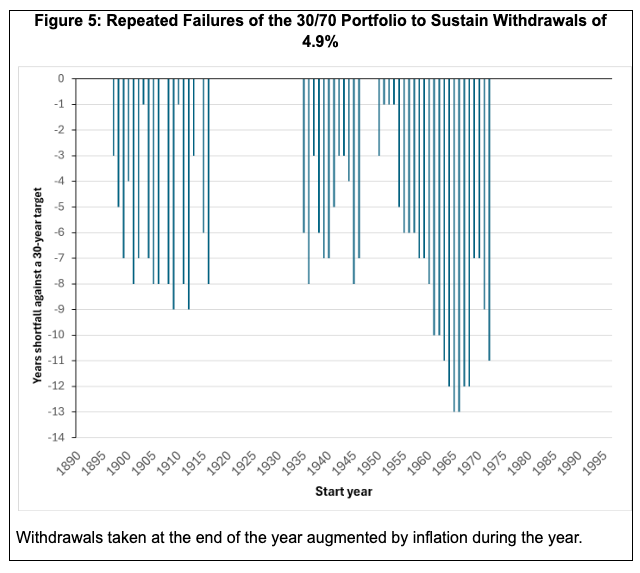
When long TIPS yield 3.0% in your early 70s, you can’t call yourself conservative if you refuse to swap out your target-date retirement fund for a TIPS ladder.
Advisors take note.
Wants and Needs: The Ages of the Investor
To review, portfolio design follows the life cycle. The young saver should invest 100% in stocks, and has no need for TIPS, even at today’s high yields.
For the retiree, things get more complicated. Do Social Security and a cushy pension cover your essential expenses? Then you’re not investing for yourself, but for your heirs and charities, and you can shrug at TIPS yielding 3.0%. Ditto if your burn rate is south of 2%, since the dividends from a global stock portfolio will cover all of the above needs.
But if you’re depending on stocks to pay for a comfortable rather than sparse retirement lifestyle, you’re spinning the revolver’s chamber. Don’t do it. Match those inflation-exposed liabilities with a TIPS ladder.
Now would be a good time.
End Notes
1 Bill treasures to this day the small hoard of quarter and half gold eagles his father hid from FDR.
2 For a dissenting view, see Ed’s paper.
3 We checked U.K. stocks and found a similar pattern.
Edward F. McQuarrie, Ph.D., is professor emeritus at Santa Clara University. He writes about financial history and its implications for retirement planning. His paper, “The 4% Rule Was Never Failproof,” won the 2026 Journal Research award from the Investments & Wealth Institute. Working papers describing his research can be downloaded here.
William J. Bernstein is a neurologist, the co-founder of Efficient Frontier Advisors, an investment management firm, and a writer with several titles on finance and economic history. He has contributed to the peer-reviewed finance literature and has written for several national publications, including Money magazine and The Wall Street Journal. He has produced several finance titles, and four volumes of history, The Birth of Plenty, A Splendid Exchange, Masters of the Word, and The Delusions of Crowds about, respectively, the economic growth inflection of the early 19th century, the history of world trade, the effects of access to technology on human relations and politics, and financial and religious mass manias. He was also the 2017 winner of the James R. Vertin Award from the CFA Institute.
A message from Advisor Perspectives and VettaFi: Discover something new! Click here to register for our upcoming webcasts.
Read more articles by Edward F. McQuarrie, William J. Bernstein
Membership required
Membership is now required to use this feature. To learn more:
View Membership BenefitsSponsored Content
Upcoming Virtual Events View All