Goldman Sachs Group Inc.’s agreement to buy Neos Investments for as much as $2.25 billion marks a new front in Wall Street’s ETF battle: paying up for specialist firms that have found growth beyond the industry’s low-fee giants.
The deal announced Wednesday is Goldman’s second major acquisition of a niche ETF manager in less than a year, following its roughly $2 billion purchase of Innovator Capital Management. Together, they give Goldman a sizable position in options-based strategies that promise investors income, downside protection or other defined outcomes, a corner of the fund industry that has been growing at a speedy clip.
The acquisitions also mark a shift for a firm that arrived relatively late to the fiercely competitive ETF business and has experimented with different ways of gaining ground.
Now it’s spending billions to acquire products that have already proved they can attract investor money.
Founded by Troy Cates and Garrett Paolella in 2022, Neos has grown to about $32.5 billion across nearly two dozen ETFs in just four years. Its funds use options to generate income or alter the payoff investors receive from traditional assets. For Goldman, Neos offers something harder to manufacture quickly: a track record of turning specialized strategies into multibillion-dollar funds.
“For some larger firms, it is easier to acquire a company with a proven track record than to start your own products replicating strategies and hope it builds traction,” said Mohit Bajaj, managing director of ETFs at WallachBeth Capital.
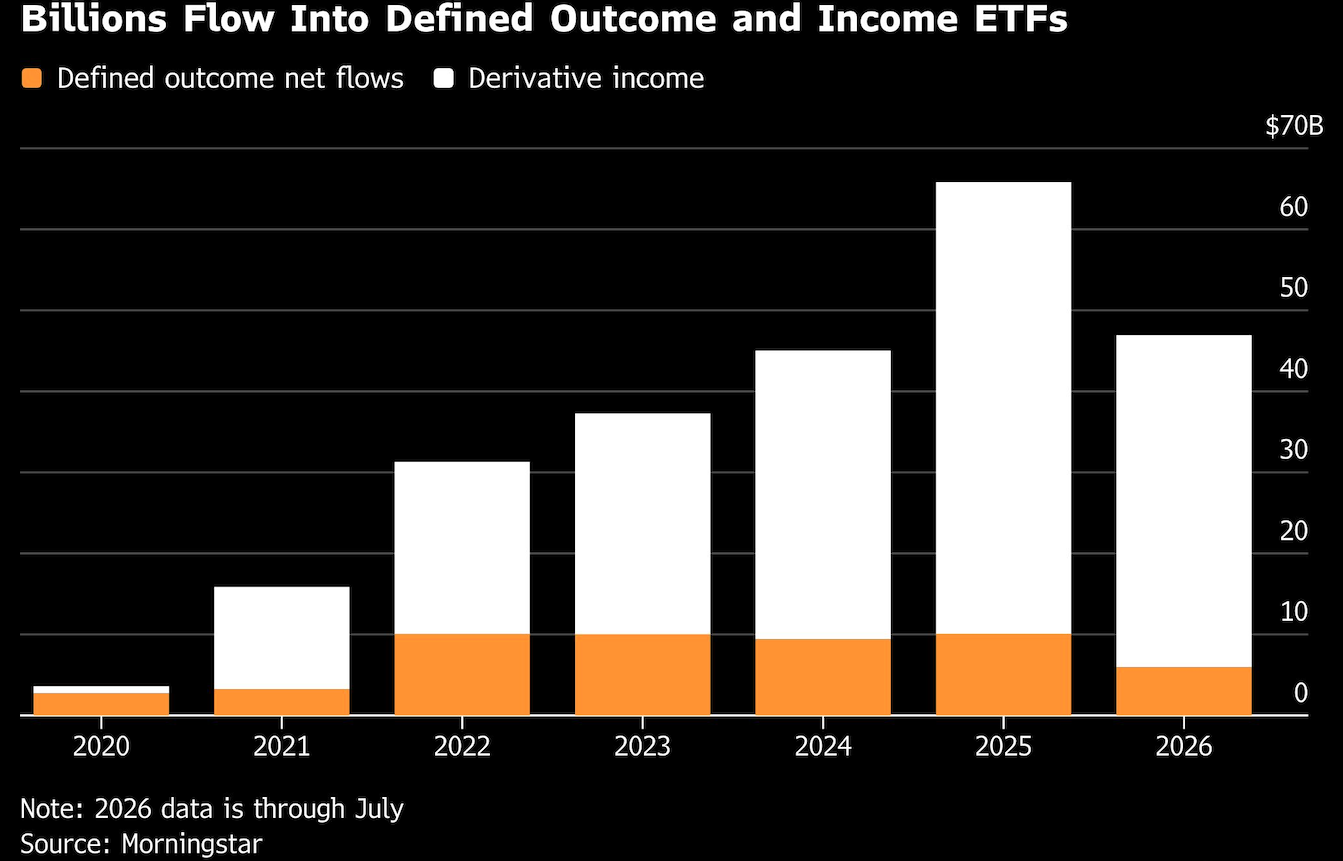
Both categories have ballooned in recent years. Defined-outcome ETFs, which use options to offer features such as downside buffers, now hold about $74 billion, according to Morningstar. Derivative-income ETFs like those sold by Neos have roughly $186 billion.
“This category is a category that we want to be in,” said Bryon Lake, global co-head of third-party wealth and chief transformation officer at Goldman Sachs Asset Management. “Now, we feel like we’ve got one of the most complete ranges of income capabilities in the income category.”
That means that the recent acquisitions give Goldman exposure to two distinct — though complementary — corners of the market. If Innovator gave Goldman a major foothold in defined-outcome ETFs, Neos will help add another piece to the options-based income puzzle. Together, they give the bank a broader toolkit for investors looking for something beyond simple market exposure.
“This is a sturdy revenue stream of non-hot sauce offerings that appeal to rich boomers,” said Eric Balchunas, senior ETF analyst at Bloomberg Intelligence. “It’s hard to find that combination in an acquire-able company in the ETF space right now.”
In a market where the biggest firms have spent decades driving down the price of basic exposure, some of the most valuable ground left to fight over is in products that investors are still willing to pay more to own. Unlike the core vanilla products that have driven the ETF industry’s fee war to near-zero, newer and more complex strategies can command considerably higher fees. That matters for an acquirer.
Bloomberg Intelligence’s Neil Sipes and Ravi Chelluri argue that Neos’ relatively high-fee products help justify the up-to $2.25 billion price tag. The deal represents roughly 7% to 8% of Neos’ assets, they wrote in a note, a multiple that looks reasonable when compared with other private-market asset-management transactions.
Still, Neos’s suite is competing in a crowded space.
JPMorgan’s Equity Premium Income ETF (JEPI) has arguably been the poster child for the options-income category. The fund has grown to $46 billion since its 2020 launch, and its blockbuster success was followed by JEPQ, the JPMorgan Nasdaq Equity Premium Income ETF, which tracks the tech-heavy index while generating income from an option-overlay strategy. The traction of these funds caught the attention of JPMorgan’s rivals and spawned a wave of copycat products — including some from Goldman.
JEPI and JEPQ — which have seen combined inflows of more than $11 billion this year — charge 0.35% each.
Neos took a slightly different — and more expensive — route. Across its 19 ETFs, the issuer charges an average 0.74% and sees an estimated annual revenue run rate of $222 million, according to Bloomberg Intelligence.
All but one of the 19 ETFs in Neos’s lineup have managed to attract inflows this year despite charging higher-than-average fees. In a business where investors have been conditioned to obsess over every basis point, that is evidence that a compelling strategy can still command a premium.
“Goldman Sachs brings the scale, resources, and global reach that will enable Neos to invest more aggressively,” said Neos co-founder Paolella. “The demand for tax-efficient, outcome-oriented investment solutions continues to accelerate.”