The US will soon announce unprecedented economic measures against Iran, Treasury Secretary Scott Bessent said, intensifying the Trump administration’s effort to force Tehran’s capitulation after almost six months of war.
“Watch this space for more announcements coming next week because we are going to apply measures like have never been seen in the history of economic isolation on a country,” Bessent said in an interview with Newsmax on Thursday. The move will be part of a “one-two punch” that includes the continued blockade of Iran’s ports, he added.
Fighting erupted on Feb. 28 when the US and Israel staged airstrikes on Iran, which responded with missile and drone attacks against American allies across the Middle East. Thousands of people were killed, mostly in Iran, before a truce was agreed in June.
Talks aimed at bringing about a lasting peace have stalled and intermittent clashes have continued, disrupting the flow of oil and other key commodities from the region.
Iran’s economy has taken a major hit, with much of its industrial capacity damaged and crude exports severely curtailed by the US blockade. But the Islamic Republic has weathered waves of sanctions that have failed to force it to bend on its nuclear program or relinquish control over the Strait of Hormuz.
US President Donald Trump in recent days has renewed his administration’s push for economic pressure on Iran as the US faces a shortfall of necessary munitions and appears wary of expanding a military campaign that’s faces mounting domestic opposition heading into midterm elections in November.
Trump told Axios over the weekend that he is “low-keying it” with Iran. “We are just watching Iran with its huge inflation and the fact they have no money,” he said.
Iran, for its part, has reorganized its military to be more aggressive abroad as talks on ending the war remain mired in stalemate, a sign that Tehran is preparing for the possibility of a protracted era of regional conflict.
See more: Iran Deal Never Came. Stocks Didn’t Care.
The US has added some 2,200 sanctions on Tehran since 2018, according to Jeremy Paner, a partner at Hughes Hubbard & Reed, who tracks designations on Iran’s oil and petrochemical sectors.
“If 47 years of sanctions haven’t broken Tehran’s will, more of the same is unlikely to produce any changes,” according to a Bloomberg Economics report led by Jennifer Welch. She sees the most likely scenario as Trump staying on the same path as before, maintaining sanctions and the blockade, alongside limited strikes and diplomatic efforts.
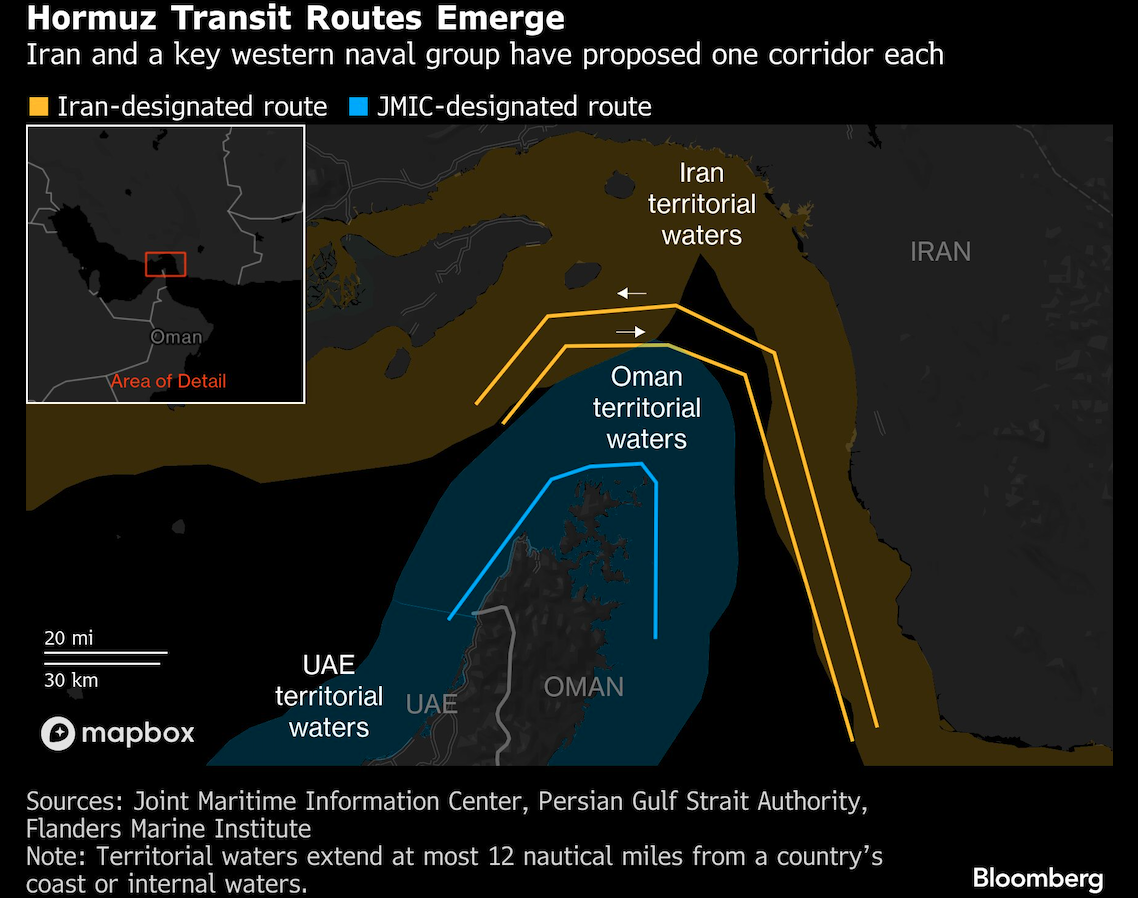
The Strait of Hormuz has been a key sticking point. Both sides claim control of the waterway, through which one-fifth of the world’s oil and gas transited prior to the war, and are demanding concessions that are unlikely to be met.
Iran and Oman have been locked in lengthy talks about establishing a shipping route through the strait, but the US isn’t party to those discussions. Mohsen Rezaee, the newly appointed secretary of Iran’s Supreme National Security Council, said any deal would remain separate from a full reopening.

Two Abu Dhabi National Oil Co. vessels were attacked while transiting Hormuz on Thursday evening, the United Arab Emirates’ state news agency WAM reported. No one was injured and the situation has been brought under control, it said.
The UAE’s foreign ministry condemned the strike, saying in a statement that targeting commercial shipping and using the strait as a tool of economic coercion or blackmail constituted “acts of piracy” by Iran’s Islamic Revolutionary Guard Corps.
Meanwhile, the UK Maritime Trade Operations said it received a report from military authorities of a tanker being struck by a drone on Thursday while exiting Hormuz. The vessel sustained minor damage and the crew are all safe and accounted for, it said.
The US forces’ ability to escort ships through Hormuz is growing and crude flows from the region will continue to increase, with the “pinch” in the oil market stemming from refining rather than deliveries, US Energy Secretary Chris Wright told Fox News on Thursday.
Vice President JD Vance told the TV channel that the first goal in the war with Iran is keeping the price of oil and gasoline cheap for Americans, and that the US has “a lot of tools at our disposal to compel action” from Iran.
Brent crude prices rose as much as 1.9% to almost $88.69 a barrel on Friday, lifting the global benchmark’s gains for the week to more than 5%.
Israel has sat out recent clashes in the Persian Gulf, while pursuing operations against Iran-backed militias in Gaza and Lebanon.
Prime Minister Benjamin Netanyahu has said Israel is poised to resume attacks on the Islamic Republic if asked by the US, but members of his government have also said economic pressure could suffice to topple its government.
“What will ultimately bring down the regime is its weakening, primarily that of its economy,” Finance Minister Bezalel Smotrich said in a July 21 interview with Tel Aviv 103 FM radio station, remarks that were echoed by his cabinet colleagues. “The current situation, in which there is an embargo, economic pressure and sanctions, is best for us.”
A message from Advisor Perspectives and VettaFi: Discover something new! Click here to register for our upcoming webcasts.
Bloomberg News provided this article. For more articles like this please visit
bloomberg.com.
Read more articles by Jon Herskovitz, Sara Gharaibeh