Convertible bond investors chasing exposure to the artificial intelligence boom are giving up some of the protection they would normally demand, pushing the market toward levels of risk-taking last seen during the pandemic.
Coupons on some new deals have fallen toward zero as buyers bet that gains in issuers’ shares will provide their returns instead. That is making the market increasingly biased toward equities and weakening one of the key attractions of convertibles: the income that can cushion investors if the underlying stock falls.
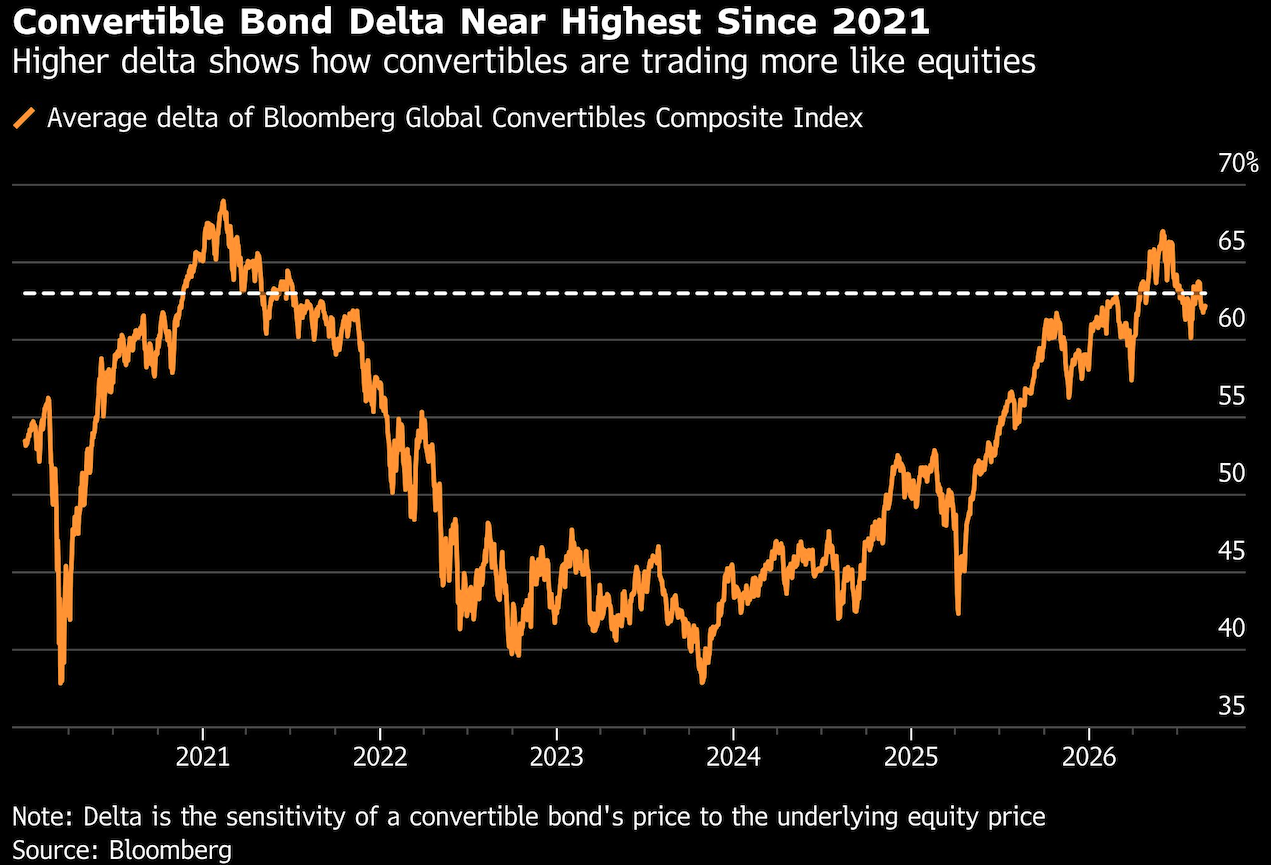
Convertible bonds allow investors to swap their debt for shares at a certain price. A measure of how equity-like the market has become is at its highest since 2021, when firms like Peloton Interactive Inc. and Beyond Meat Inc. raised billions with deals carrying 0% coupons. That episode ended painfully when their shares collapsed, leaving investors holding unsecured debt that paid no interest.
This time around, it’s coming just as tech stocks wobble over fears of a bubble, yet investors argue the potential to get equity exposure to AI is worth it. The problems stemming from 2021’s frenzy of sales, they say, came from subsequent sharp interest-rate hikes hitting companies with rapid revenue growth but minimal profitability.
“Some version of that can always repeat, but rates are at a very different place today,” said Joe Wysocki, a senior vice-president and portfolio manager at Calamos Investments LLC. “While there are still pockets of higher risk names, today’s convert market has many issuers that are experiencing exceptional fundamental momentum in both revenue and profitability.”

See more: Buybacks, Market Functioning, and Treasury Predictability
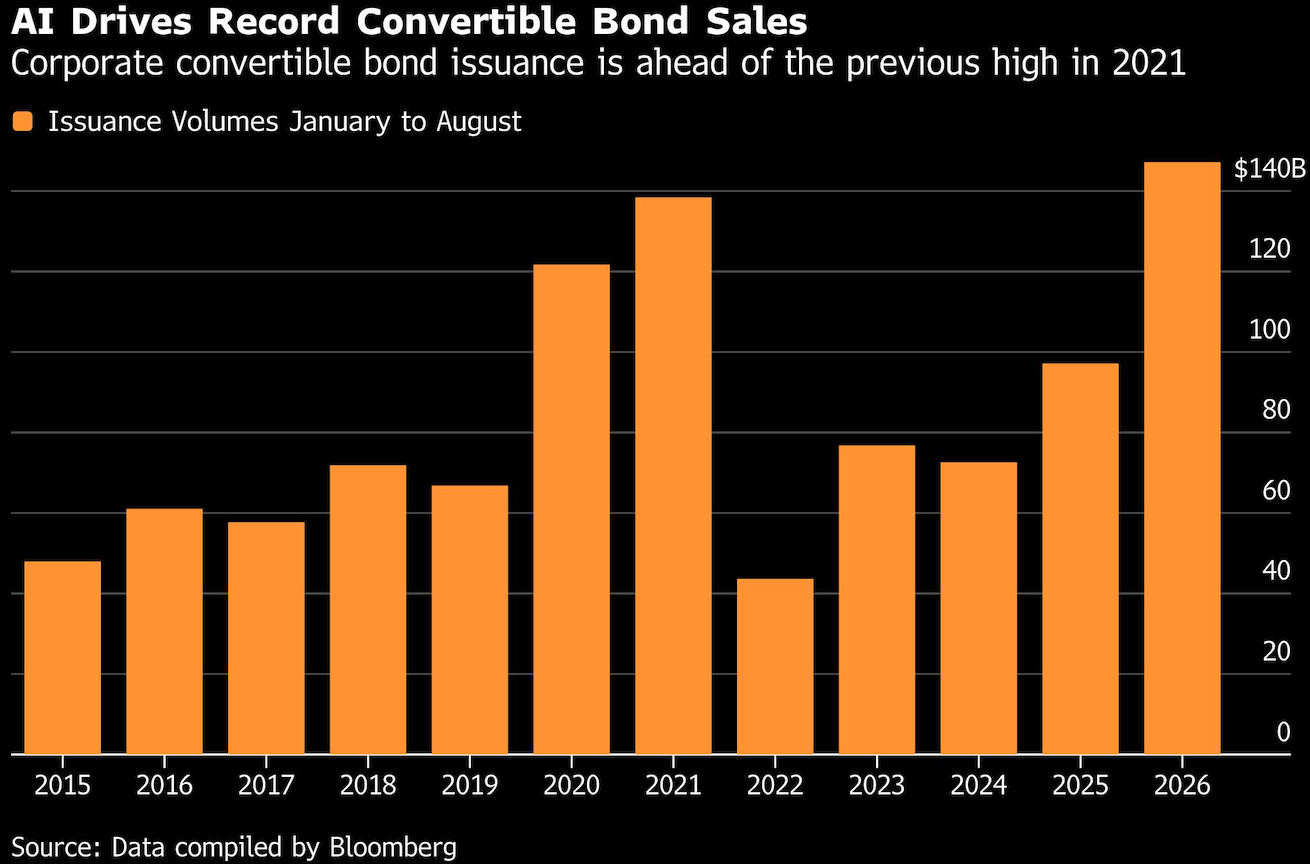
So far this year, tech firms have helped drive global issuance of convertible bonds to hit $147 billion, more than 50% higher than at the same point last year and already topping the previous annual record set in 2021.
Big deals have come from the likes of CoreWeave Inc., which provides software to run AI applications, and equipment maker Lenovo Group Ltd. Just last week, Nebius Group NV, which builds a cloud platform for artificial intelligence workloads, turned to the convertibles market to raise $4.5 billion on top of another $9.75 billion it had already issued. The deal included 2030 notes with a coupon of 0% to 0.5%.
Coupons close to zero mean holders are no longer being “paid to wait” as they were in recent years when convertibles had much higher yields, according to Nicolas Cremieux, Mirabaud Asset Management’s head of convertible bonds. He said investors are instead being enticed by the equity option.
That is shown in the delta, a measure of the sensitivity of a convertible bond’s price to changes in the underlying stock price. The current average of 64% is around the highest since 2021, according to data compiled by Bloomberg.
As the convertibles market becomes more equities-like, investors must distinguish between winners and losers instead of buying the asset class indiscriminately, according to T. Rowe Price portfolio manager Adam Marden.
AI could be a productivity boost making a “dreamland” for convertibles, or “could also be the biggest waste of money the world has ever seen,” he said, adding that makes it important to read the fine print on each bond to understand what protection is in there.
Without much of a coupon, investors will be relying on future equity returns. The tech-focused Nasdaq 100 Index has wobbled in recent months after hitting a record in June.
Companies such as Google parent Alphabet Inc. are increasingly taking on debt in the conventional credit market to fund infrastructure spending.
Investment-grade deals for data centers linked to hyperscaler companies are now offering yields more commonly associated with junk-rated firms.
As investors gain exposure to AI through equities, credit and increasingly equity-like convertibles, the experience of 2021-2022 highlights the risk of portfolios becoming heavily exposed to the same underlying theme without it being obvious from individual positions, said Stephan Bach, a senior portfolio manager at Sparinvest.
“The point is not to avoid strong themes, but to make sure that enthusiasm for a theme does not overwhelm valuation discipline or portfolio construction,” said Bach.
A message from Advisor Perspectives and VettaFi: Discover something new! Click here to register for our upcoming webcasts.
Bloomberg News provided this article. For more articles like this please visit
bloomberg.com.
Read more articles by Selina Chen, Ronan Martin