Advisor Perspectives welcomes guest contributions. The views presented here do not necessarily represent those of Advisor Perspectives.
Over seven years ago, I wrote a piece using the 1960s TV sitcom Gilligan's Island to provide a simple example of why productivity is the most important driver of economic growth. In this article, I present the next episode of Gilligan’s Island, describing what happens after the benefits of innovation stop driving economic growth.
Right now, the U.S. and global economies are in a gap between two innovation eras: The IT boom's productivity tailwind is largely spent, and AI's potential is budding. Nobody knows when or how large the AI payoff will ultimately be.
While no one has answers about what AI has in store for the economy, I can help you appreciate why productivity and innovation are vital for economic growth and, ultimately, investment returns.
Review of Gilligan’s Island Episode 1 — Innovation Takes Root
On my fictitious island and plot, seven castaways produced only one product: coconuts. They harvested coconuts to sell to other islands and to obtain necessary goods.
Without innovation, the castaways had only a few ways to increase coconut production and grow their economy; however, each had limitations:
- They could work more hours, but daylight and physical stamina capped their efforts.
- They could invite new castaways to the island. While more people will increase production, the output per person won’t change. Thus, it wouldn’t be a genuine increase in prosperity.
- Thurston Howell III can borrow money from a neighboring island so they could consume more goods, but that debt must be repaid with interest, essentially forgoing tomorrow's consumption to fund today's.
The Professor’s Innovations
The true, lasting way to grow an economy comes only from innovation that boosts productivity. For example, the professor recommends redirecting some of their coconut revenue from frivolous consumption to buy ladders. By doing so, the castaways can get up and down the trees more quickly than by climbing and pick more coconuts per hour.
He also recommends investing in genetically modified trees that yield five times as many coconuts per tree. The simple ladders and the highly scientific genetically modified trees represent productivity growth. Both innovations allow the castaways to produce more coconuts without working more hours, adding more people, or taking on debt.
Economic growth, whether on Gilligan's Island or in the real world, is a direct function of productivity, which measures the leverage an economy can generate from its two primary inputs: labor and capital. Without productivity, an economy relies solely on these two inputs, both of which are limited.
Gilligan’s Island Episode 2 — Innovation Exhaustion
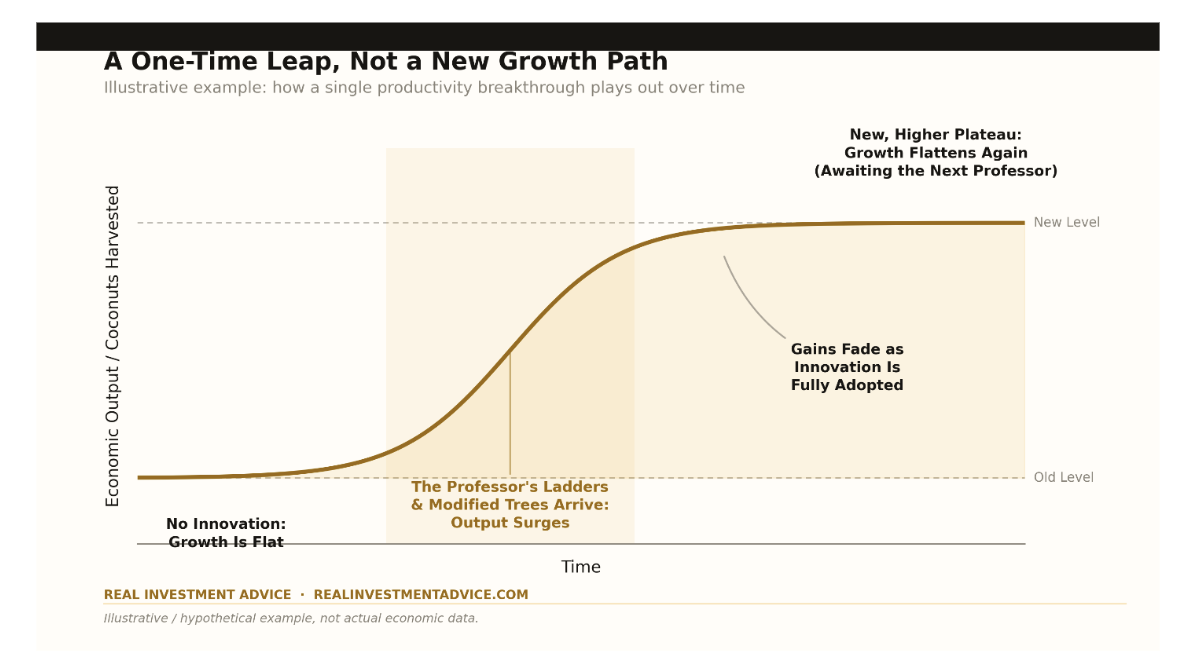
My next episode of the Gilligan's Island economic story occurs after the benefits of the ladders and modified trees are fully realized. Once every tree on the island has been upgraded and every castaway has a ladder, economic growth flattens again.
The professor's breakthrough did not ensure permanent growth; it was a limited burst of growth and a one-time leap in the island’s coconut output. The graph below shows a hypothetical plot of the island’s GDP.
Just as labor and capital run into physical limits, productivity runs into innovation limits. An economy that has already captured its easy productivity gains finds each additional percentage point of growth harder and costlier to generate than the last. This is precisely the wall the U.S. economy has been running into for roughly 50 years.
Measuring Productivity
Before proceeding, it is important to define total factor productivity (TFP), a popular measure that economists use to quantify productivity. TFP is the share of labor productivity growth that cannot be explained by changes in labor quality or capital deepening. It serves as a broad measure of overall economic efficiency, technological innovation, and how effectively inputs are converted into output.
Think of TFP as the extra economic growth that comes from using inputs more cleverly, whether through better technology, smarter organization, or more efficient processes. In the Gilligan's Island example, it's the ladders and the genetically modified trees. Adding more castaways, working longer hours, and borrowing money do not increase TFP, even if they do increase economic output.
TFP: The Golden Age
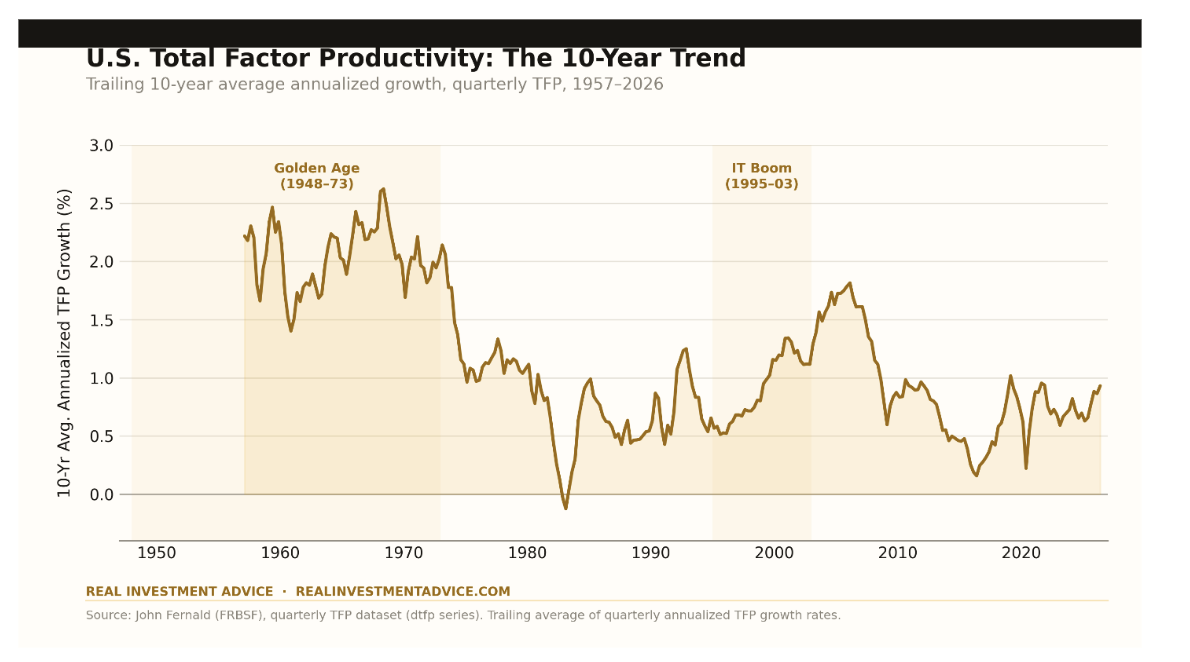
The graph below charts the 10-year annualized TFP growth using San Francisco Fed data starting in 1948. I smoothed the data over 10-year periods to reduce the noise from irregular COVID-19–related activity and other economic shocks.
In 2013, Robert Shackleton from the Congressional Budget Office (CBO) wrote a white paper titled "Total Factor Productivity Growth In Historical Perspective." The paper helps explain the Golden Age and IT productivity booms and the periods of slower TFP growth that followed. The rise and fall of productivity mirror Gilligan’s Island: a tale of technological breakthrough followed by exhaustion.
To help explain the concept of boom and bust in productivity growth, I summarize the period Shackleton’s paper calls the postwar "Golden Age," which ran from 1948 to 1973. He notes:
Critically, the paper argues this wasn't a new burst of invention. Rather, the golden age may be more accurately interpreted as the full final exploitation of an earlier burst of innovations through electrification, suburbanization, completion and increasing exploitation of the highway system, and production of consumer appliances.
In other words, the Golden Age was the payoff phase of innovations invented decades earlier, not a fresh professor moment of its own. Those “earlier bursts of innovations” trace back to what Shackleton calls the "big wave" of the 1920s and 1930s.
He attributes this “primarily to four clusters of critical innovations — electricity generation, internal-combustion engines, chemicals, and telecommunications — with nearly all of the important innovations in those clusters already in place well before World War II.”
Further, if you combine the government's post-WWII buildout of the interstate highway system and suburban infrastructure with a surge in both corporate R&D (Bell Labs, DuPont, GE) and federal research spending, and you have the primary forces behind the Golden Age
The Golden Age ended precisely because those sources of economic leverage ran their course. “By about 1970, however, the bulk of the gains in TFP associated with the innovations of earlier periods had been exploited,” Shackleton wrote.
The IT Boom
Another professor moment arrived in the mid-1990s. This was the productivity boom driven by personal computers and the internet. Information technology delivered the kind of broad, economy-wide leverage that the factors noted above delivered in the post-WWII Golden Age.
But the productivity growth rebound proved temporary, exactly as the castaways on Gilligan's Island found out. The IT boom's ladders had been distributed. The genetically modified trees of the internet age had already been planted. Growth flattened, and we are still waiting to see if AI is the next great innovation.
Where We Stand Today
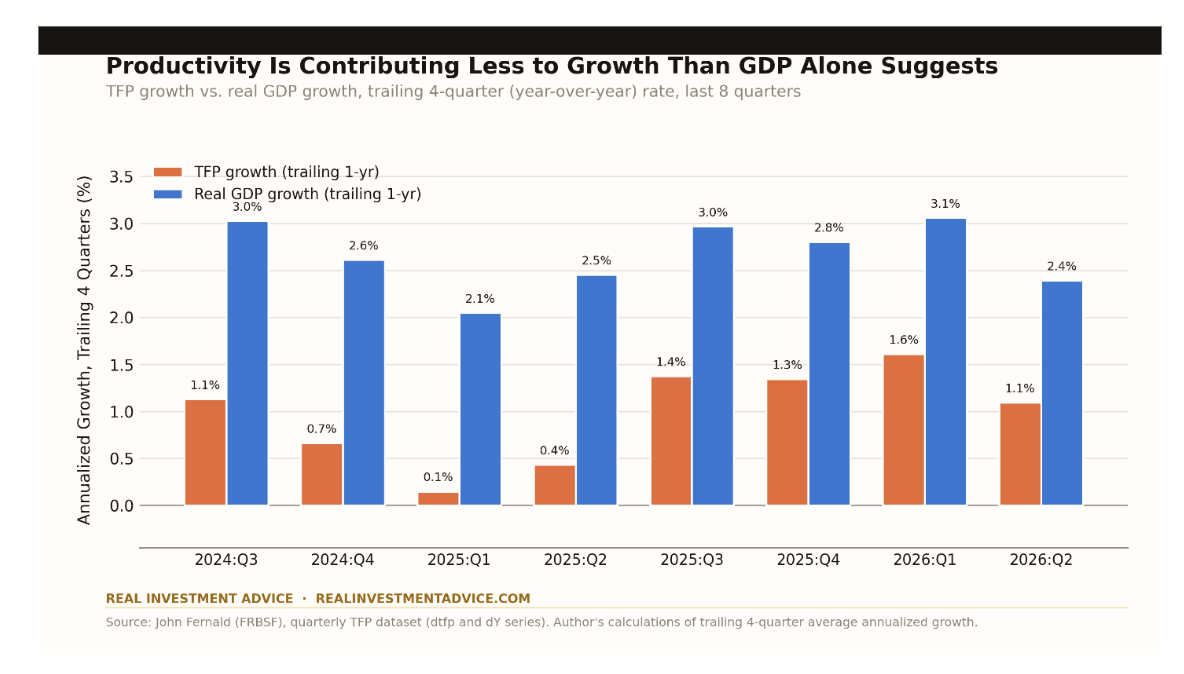
The most current productivity reading suggests that despite the promising AI innovation wave, we have yet to see tangible productivity benefits. The San Francisco Fed's measure of productivity — utilization-adjusted total factor productivity — grew by just 0.07% over the four quarters ending in the first quarter of 2026. This is not far from zero and well below the growth rate of the post-Golden Age era.
Kansas City Fed researchers separately found that the recent productivity pickup visible in some official data is "not yet broad-based," with a small set of industries accounting for most of the gains.
AI: The Next Rung on the Innovation Ladder?
AI appears to be the leading candidate for the next innovation that can boost productivity growth. During the Golden Age, it took a few decades for the productivity benefits of remarkable innovations to fully impact the economy.
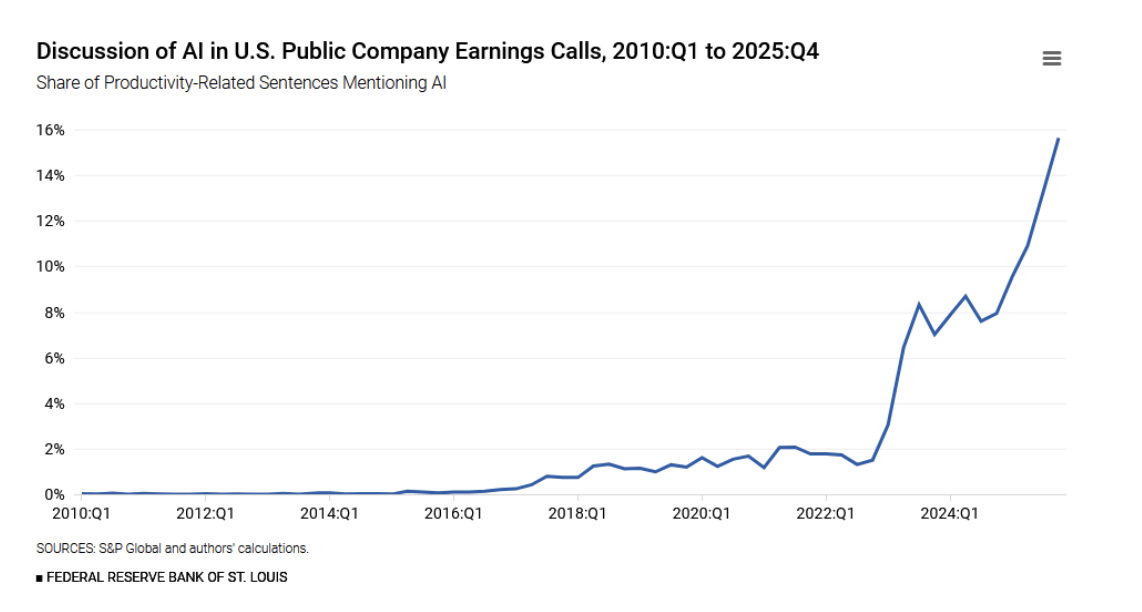
So far, the evidence of productivity gains from AI is a puzzle. San Francisco Fed researchers Aakash Kalyani and Huiyu Li used nearly 500,000 corporate earnings call transcripts spanning 5,198 public firms to measure how executives talk about AI and productivity. They found that firms with positive AI sentiment on their calls have "substantially higher investment growth" than other public companies, concentrated overwhelmingly among the largest technology firms building AI infrastructure.
Kalyani offers proper framing that separates this research from popular AI hype: “We trust what people do, not what they say," noting that the correlation between AI-positive language and actual capital spending is real, although the resulting productivity has not yet shown up.
The National Bureau of Economic Research (NBER) surveyed corporate executives across the U.S., the U.K., Germany, and Australia. It found that more than 80% of firms report no measurable impact from AI on either employment or productivity over the past three years, even though roughly 70% of firms are actively using it.
However, the survey showed the “same executives predict sizable effects over the next 3 years, predicting that AI will boost productivity at their firms by an average of 1.4%, raise output 0.8%, and cut employment 0.7%.”
Other Opinions
Fed Chair Kevin Warsh often discusses the coming productivity boom from AI, but he is uncertain when it will occur. On the longer-run productivity payoff, he pointed to the possibility of "material improvement in productivity, which should have a material improvement ultimately in wages and the strength of the economy," making the economy "richer" and "more productive."
However, he hedged his optimism with doubts about the timing: “The long term can be quite far out, and we've got to monitor things month by month, quarter by quarter, as we get there.”
Fortune magazine reminds us that AI benefits can be limited due to the entire economic chain: “However fast AI accelerates research or drafting or analysis, two people still need to schedule and show up to a meeting, and that step moves at exactly the same speed it did four years ago.”
The ladders will work brilliantly for picking coconuts faster, but if the castaways can't ship more coconuts to neighboring islands, the benefits of the ladders are limited.
The graph below shows no material benefits from AI in either economic output or TFP data.
Summary
No one knows the extent to which AI will boost productivity and its impact on the economy. There is also no good forecast of the timing of such an impact. History's two prior productivity step-changes — the Golden Age and IT boom — both took years to show up convincingly in the aggregate data after the underlying technology proved to be genuinely transformative.
The Gilligan's Island framework is a useful discipline because it strips away the jargon and complex formulas economists use, as well as the hype investment pundits frequently spew.
An economy does not grow permanently faster simply because companies are spending heavily any more than the island's economy would have grown permanently faster simply because the castaways worked longer hours or increased the island's population. The spending must ultimately convert into more output per unit of labor and capital. On that specific test, the evidence for AI is unsettled, but the potential is real.
Read more by Michael Lebowitz:
Michael Lebowitz is a portfolio manager with RIA Advisors and author for Real Investment Advice. For more information, contact him at [email protected] or 301.466.1204.
Join RIA Advisors and elevate your career within a deeply experienced team focused on innovation. Our collaborative environment is built on a foundation of advanced technology and effective investment models, designed to enhance your ability to serve clients and grow your practice. Benefit from a supportive culture that encourages professional development and fosters a forward-thinking approach. By joining our team, you’ll be part of a group dedicated to excellence and continuous improvement, empowering you to focus on building meaningful client relationships and pursuing your business ambitions. Discover the advantages of working with our accomplished advisory team by starting your conversation today.
A message from Advisor Perspectives and VettaFi: Discover something new! Click here to register for our upcoming webcasts.
More Retirement Income Topics >
 Advisor Perspectives welcomes guest contributions. The views presented here do not necessarily represent those of Advisor Perspectives.